When you click on links to various merchants on this site and make a purchase, this can result in this site earning a commission. Affiliate programs and affiliations include, but are not limited to, the eBay Partner Network.
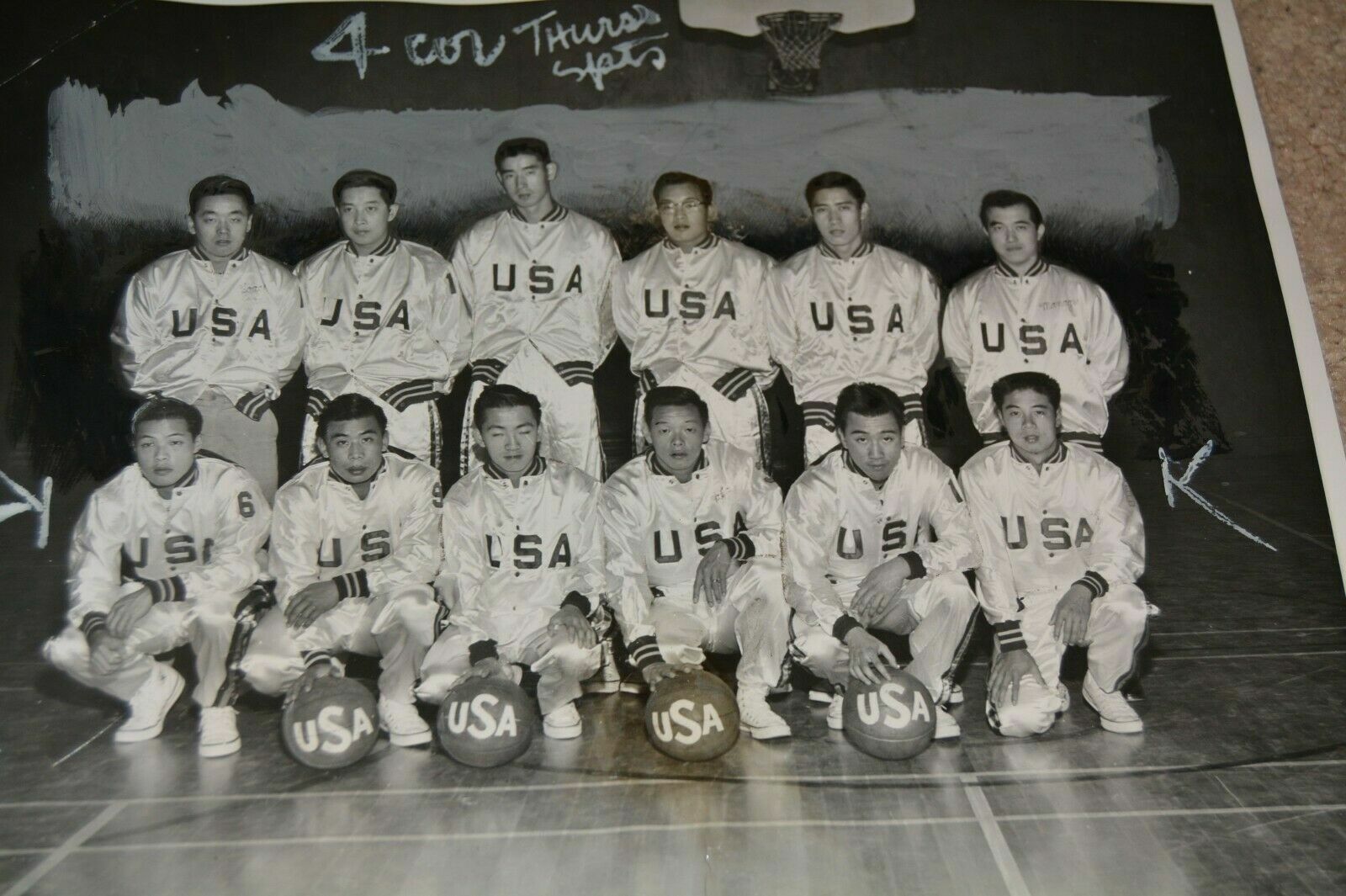
A VINTAGE ORIGINAL 8X10 INCH PHOTO FROM 1955 OF CHINESE ON TOUR - PICTURED ABOVE IN THE SAN FRANCISCO CHINESE AMERICAN BASKETBALL TEAM WHICH LEAVES TODAY FOR THE FAR EAST
As of 2012, 21.4% of the population in San Francisco was of Chinese descent, and at least 150,000 Chinese American residents.[1] The Chinese are the largest Asian American subgroup in San Francisco.[2] San Francisco has the highest percentage of residents of Chinese descent of any major U.S. city, and the second largest Chinese American population, after New York City. The San Francisco Area is 7.9% Chinese American, with many residents in Oakland and Santa Clara County. San Francisco\'s Chinese community has ancestry mainly from Guangdong province, China and Hong Kong, although there is a sizable population of ethnic Chinese with ancestry from other parts of mainland China and Taiwan as well.Contents1 History2 Geography3 Cultural institutions4 Healthcare4.1 Prior to health care4.2 Struggles to establish health care4.3 First medical facility: Tung Wah Dispensary4.4 Natural disaster led to the first modern hospital5 Education6 Media7 Transportation8 Cultural events9 Notable people10 References11 Further reading12 External linksHistory
The Gateway Arch (Dragon Gate) on Grant Avenue at Bush Street in Chinatown.The Chinese arriving in San Francisco, primarily from the Taishan and Zhongshan regions as well as Guangdong province of mainland China, did so at the height of the California Gold Rush, and many worked in the mines scattered throughout the northern part of the state.[3] Chinatown was the one geographical region deeded by the city government and private property owners which allowed Chinese people to inherit and inhabit dwellings. The majority of these Chinese shopkeepers, restaurant owners, and hired workers in San Francisco Chinatown were predominantly Hoisanese and male[citation needed]. Many Chinese found jobs working for large companies, most famously as part of the Central Pacific[4] on the Transcontinental Railroad. Other early immigrants worked as mine workers or independent prospectors hoping to strike it rich during the California Gold Rush.
Although many of the earlier waves of Chinese immigration were predominantly men searching for jobs, Chinese women also began making the journey towards the United States. The first known Chinese woman to immigrate was Marie Seise who arrived in 1848 and worked in the household of Charles V. Gillespie.[5] Within a matter of months of Seise\'s arrival to the West Coast, the rush for gold in California commenced which brought a flooding of prospective miners from around the globe. Among this group were Chinese, primarily from the Guangdong Province, most of whom were seafarers who had already established Western contacts. “Few women accompanied these early sojourners, many of whom expected to return from after they made their fortune.”[6]
Although the oceanic voyage to the United States offered new and exciting opportunities, dangers also loomed for women while traveling and many were discouraged from making the trip due to the harsh living conditions. Oceanic voyages with Chinese immigrants boarded the Pacific Mail Steamship Company and Canadian Pacific Steamship Company. Chinese immigrants would have to ride in the steerage where food was stored. Many were given rice bowls to eat during the voyage. In 1892, a federal law passed to ensure immigrants who were on board, needed a certificate. Due to tight arrangements, unhygienic situations and scarcity in food, this led to health degradation.[7] Many immigrants were unable to board these voyages due to the Geary Act of 1892 which blocked the reunion of immigrants in America with their families not with them.[8] Many diseases found through these voyages were Hookworm Yersinia pestis which contributed greatly to the Bubonic Plague.[9]
“During the Gold Rush era, when Chinese men were a common sight in California, Chinese women were an oddity” and in urban spaces were rarely seen in public. Unlike the rural areas, Chinatown afforded few opportunities for women to come into contact with the larger society.”[6] Simultaneously, Chinese women also participated in urban sex work, which resulted in local laws like one passed in April 1854 that sought to shut down \"houses of ill-fame,\" not racialized in name but practically deployed to \"[single] out Mexican and Chinese houses of ill fame, starting with Charles Walden\'s Golden Rule House on Pacific Street and moving on to establishments run by Ah-Choo, C. Lossen, and Ah Yow.\"[10]
With national unemployment in the wake of the Panic of 1873, racial tensions in the city boiled over into full blown race riots. Like much of San Francisco during these times, a period of criminality ensued in some Chinese gangs known as tongs, which were onto smuggling, gambling and prostitution. In response to the violence, the Consolidated Chinese Benevolent Association or the Chinese Six Companies, which evolved out of the labor recruiting organizations for different areas of Guangdong province, was created as a means of providing a unified voice for the community. The heads of these companies were the leaders of the Chinese merchants, who represented the Chinese community in front of the business community as a whole and the city government. Numerous white citizens defended the Chinese community, among them Pastor Franklin Rhoda whose numerous letters appeared in the local press. By the early 1880s, the population had adopted the term Tong war to describe periods of violence in Chinatown, the San Francisco Police Department had established its so-called Chinatown Squad. The anti-immigrant sentiment became law as the United States Government passed the Chinese Exclusion Act of 1882 – the first immigration restriction law aimed at a single ethnic group. This law, along with other immigration restriction laws such as the Geary Act, greatly reduced the number of Chinese people allowed into the country and the city, and in theory limited Chinese immigration to single men only. Exceptions were granted to the families of wealthy merchants, but the law was still effective enough to reduce the population of the neighborhood to an all-time low in the 1920s. The neighborhood was completely destroyed in the 1906 earthquake that leveled most of the city. One of the more successful sergeants of Chinatown Squad, Jack Manion, was appointed in 1921 and served for two decades. From 1910 to 1940, Chinese immigrants were detained at the Angel Island immigration station in the San Francisco Bay. To be permitted entry to the United States, thousands of mostly Chinese immigrants crossing the Pacific to San Francisco had to enter through the gauntlet of Angel Island, and were detained for months in a purgatory of isolation. Some spent years on the island waiting for entry to the U.S.[11][12]The exclusion act was repealed during World War II under the Magnuson Act, in recognition of the important role of China as an ally in the war, although tight quotas still applied. The Chinatown Squadwas finally disbanded in August 1955 by police chief George Healey, upon the request of the influential Chinese World newspaper, which had editorialized that the squad was an \"affront to Americans of Chinese descent\".[13]
Many working-class Hong Kong Chinese immigrants began arriving in Chinatown in large numbers in the 1960s, and despite their status and professions in Hong Kong, had to find low-paying employment in restaurants and garment factories in Chinatown because of limited English fluency. An increase in Cantonese-speaking immigrants from Hong Kong and Guangdong has gradually led to the replacement of the Taishanese (Hoisanese) dialect with the standard Cantonese dialect.
The Golden Dragon massacre occurred in 1977.
In the Sunset District in western San Francisco, a demographic shift began in the late 1960s and accelerated from the 1980s as Asian immigration to San Francisco increased dramatically. Much of the original, largely Irish American population of the Sunset moved to other neighborhoods and outlying suburban areas, although there is still a significant Irish American and Irish minority in the neighborhood. Informal Chinatowns have emerged on Irving Street between 19th Avenue and 26th Avenue as well as on the commercial sections of Taraval Street and Noriega Street west of 19th Avenue. About half of the Sunset District\'s residents are Asian American, mostly of Chinese birth and descent. The immigrants in the Sunset District were both Mandarin- and Cantonese-speaking.
With the rise of the technology industry in Silicon Valley, many immigrants from China and Taiwan moved to the San Francisco Area. Many of them reside in the South Area cities of Cupertino, Sunnyvale, Santa Clara, San Jose, and Fremont.[2]
GeographyChinatowns in San Francisco:
Chinatown, San FranciscoClement Street Chinatown, San Francisco, the \"Second Chinatown\"Irving Street Chinatown, San Francisco, the \"Third Chinatown\"Noriega Street Chinatown, San Francisco, the \"Fourth Chinatown\"Chinatowns around San Francisco:
Chinatown, OaklandChinatown, San Jose, CaliforniaMilpitas Square, a Chinese shopping center in Milpitas, CaliforniaCultural institutionsThe Chinese Culture Center, a community-based, non-profit organization, is located between Chinatown and the Financial District in San Francisco.
The Chinese Historical Society of America, since 1963, is a non-profit, and the first organization established in the US to preserve, promote and present the history, heritage, culture and legacy of Chinese in America through exhibitions, education, and research; the Museum is located in San Francisco\'s original Chinatown on Clay Street.
HealthcarePrior to health careAccording to \"Handbook of Asian American Health\" by Grace J. Yoo, the late 19th century was a period of major epidemics in San Francisco, which included outbreaks such as the bubonic plague, smallpox, and cholera. These diseases were commonly found among the poor and working classes. At the time, many believed in the miasma theory, or the spreading of disease due to \"breathing sick air\", rather than the now widely accepted germ theory. \"In 1876, the Chinese were blamed as the source of the disease because of the unsanitary conditions of Chinatown.\" The area was unsanitary and overpopulated because the city\'s Chinese population was discriminated against, as Americans saw them as competition for work. This sentiment withheld services, such as access to healthcare or physicians, and property rights from the Chinese, causing them to cluster within Chinatown.[14]
Struggles to establish health careBefore the Chinese had any particular health care system for their community, all of them had to go through the following barriers: they had to walk a very long distance to receive any medical attention at a hospital, and they were denied coverage due to unaffordable rates of the services provided by the hospitals. Instead most Chinese relied on \"folk healer\" than on western medicine. The \"Folk Healers\" were those that provided Chinese traditional medicine to the Chinese community in San Francisco Chinatown. Therefore, many Chinese did not bother to go to the hospital unless it was a crisis.[15]
First medical facility: Tung Wah DispensaryThe first medical care place in San Francisco Chinatown was the Tung Wah Dispensary. It was provided by the Chinese Six Companies, and it was built in 1900 on 828 Sacramento Street. The dispensary was named after the Tung Wah Group of Hospitals in Hong Kong, and it housed 25 beds, provided both western and Chinese medicine, free or to low cost care to patients, and its staff was volunteers from the community and physicians from outside of the community. Of those physicians three were American physicians and the rest were Chinese American physicians who helped with the Chinese medicine and translating from Chinese to English for the American physicians.[15]
Natural disaster led to the first modern hospitalIn 1906, due to the great earthquake in San Francisco, the Tung Wah Dispensary was destroyed but was rebuilt in Trenton Alley. However, with the many injuries due to the natural disaster, a lot more Chinese patients needed medical attention, and the dispensary was beginning to overflow with patients. Therefore, they decided to expand the dispensary to a modern hospital. In order to build the modern hospital they needed to make $200,000, so they began to have Chinese pageants that helped to contribute the donations from the Chinese Americans and Americans. So, when they got they collected the $200,000, they finally got permission from the San Francisco Board of Supervisors to build the Hospital, and in two years the construction was in underway. By April 18, 1925 the San Francisco Chinese Hospital (東華醫院) in the San Francisco Chinatown was established. It is the only Chinese-language hospital in the United States.[16][17] The Asian Aids Project (AAP) was started in the 1987, it is made to help them fight the AIDS epidemic in the Asian Community including the Chinese Americans.[18]
Education[icon] This section needs expansion. You can help by adding to it. (April 2015)
Chinese School, San Francisco (中華學校)
Chinese Education Center Elementary School San Francisco:
The Chinese American International School, Cumberland Chinese School, North Valley Chinese School, Mei Jia Chinese Learning Center, and Alice Fong Yu Alternative School are located in San Francisco.Around San Francisco:
Palo Alto Chinese School is located in Palo Alto, and has classes teaching both Mandarin and Cantonese. The Shoong Family Chinese Cultural Center in Oakland serves as the premier Chinese-language school in the East Area, and Contra Costa Chinese School is located in Pleasant Hill.The North Valley Chinese School in Milpitas and San Jose Chinese school both serve the greater San Jose area.The Redwood Empire Chinese Center\'s Chinese school in Santa Rosa serves the North Bay.MediaThe New York-based worldwide distributed newspaper Epoch Times (大紀元時報) has a branch office in San Francisco. The Hong Kong-based newspaper Sing Tao Daily (星島日報) has an office in San Francisco. East West, The Chinese American Journal folded in 1989.[citation needed] The Chinese-American newspaper World Journal (世界日報) has an office in Millbrae.[19]
KTSF serves as a Chinese language radio station.[20]The Chinese Basketball Association (simplified Chinese: 中国男子篮球职业联赛; traditional Chinese: 中國男子籃球職業聯賽; pinyin: Zhōngguó Nánzǐ Lánqiú Zhíyè Liánsài), often abbreviated as the CBA, is the first-tier professional men\'s basketball league in China. It is widely regarded as the preeminent professional men\'s basketball league in Asia.
The league is commonly known by fans as the CBA, and this acronym is even used in Chinese on a regular basis. The CBA should not be confused with the National Basketball League (NBL), which is a professional minor league. There is also a Women\'s Chinese Basketball Association (WCBA).
A few Chinese players who competed in the CBA in the early stages of their careers — including Wang Zhizhi, Mengke Bateer, Yao Ming, Yi Jianlian, Sun Yue, and Zhou Qi — have also played in the National Basketball Association (NBA). Others such as Xue Yuyang and Wang Zhelin were chosen in the draft, but have not played in the NBA.
Only a limited number of foreign players are allowed on each CBA team. Notable imports include former NBA All-Stars Stephon Marbury, Tracy McGrady, Gilbert Arenas, Steve Francis, and Metta World Peace — as well as several NBA veterans who would become CBA All-Stars — Michael Beasley, Aaron Brooks, Jimmer Fredette, Al Harrington, Lester Hudson, Kenyon Martin, Randolph Morris, Shavlik Randolph, Jeremy Lin and J.R. Smith.Contents1 Background2 Team names3 Current clubs4 Timeline5 Finals5.1 Finals appearances6 Awards7 Scoring leaders8 Records8.1 Single game records8.2 Career records9 Notable players9.1 Domestic players from the CBA who are known for crossing over to the NBA9.2 Domestic players from the CBA who were drafted but have not played in the NBA9.3 Domestic players from the CBA who have only played in NBA pre-season games9.4 Domestic players from the CBA who have participated in the NBA Summer League9.5 Domestic players from the CBA who are known for league or national team exploits10 Foreign imports10.1 Non-Chinese players who spent 5 or more seasons in the CBA10.2 Non-Chinese players who spent 2 to 4 seasons in the CBA10.3 Non-Chinese players for whom 2019–20 is their 1st season in the CBA10.4 Other Non-Chinese players who spent only 1 season in the CBA11 Politics12 See also13 References14 External linksBackgroundThe CBA began play in the 1995–96 season. The league should not be confused with the Chinese Basketball Association (organisation), which was founded in June 1956[1] and represents the country in matters involving the sport\'s governing body, FIBA. Basketball in China is currently regulated by the Chinese Basketball Management Center.
Other Chinese basketball leagues include the National Basketball League (NBL), the Chinese University Basketball Association (CUBA), and the Chinese High School Basketball League (CHBL).[2] At one time there was a league called the Chinese New Basketball Alliance (CNBA),[3] one of whose most prominent teams was the Beijing Sea Lions, but this venture lasted for just one winter (1996–97).[4]
The first non-Chinese player to compete in the CBA was Mihail Savinkov of Uzbekistan, who joined the Zhejiang Squirrels in the league\'s inaugural 1995–96 campaign.[5] During the 1996–97 season, James Hodges became one of the first Americans to play in the CBA, and his signing by the Liaoning Hunters helped pave the way for many more imports from the United States to follow in the ensuing years.
Some other notable foreign pioneers included John Spencer, who joined the Jiangsu Dragons later in the 1996–97 campaign, and David Vanterpool, who inked a deal with the Jilin Northeast Tigers the following winter, and helped the team move up to the CBA in time for the 1998–99 season. The CBA\'s first international coach was American Robert Hoggard, who led the Sichuan Pandas for the last eight games of the 1997–98 campaign.[6]
Team namesFor a full list of teams, see Category:Chinese Basketball Association teams.
The full name of each team usually consists of three parts, in the following order:
A geographic designation (except in the case of Bayi, which technically translates into English as \"August First,\" the day China\'s People\'s Liberation Army was founded). All others are province-level designations (either a province or a Chinese municipality).A corporate sponsor name. This sponsor may change from year to year, and sometimes even in mid-season.A nickname, such as the name of an animal.The presence of corporate sponsor names can occasionally lead to confusion about what name to use in English because many variants may be seen. Team names are usually abbreviated (in Chinese or English), so that either the corporate sponsor name or the nickname is used interchangeably (rarely both). In addition, team nicknames can sometimes be translated into English in more than one way, and corporate sponsors tend to change frequently over time.
Nickname changes are rare, but occasionally happen, such as when the Shandong team switched from Flaming Bulls (1995) to Lions (2003) to Gold Lions (2004) to Golden Stars (2014). Other examples include the Liaoning team dumping Hunters (1995) for Dinosaurs (2008) and then Flying Leopards (2011) -- as well as the Foshan team\'s evolving attempts to \"Anglicize\" its nickname—by going from Kylins (2001) to Dralions to Long-Lions
In previous years, the title of the league itself was available for corporate naming sponsorship. In 1999–2000 and 2000–2001 it was known as the Hilton League, in 2001–2002 and 2002–2003 it was the Motorola League, and in 2003–2004 it was sponsored by China Unicom. These corporate league titles were not always used in the news media, however, and this sponsorship practice was discontinued at the start of the 2004–2005 season.[7]
Current clubsWhile teams are listed by division here, the CBA does not use these designations for regular season purposes anymore, as each squad now plays each other once at home and once on the road (plus eight additional games within each of the four rotating \"strength of schedule\" sub-groupings). Divisions are used for the league\'s annual All-Star Game, however, and are shown here for the sake of convenience.
Chinese Basketball Association is located in of the CBA teamsTeam City / Region Arena Head CoachNorthern DivisionBeijing Ducks Beijing Wukesong Arena Italy Simone PianigianiBeijing Royal Fighters Beijing Beijing Olympic Sports Center Gymnasium United States Stephon MarburyJilin Northeast Tigers Changchun, JilinJilin City, Jilin Changchun GymnasiumJilin City Arena China Wang HanLiaoning Flying Leopards Shenyang, Liaoning Liaoning Gymnasium China Yang MingQingdao Eagles Qingdao, Shandong Guoxin Gymnasium China Wu QinglongShandong Heroes Jinan, Shandong Shandong Arena China Gong XiaobinShanxi Loongs Taiyuan, Shanxi Shanxi Sports Centre GymnasiumTaiyuan Riverside Sports Centre Gymnasium China Ding WeiSichuan Blue Whales Chengdu, Sichuan Sichuan Provincial Gymnasium China Zhou JinliTianjin Pioneers Tianjin Dongli GymnasiumTianjin Arena China Liu TieXinjiang Flying Tigers Ürümqi, Xinjiang Hongshan Arena China Adiljan SuleymanSouthern DivisionFujian Sturgeons Jinjiang, Quanzhou, Fujian Zuchang Gymnasium Serbia New ZealandNenad VučinićGuangdong Southern Tigers Dongguan, Guangdong Dongfeng Nissan Cultural and Sports Centre China Du FengGuangzhou Loong Lions Guangzhou, Guangdong Tianhe Gymnasium China Guo ShiqiangJiangsu Dragons Suzhou, Jiangsu
Changzhou, Jiangsu Suzhou Industrial Park Sports CenterSuzhou Sports Center GymnasiumChangzhou Olympic Sports Center Gymnasium China Li NanNanjing Monkey Kings Nanjing, Jiangsu Nanjing Youth Olympic Sports Park Slovenia Memi BečirovičShanghai Sharks Shanghai Yuanshen Sports Centre Stadium Croatia Neven SpahijaShenzhen Aviators Shenzhen, Guangdong Shenzhen Universiade Sports Centre China Qiu BiaoZhejiang Golden Bulls Hangzhou, ZhejiangYiwu, Jinhua, Zhejiang Binjiang GymnasiumYiwu Meihu Sports Centre China Liu WeiweiZhejiang Guangsha Lions Zhuji, Shaoxing, ZhejiangHangzhou, Zhejiang Zhuji Sports Centre GymnasiumHangzhou Gymnasium China Li ChunjiangTimelineThis is a chronological listing of current and former CBA teams according to the season that they entered the league.Current Teams Defunct Teams
FinalsFurther information: CBA Finals Most Valuable PlayerIn 2005, the league unveiled the Mou Zuoyun Cup (Chinese: 牟作云杯), which was awarded for the first time to the winning team in the CBA Finals. Mou Zuoyun (1913–2007) was a member of the Chinese men\'s national basketball team which competed at the 1936 Summer Olympics, and he later served as a coach and a pioneer in building Chinese basketball.[8]
Season Champions Result Runners-up Finals MVP Notes1995–96 Bayi Rockets 2–0 Guangdong Southern Tigers Home-and-away series used for 2 seasons1996–97 Bayi Rockets 2–0 Liaoning Hunters 1997–98 Bayi Rockets 3–0 Liaoning Hunters Best-of-five series used for 8 seasons1998–99 Bayi Rockets 3–0 Liaoning Hunters 1999–00 Bayi Rockets 3–0 Shanghai Sharks Wang Zhizhi (Bayi) 2000–01 Bayi Rockets 3–1 Shanghai Sharks Yao Ming (Shanghai) 2001–02 Shanghai Sharks 3–1 Bayi Rockets Liu Yudong (Bayi) 2002–03 Bayi Rockets 3–1 Guangdong Southern Tigers Liu Yudong (Bayi) 2003–04 Guangdong Southern Tigers 3–1 Bayi Rockets Du Feng (Guangdong) 2004–05 Guangdong Southern Tigers 3–2 Jiangsu Dragons Zhu Fangyu (Guangdong) 2005–06 Guangdong Southern Tigers 4–1 Bayi Rockets Yi Jianlian (Guangdong) Best-of-seven series used since 2005–062006–07 Bayi Rockets 4–1 Guangdong Southern Tigers Wang Zhizhi (Bayi) 2007–08 Guangdong Southern Tigers 4–1 Liaoning Hunters Zhu Fangyu (Guangdong) 2008–09 Guangdong Southern Tigers 4–1 Xinjiang Flying Tigers Zhu Fangyu (Guangdong) 2009–10 Guangdong Southern Tigers 4–1 Xinjiang Flying Tigers Zhu Fangyu (Guangdong) 2010–11 Guangdong Southern Tigers 4–2 Xinjiang Flying Tigers Wang Shipeng (Guangdong) 2011–12 Beijing Ducks 4–1 Guangdong Southern Tigers Lee Hsueh-lin (Beijing) 2012–13 Guangdong Southern Tigers 4–0 Shandong Gold Lions Yi Jianlian (Guangdong) 2013–14 Beijing Ducks 4–2 Xinjiang Flying Tigers Randolph Morris (Beijing) 2014–15 Beijing Ducks 4–2 Liaoning Flying Leopards Stephon Marbury (Beijing) 2015–16 Sichuan Blue Whales 4–1 Liaoning Flying Leopards Hamed Haddadi (Sichuan) 2016–17 Xinjiang Flying Tigers 4–0 Guangdong Southern Tigers Darius Adams (Xinjiang) 2017–18 Liaoning Flying Leopards 4–0 Zhejiang Guangsha Lions Lester Hudson (Liaoning) 2018–19 Guangdong Southern Tigers 4–0 Xinjiang Flying Tigers Yi Jianlian (Guangdong) 2019–20 Guangdong Southern Tigers 2–1 Liaoning Flying Leopards Sonny Weems (Guangdong) Best-of-three seriesFinals appearancesThis is a list of the teams which have advanced to the CBA Finals and the overall win-loss records they have registered in the Championship Series.
No. Team W L Pct. Notes15 Guangdong Southern Tigers 10 5 .667 Made eleven consecutive finals appearances from 2002–03 to 2012–1311 Bayi Rockets 8 3 .727 Won six league titles in a row from 1995–96 to 2000–013 Beijing Ducks 3 0 1.000 Won three league titles in four seasons from 2011–12 to 2014–158 Liaoning Flying Leopards 1 7 .125 Made three consecutive finals appearances from 1996–97 to 1998–996 Xinjiang Flying Tigers 1 5 .167 Made three consecutive finals appearances from 2008–09 to 2010–113 Shanghai Sharks 1 2 .333 Made three consecutive finals appearances from 1999–00 to 2001–021 Sichuan Blue Whales 1 0 1.000 1 Jiangsu Dragons 0 1 .000 1 Shandong Gold Lions 0 1 .000 1 Zhejiang Guangsha Lions 0 1 .000 AwardsThe CBA Most Valuable Player award is presented to the league\'s best player in a given CBA season. Since the 2012–13 campaign, two awards have been handed out each year, Domestic MVP and International MVP. At the conclusion of each season, the CBA Finals MVP award is bestowed upon the most outstanding player in that year\'s championship series.
Each campaign\'s scoring leader is also recognized on an annual basis and the league maintains a list of single game, single season, and career record holders in various statistical categories. Furthermore, a CBA All-Star Game MVP award is given to the player deemed to have the most impactful performance in the league\'s annual mid-season exhibition contest.
Scoring leadersMain article: Chinese Basketball Association scoring leadersThe CBA\'s highest single season scoring average, depending on how many games are required to be recognized as a statistical qualifier, is either 43.1 points per game by Jordan Crawford, who played in 26 of Tianjin\'s 38 games (68.4%) in 2015–16, or 42.0 points per game by Jonathan Gibson, who played in 36 of Qingdao\'s 38 games (94.7%) in 2015–16.
RecordsMain article: Chinese Basketball Association recordsThis is a list of individual records separated into two categories — career records and single game records.
Records last updated and confirmed on March 13, 2019, the final day of the 2018–19 CBA regular season.
Single game recordsRecord Num. Player Team Game DatePoints82United States Errick McCollumZhejiang Golden BullsZhejiang Golden Bulls 119–129 Guangdong Southern Tigers2015 January 30[10]Rebounds38Dominica Garth JosephShaanxi KylinsShaanxi Kylins 139–88 Shenzhen Yikang2002 March 20[11]Assists28China Li QunGuangdong Southern TigersGuangdong Southern Tigers 110–101 Nanjing Army2000 February 2Steals13China Ju WeisongShandong Flaming BullsShandong Flaming Bulls 84–70 Vanguard / Police1995–96 SeasonChina Zhang YongjunGuangdong Southern TigersBayi Rockets 109–81 Guangdong Southern Tigers1996–97 SeasonChina Hu XuefengJiangsu DragonsJiangsu Dragons 135–108 Jilin Northeast Tigers2004 December 1Blocks13China Yao MingShanghai SharksJilin Northeast Tigers 126–118 Shanghai Sharks2001 February 11[12]Ivory Coast Herve LamizanaTianjin Gold LionsTianjin Gold Lions 113–108 Fujian Sturgeons2010 February 10[13]United States Sean WilliamsFujian SturgeonsFujian Sturgeons 101–94 Jilin Northeast Tigers2010 February 26[14]Minutes Played67Iran Samad Nikkhah BahramiFujian SturgeonsFujian Sturgeons 178–177 (5OT) Zhejiang Golden Bulls2014 February 9[15]3-Pointers Made15United States Leon RodgersJilin Northeast TigersJilin Northeast Tigers 124–110 Shanxi Brave Dragons2009 March 11[16]Dunks Made10United States James HodgesLiaoning HuntersLiaoning Hunters 95–85 Shandong Flaming Bulls1998–99 SeasonFree Throws Made25United States Errick McCollumZhejiang Golden BullsZhejiang Golden Bulls 119–129 Guangdong Southern Tigers2015 January 30[17]Career recordsRecord Num. Player Team(s) SeasonsPoints11,677+China Yi Jianlian (active)Guangdong Southern Tigers2002–2003 to 2006–2007 / 2011–2012 to presentRebounds5,516+China Yi Jianlian (active)Guangdong Southern Tigers2002–2003 to 2006–2007 / 2011–2012 to presentAssists2,595China Hu XuefengJiangsu Dragons1999–2000 to 2016–2017Steals1,762China Hu XuefengJiangsu Dragons1999–2000 to 2016–2017Blocks852China Wang ZhizhiBayi Rockets1995–1996 to 2000–2001 / 2006–2007 to 2014–2015Minutes Played(Only available since 2011)14,785+United States Lester Hudson (active)Guangdong Southern TigersQingdao EaglesDongguan LeopardsXinjiang Flying TigersLiaoning Flying LeopardsShandong Heroes2010–2011 to present[18]3-Pointers Made1,755+United States Lester Hudson (active)Guangdong Southern TigersQingdao EaglesDongguan LeopardsXinjiang Flying TigersLiaoning Flying LeopardsShandong Heroes2010–2011 to presentDunks Made1130+China Yi Jianlian(active)Guangdong Southern Tigers2002–2003 to 2006–2007 / 2011–2012 to present[19]Free Throws Made2,666+China Yi Jianlian (active)Guangdong Southern Tigers2002–2003 to 2006–2007 / 2011–2012 to presentPersonal Fouls1,615+China Li Xiaoxu(active)Liaoning Flying Hu XuefengJiangsu Dragons1999–2000 to 2016–2017Games Played698China Zhu FangyuGuangdong Southern Tigers1999–2000 to 2016–2017[20]Notable playersListed below are some of the most accomplished Chinese players who have competed in the CBA. Time spent with teams in lower leagues before they joined the CBA, or after they left the CBA, cannot be counted as CBA seasons. Notes will be made of such service below a player\'s CBA information.
Domestic players from the CBA who are known for crossing over to the NBAName CBA Team (Years) NBA Team (Years) DraftedChina Mengke Bateer Beijing Ducks (1997–2002, 2005–2006)Xinjiang Flying Tigers (2007–2013)Denver Nuggets (2002)San Antonio Spurs (2002–2003)Toronto Raptors (2003–2004)Undrafted in 1999 NBA DraftChina Sun Yue Beijing Olympians (2002–2004)Beijing Ducks (2013–2017)Beikong Royal Fighters (2019–present)Also played for post-CBA Beijing Olympians in 2004–2008 & 2009–2013Los Angeles Lakers (2008–2009)2007 / Round 2 / 40th overall pickSelected by Los Angeles LakersChina Wang Zhizhi Bayi Rockets (1995–2001 & 2006–2015)Dallas Mavericks (2001–2002)Los Angeles Clippers (2002–2003)Miami Heat (2003–2005)1999 / Round 2 / 36th overall pickSelected by Dallas MavericksChina Yao Ming Shanghai Sharks (1997–2002)Houston Rockets (2002–2011)2002 / Round 1 / 1st overall pickSelected by Houston RocketsChina Yi Jianlian Guangdong Southern Tigers (2002–2007, 2011, 2012–present)Milwaukee Bucks (2007–2008)New Jersey Nets (2008–2010)Washington Wizards (2010–2011)Dallas Mavericks (2012)2007 / Round 1 / 6th overall pickSelected by Milwaukee BucksChina Zhou Qi Xinjiang Flying Tigers (2014–2017)Houston Rockets (2017–2018)2016 / Round 2 / 46th overall pickSelected by Houston RocketsDomestic players from the CBA who were drafted but have not played in the NBAName CBA Team (Years) DraftedChina Wang Zhelin Fujian Sturgeons (2012–present)2016 / Round 2 / 57th overall pickSelected by Memphis GrizzliesChina Xue Yuyang Jilin Northeast Tigers (2001–2002)Hong Kong Flying Dragons (2002–2003)Xinjiang Flying Tigers (2003–2010)Zhejiang Guangsha Lions (2010–2011)Qingdao Eagles (2011–2014)2003 / Round 2 / 57th overall pickSelected by Dallas MavericksDomestic players from the CBA who have only played in NBA pre-season gamesName CBA Team (Years) NBA Team (Pre-season)China Ding Yanyuhang Shandong Gold Lions/Golden Stars (2011–2018)Dallas Mavericks (2018–2019)China Liu Wei Shanghai Sharks (1997–2014, 2018–2019)Xinjiang Flying Tigers (2014–2016)Sichuan Blue Whales (2016–2018)Sacramento Kings (2004–2005)Domestic players from the CBA who have participated in the NBA Summer LeagueName CBA Team (Years) NBA Team (Summer League)China Abdusalam Abdurixit Xinjiang Flying Tigers (2015–present)Golden State Warriors (2018)China Ding Yanyuhang Shandong Gold Lions/Golden Stars (2011–2018)Dallas Mavericks (2017)China He Tianju Liaoning Dinosaurs/Flying Leopards (2010–present)New Orleans Pelicans (2015)Note: The Red Squad of the Chinese National Team toured the USA and played several NBA Summer League teams during the 2018 NBA Summer League season while the combined Chinese National Team did likewise during the 2019 NBA Summer League season.
Domestic players from the CBA who are known for league or national team exploitsScroll down to view more names.China Du Feng ~ Guangdong Southern Tigers 1997–98, 1998–99, 1999–2000, 2000–01, 2001–02, 2002–03, 2003–04, 2004–05, 2005–06, 2006–07, 2007–08, 2008–09, 2009–10, 2010–11, 2011–12China Gong Xiaobin ~ Shandong Flaming Bulls 1995–96, 1996–97, 1997–98, 1998–99, 1999–2000, 2000–01, 2001–02, 2002–03China Guo Ailun ~ Liaoning Dinosaurs/Flying Leopards 2010–11, 2011–12, 2012–13, 2013–14, 2014–15, 2015–16, 2016–17, 2017–18, 2018–19, 2019–20China Guo Shiqiang ~ Liaoning Hunters 1995–96, 1996–97, 1997–98, 1998–99, 1999–2000, 2000–01, 2001–02, 2002–03, 2003–04, 2004–05China Han Dejun ~ Liaoning Hunters/Dinosaurs/Flying Leopards 2007–08, 2008–09, 2009–10, 2010–11, 2011–12, 2012–13, 2013–14, 2014–15, 2015–16, 2016–17, 2017–18, 2018–19, 2019–20China Hu Weidong ~ Jiangsu Dragons 1995–96, 1996–97, 1997–98, 1998–99, 1999–2000, 2000–01, 2001–02, 2002–03, 2003–04China Hu Xuefeng ~ Jiangsu Dragons 1999–2000, 2000–01, 2001–02, 2002–03, 2003–04, 2004–05, 2005–06, 2006–07, 2007–08, 2008–09, 2009–10, 2010–11, 2011–12, 2012–13, 2013–14, 2014–15, 2015–16, 2016–17China Li Gen ~ Shanghai Sharks 2008–09, 2009–10, Qingdao Eagles 2010–11, 2011–12, Beijing Ducks 2012–13, 2013–14, 2014–15, Xinjiang Flying Tigers 2015–16, 2016–17, 2017–18, 2018–19, Shanghai Sharks 2019–20China Li Nan ~ Bayi Rockets 1995–96, 1996–97, 1997–98, 1998–99, 1999–2000, 2000–01, 2001–02, 2002–03, 2003–04, 2004–05, 2005–06, 2006–07, 2007–08, 2008–09China Li Xiaoxu ~ Liaoning Hunters/Dinosaurs/Flying Leopards 2005–06, 2006–07, 2007–08, 2008–09, 2009–10, 2010–11, 2011–12, 2012–13, 2013–14, 2014–15, 2015–16, 2016–17, 2017–18, 2018–19, 2019–20China Liu Yudong ~ Bayi Rockets 1995–96, 1996–97, 1997–98, 1998–99, 1999–2000, 2000–01, 2001–02, 2002–03, 2003–04, 2004–05, Fujian Xunxing 2007–08, 2008–09, 2009–10China Shang Ping ~ Beijing Ducks 2009–10, Shanxi Brave Dragons 2010–11, 2011–12, Qingdao Eagles 2012–13, Tianjin Gold Lions 2014–15, 2015–16China Sun Jun ~ Jilin Northeast Tigers 1998–99, 1999–2000, 2000–01, 2001–02, 2002–03, 2003–04, 2004–05, 2005–06China Sun Mingming ~ Beijing Ducks 2009–10, 2010–11, 2011–12China Tang Zhengdong ~ Jiangsu Dragons 2003–04, 2004–05, 2005–06, 2006–07, 2007–08, 2008–09, 2009–10, 2010–11, Xinjiang Flying Tigers 2011–12, 2012–13, 2013–14, 2014–15, Foshan Long-Lions 2015–16, Tongxi/Nanjing Monkey Kings 2016–17, 2017–18China Wang Shipeng ~ Guangdong Southern Tigers 2003–04, 2004–05, 2005–06, 2006–07, 2007–08, 2008–09, 2009–10, 2010–11, 2011–12, 2012–13, 2013–14, 2014–15, 2015–16China Zhai Xiaochuan ~ Beijing Ducks 2011–12, 2012–13, 2013–14, 2014–15, 2015–16, 2016–17, 2017–18, 2018–19, 2019–20China Zhang Qingpeng ~ Liaoning Hunters/Dinosaurs 2001–02, 2002–03, 2003–04, 2004–05, 2005–06, 2006–07, 2007–08, 2008–09, 2009–10, Xinjiang Flying Tigers 2010–11, Liaoning Flying Leopards 2011–12, Xinjiang Flying Tigers 2012–13, 2013–14, Beijing Ducks 2014–15, 2015–16, 2016–17, Qingdao Eagles 2017–18, 2018–19, Shandong Heroes 2019–20China Zhao Tailong ~ Fujian Xunxing/Sturgeons 2007–08, 2008–09, 2009–10, 2010–11, 2011–12, 2012–13, 2013–14, 2014–15, 2015–16, 2016–17, 2017–18, 2018–19, Qingdao Eagles 2019–20China Zhou Peng ~ Guangdong Southern Tigers 2006–07, 2007–08, 2008–09, 2009–10, 2010–11, 2011–12, 2012–13, 2013–14, 2014–15, 2015–16, 2016–17, 2017–18, 2018–19China Zhu Fangyu ~ Guangdong Southern Tigers 1999–2000, 2000–01, 2001–02, 2002–03, 2003–04, 2004–05, 2005–06, 2006–07, 2007–08, 2008–09, 2009–10, 2010–11, 2011–12, 2012–13, 2013–14, 2014–15, 2015–16, 2016–17Foreign importsListed below are some of the most accomplished foreign imports who have competed in the CBA. Players must appear in at least one game for the team to receive credit for a season. Someone who signs a contract but never steps on the court does not count.
Non-Chinese players who spent 5 or more seasons in the CBAScroll down to view more namesJordan Zaid Abbas ~ Shanghai Sharks 2009–10, Beijing Ducks 2010–11, Fujian Sturgeons 2011–12, Shandong Gold Lions 2012–13, Tianjin Gold Lions 2013–14, Shanxi Brave Dragons 2014–15, Tongxi Monkey Kings 2016–17, Beikong Fly Dragons 2017–18United StatesNigeria Josh Akognon ~ Dongguan Leopards 2010–11, 2011–12, Liaoning Flying Leopards 2012–13, Qingdao Eagles 2013–14, Foshan Long-Lions 2014–15, Jilin Northeast Tigers 2015–16United States Levan Alston Sr. ~ Beijing Ducks 1997–98, 1998–99, 1999–00, 2000–01, 2001–02, Shandong Flaming Bulls 2002–03United StatesPhilippines Andray Blatche ~ Xinjiang Flying Tigers 2014–15, 2015–16, 2016–17, 2017–18, Tianjin Gold Lions 2018–19United States MarShon Brooks ~ Jiangsu Dragons 2015–16, 2016–17, 2017–18, Guangdong Southern Tigers 2018–19, 2019–20United States Dwight Buycks ~ Tianjin Gold Lions 2014–15, Fujian Sturgeons 2015–16, 2016–17, Shenzhen Leopards/Aviators 2018–19, 2019–20United StatesNigeria Ike Diogu ~ Xinjiang Flying Tigers 2011–12, Guangdong Southern Tigers 2012–13, Dongguan Leopards 2014–15, Guangdong Southern Tigers 2015–16, Tongxi Monkey Kings 2016–17, Sichuan Blue Whales 2017–18United States Jason Dixon ~ Guangdong Southern Tigers 1998–99, 1999–00, 2000–01, 2002–03, 2003–04, 2004–05, 2005–06, 2006–07, 2007–08, 2008–09United States Jamaal Franklin ~ Guangsha Lions 2014–15, Shanxi Brave Dragons 2015–16, 2016–17, Sichuan Blue Whales 2017–18, 2018–19, Shanxi Loongs 2019–20United States Charles Gaines ~ Xinjiang Flying Tigers 2009–10, Qingdao Eagles 2010–11, Shanxi Brave Dragons 2011–12, 2012–13, 2013–14, Zhejiang Golden Bulls 2014–15, 2015–16United States Jonathan Gibson ~ Guangsha Lions 2013–14, Qingdao Eagles 2015–16, 2017–18, 2018–19, Jiangsu Dragons 2019–20United States Rod Gregoire ~ Jilin Northeast Tigers 2000–01, 2001–02, 2002–03, 2003–04, 2004–05, 2005–06Iran Hamed Haddadi ~ Sichuan Blue Whales 2013–14, Qingdao Eagles 2014–15, Sichuan Blue Whales 2015–16, 2016–17, 2017–18, Xinjiang Flying Tigers 2018–19, Nanjing Monkey Kings 2019–20United States Mike Harris ~ Dongguan Leopards 2007–08, 2008–09, Shanghai Sharks 2010–11, 2011–12, Jiangsu Dragons 2012–13, Zhejiang Golden Bulls 2013–14, Qingdao Eagles 2014–15, Sichuan Blue Whales 2015–16, 2016–17, Fujian Sturgeons 2017–18United States Donnell Harvey ~ Jiangsu Dragons 2008–09, 2009–10, Tianjin Gold Lions 2011–12, 2012–13, Shandong Gold Lions 2013–14United States Eli Holman ~ Guangsha Lions 2014–15, 2015–16, 2016–17, Tianjin Gold Lions 2017–18, Jilin Northeast Tigers 2019–20United States Lester Hudson ~ Guangdong Southern Tigers 2010–11, Qingdao Eagles 2011–12, Dongguan Leopards 2012–13, Xinjiang Flying Tigers 2013–14, Liaoning Flying Leopards 2014–15, 2015–16, 2016–17, 2017–18, 2018–19, Shandong Heroes 2019–20United StatesUkraine Eugene \"Pooh\" Jeter ~ Shandong Gold Lions/Golden Stars 2012–13, 2013–14, 2014–15, 2015–16, Tianjin Gold Lions 2016–17, 2017–18, Fujian Sturgeons 2018–19, 2019–20United States Dominique Jones ~ Liaoning Flying Leopards 2013–14, Jilin Northeast Tigers 2014–15, Shanxi Brave Dragons 2015–16, Qingdao Eagles 2016–17, Nanjing Monkey Kings 2017–18, Jilin Northeast Tigers 2018–19, 2019–20United States Stephon Marbury ~ Shanxi Brave Dragons 2009–10, Foshan Dralions 2010–11, Beijing Ducks 2011–12, 2012–13, 2013–14, 2014–15, 2015–16, 2016–17, Beikong Fly Dragons 2017–18United States Will McDonald ~ Fujian Sturgeons 2011–12, 2012–13, 2013–14, Tongxi Monkey Kings 2014–15, Jiangsu Dragons 2015–16United States Randolph Morris ~ Beijing Ducks 2010–11, 2011–12, 2012–13, 2013–14, 2014–15, 2015–16, 2016–17Nigeria Olumide Oyedeji ~ Beijing Ducks 2003–04, 2004–05, 2007–08, Shanxi Brave Dragons 2008–09, Liaoning Dinosaurs 2009–10, Qingdao Eagles 2011–12Puerto Rico Peter John Ramos ~ Guangsha Lions 2009–10, 2010–11, 2011–12, 2012–13, Qingdao Eagles 2013–14, Jilin Northeast Tigers 2015–16United States Shavlik Randolph ~ Dongguan Leopards 2011–12, Foshan Dralions 2012–13, 2013–14, Liaoning Flying Leopards 2015–16, 2016–17, Beikong Fly Dragons 2017–18, 2018–19State of Palestine Sani Sakakini ~ Qingdao Eagles 2011–12, 2013–14, Tongxi Monkey Kings 2015–16, Tianjin Gold Lions 2016–17, Guangzhou Long-Lions 2017–18, Beikong Royal Fighters 2019–20Mali Soumaila Samake ~ Zhejiang Cyclones 2004–05, 2005–06, 2006–07, 2007–08, Jilin Northeast Tigers 2008–09, 2009–10United States God Shammgod ~ Zhejiang Cyclones 2001–02, 2002–03, 2003–04, 2004–05, Shanxi Brave Dragons 2006–07United States Von Wafer ~ Xinjiang Flying Tigers 2012–13, Shanghai Sharks 2013–14, Shanxi Brave Dragons 2014–15, Tongxi Monkey Kings 2015–16, Jilin Northeast Tigers 2017–18United States Jameel Watkins ~ Fujian Xunxing 2007–08, Jiangsu Dragons 2008–09, 2009–10, Jilin Northeast Tigers 2010–11, 2011–12United States Rodney White ~ Guangsha Lions 2007–08, 2008–09, 2009–10, Shandong Gold Lions 2010–11, Guangsha Lions 2011–12United States Marcus E. Williams ~ Zhejiang Golden Bulls 2009–10, 2010–11, Shanxi Brave Dragons 2011–12, 2012–13, 2013–14, Jilin Northeast Tigers 2015–16Non-Chinese players who spent 2 to 4 seasons in the CBAScroll down to view more namesUnited States George Ackles ~ Shanghai Sharks 2000–01, Beijing Ducks 2001–02United StatesBulgaria Darius Adams ~ Xinjiang Flying Tigers 2016–17, 2017–18, 2018–19, Qingdao Eagles 2019–20United States Myron Allen ~ Xinjiang Flying Tigers 2008–09, 2009–10, Shandong Gold Lions 2010–11United States Gilbert Arenas ~ Shanghai Sharks 2012–13, 2013–14Iran Samad Nikkhah Bahrami ~ Fujian Sturgeons 2013–14, Zhejiang Golden Bulls 2015–16, Guangzhou Long-Lions 2016–17, Nanjing Monkey Kings 2017–18United States Brandon Bass ~ Liaoning Flying Leopards 2017–18, 2018–19, 2019–20Uruguay Esteban Batista ~ Beikong Fly Dragons 2015–16, 2016–17United States Michael Beasley ~ Shanghai Sharks 2014–15, Shandong Golden Stars 2015–16, Guangdong Southern Tigers 2018–19United States Jerrelle Benimon ~ Foshan Long-Lions 2015–16, Qingdao Eagles 2016–17United States Josh Boone ~ Zhejiang Golden Bulls 2010–11, 2011–12, 2012–13Greece Ioannis Bourousis ~ Guangsha Lions 2017–18, 2018–19United States Denzel Bowles ~ Jilin Northeast Tigers 2013–14, 2014–15United States Bobby Brown ~ Dongguan/Shenzhen Leopards 2013–14, 2014–15, 2015–16, Shanxi Loongs 2018–19United States Ernest Brown ~ Liaoning Hunters 2004–05, 2006–07United States Jabari Brown ~ Foshan Long-Lions 2015–16, Jilin Northeast Tigers 2016–17, Jiangsu Dragons 2017–18United States Lorenzo Brown ~ Zhejiang Golden Bulls 2016–17, Guangzhou Long-Lions 2018–19United States Will Bynum ~ Guangdong Southern Tigers 2014–15, 2015–16Senegal Babacar Camara ~ Jilin Northeast Tigers 2005–06, 2006–07United StatesBelize Alex Carcamo ~ Shenzhen Yikang 2000–01, Guangdong Southern Tigers 2001–02United States Lorenzo Coleman ~ Xinjiang Flying Tigers 2003–04, 2004–05, 2005–06, 2006–07United States Peter Cornell ~ Zhejiang Cyclones 2003–04, Guangdong Southern Tigers 2004–05United States Jordan Crawford ~ Xinjiang Flying Tigers 2014–15, Tianjin Gold Lions 2015–16, Sichuan Blue Whales 2018–19United States Brandon Crump ~ Shaanxi Kylins 2005–06, 2006–07United StatesJordan Osama \"Sam\" Daghles ~ Jilin Northeast Tigers 2011–12, Tianjin Gold Lions 2012–13, Jilin Northeast Tigers 2013–14HaitiCanada Samuel Dalembert ~ Shanxi Brave Dragons 2015–16, 2016–17United States Chris Daniels ~ Qingdao Eagles 2012–13, Liaoning Flying Leopards 2013–14, Guangdong Southern Tigers 2014–15United States Marcus Denmon ~ Zhejiang Golden Bulls 2018–19, 2019–20United States Justin Dentmon ~ Qingdao Eagles 2014–15, Sichuan Blue Whales 2015–16, Shandong Golden Stars 2016–17United States Carlos Dixon ~ Jiangsu Dragons 2005–06, 2006–07United States Quincy Douby ~ Xinjiang Flying Tigers 2010–11, Zhejiang Golden Bulls 2012–13, Shanghai Sharks 2013–14, Tianjin Gold Lions 2014–15United StatesPhilippines Marcus Douthit ~ Foshan Dralions 2011–12, 2012–13United StatesNigeria Michael Efevberha ~ Sichuan Blue Whales 2013–14, 2014–15United States Ed Elisma ~ Shandong Lions 2003–04, Henan Dragons 2004–05United States LeRon Ellis ~ Beijing Olympians 1999–00, 2001–02United States Andre Emmett ~ Shandong Gold Lions 2009–10, Fujian Sturgeons 2010–11Lebanon Rony Fahed ~ Tianjin Gold Lions 2009–10, 2011–12United States Kay Felder ~ Xinjiang Flying Tigers 2018–19, 2019–20United States Kyle Fogg ~ Guangzhou Long-Lions 2017–18, 2018–19, Beikong Royal Fighters 2019–20United States Alton Ford ~ Fujian Sturgeons 2004–05, Xinjiang Flying Tigers 2009–10United States Ryan Forehan-Kelly ~ Jiangsu Dragons 2004–05, 2007–08, Shanghai Sharks 2011–12United States Courtney Fortson ~ Guangsha Lions 2016–17, 2017–18, 2018–19, Sichuan Blue Whales 2019–20United States Jimmer Fredette ~ Shanghai Sharks 2016–17, 2017–18, 2018–19United States Andrew Goudelock ~ Xinjiang Flying Tigers 2015–16, Shandong Golden Stars 2018–19United States Terrance Green ~ Guangdong Southern Tigers 2005–06, 2006–07United States Martin Green-Werscott ~ Jiangsu Dragons 2004–05, 2007–08United States Marcus Haislip ~ Guangdong Southern Tigers 2010–11, Foshan Dralions 2011–12, Dongguan Leopards 2012–13, Jiangsu Dragons 2013–14United States Simeon Haley ~ Jiangsu Dragons 2002–03, 2003–04, 2004–05United StatesCroatia Justin Hamilton ~ Beijing Ducks 2017–18, 2018–19, 2019–20United States Tyler Hansbrough ~ Guangzhou Long-Lions 2017–18, Zhejiang Golden Bulls 2018–19, Sichuan Blue Whales 2019–20United States David Harrison ~ Beijing Ducks 2008–09, Guangdong Southern Tigers 2009–10, 2010–11, Tianjin Gold Lions 2011–12United States Stephen Hart ~ Shanghai Sharks 2001–02, Jiangsu Dragons 2002–03United States Chris Herren ~ Beijing Ducks 2002–03, Jiangsu Dragons 2003–04United States J.J. Hickson ~ Fujian Sturgeons 2016–17, Nanjing Monkey Kings 2017–18United States James Hodges ~ Liaoning Hunters 1996–97, Jiangsu Dragons 1997–98, Liaoning Hunters 1998–99, 1999–00United States Othello Hunter ~ Shandong Gold Lions 2011–12, Jiangsu Dragons 2012–13United States Aaron Jackson ~ Beijing Ducks 2017–18, 2018–19, Guangsha Lions 2019–20United States Darnell Jackson ~ Xinjiang Flying Tigers 2012–13, Shanghai Sharks 2013–14United States Pierre Jackson ~ Beikong Fly Dragons 2018–19, Shenzhen Aviators 2019–20United States Bernard James ~ Shanghai Sharks 2014–15, 2015–16United States Chris Johnson ~ Guangsha Lions 2013–14, Zhejiang Golden Bulls 2014–15United States Dakari Johnson ~ Qingdao Eagles 2018–19, 2019–20United States Ivan Johnson ~ Qingdao Eagles 2011–12, Zhejiang Golden Bulls 2013–14United States Dwayne Jones ~ Fujian Sturgeons 2010–11, Guangsha Lions 2011–12Dominica Garth Joseph ~ Shaanxi Kylins 2001–02, 2002–03, 2003–04, 2004–05Iran Mehdi Kamrani ~ Tongxi Monkey Kings 2014–15, Beikong Fly Dragons 2015–16, Jilin Northeast Tigers 2016–17Lebanon Fadi El Khatib ~ Foshan Long-Lions 2014–15, Fujian Sturgeons 2015–16PolandSweden Maciej Lampe ~ Shenzhen Leopards 2016–17, Qingdao Eagles 2017–18, Jilin Northeast Tigers 2018–19United States Ty Lawson ~ Shandong Golden Stars 2017–18, 2018–19, Fujian Sturgeons 2019–20United States Justin Love ~ Beijing Olympians 2002–03, 2003–04United States John Lucas III ~ Shanghai Sharks 2009–10, 2010–11, Fujian Sturgeons 2014–15Syria Michael Madanly ~ Foshan Dralions 2011–12, 2012–13, Qingdao Eagles 2013–14, Jilin Northeast Tigers 2014–15United StatesCentral African Republic James Mays ~ Beijing Ducks 2009–10, Qingdao Eagles 2017–18, Shandong Heroes 2019–20United States Jelani McCoy ~ Jiangsu Dragons 2004–05, Guangsha Lions 2008–09, Fujian Xunxing 2009–10United States Errick McCollum ~ Zhejiang Golden Bulls 2014–15, Beikong Fly Dragons 2016–17United States Nick Minnerath ~ Shanghai Sharks 2017–18, Xinjiang Flying Tigers 2018–19United StatesNigeria Gabe Muoneke ~ Beijing Olympians 2003–04, Guangsha Lions 2006–07, Yunnan Bulls 2008–09Lithuania Donatas Motiejūnas ~ Shandong Golden Stars 2017–18, 2018–19, Shanghai Sharks 2019–20United States Shabazz Muhammad ~ Shanxi Loongs 2018–19, Shenzhen Aviators 2019–20United States Lamond Murray ~ Guangdong Southern Tigers 2006–07, 2007–08, 2008–09United States Anthony Myles ~ Dongguan Leopards 2005–06, 2006–07Senegal Hamady N\'Diaye ~ Foshan Dralions 2011–12, Tianjin Gold Lions 2012–13Canada Andrew Nicholson ~ Guangdong Southern Tigers 2017–18, Fujian Sturgeons 2018–19, Guangzhou Loong-Lions 2019–20United StatesNigeria Reggie Okosa ~ Shanghai Sharks 2005–06, 2006–07, Qingdao Eagles 2009–10, Xinjiang Flying Tigers 2013–14United States Jeremy Pargo ~ Guangsha Lions 2015–16, Shenzhen Leopards 2016–17, Nanjing Monkey Kings 2017–18United States Smush Parker ~ Guangdong Southern Tigers 2008–09, 2009–10United States Tim Pickett ~ Shanxi Brave Dragons 2008–09, Shaanxi Kylins 2009–10, Jilin Northeast Tigers 2010–11, Xinjiang Flying Tigers 2011–12United States Chris Porter ~ Fujian Xunxing 2005–06, 2006–07United States Josh Powell ~ Liaoning Flying Leopards 2011–12, Guangdong Southern Tigers 2013–14United States A.J. Price ~ Shanghai Sharks 2015–16, Shandong Golden Stars 2016–17United States Laron Profit ~ Guangdong Southern Tigers 2002–03, 2003–04Serbia Miroslav Raduljica ~ Shandong Gold Lions 2014–15, Jiangsu Dragons 2017–18, 2018–19, 2019–20United States Andre Reid ~ Liaoning Hunters 1998–99, 2000–01, 2001–02United States Kit Rhymer ~ Henan Dragons 2005–06, Fujian Xunxing 2006–07United States Thomas Robinson ~ Beikong Fly Dragons 2018–19, Sichuan Blue Whales 2019–20United States Leon Rodgers ~ Jilin Northeast Tigers 2008–09, 2009–10, Shanxi Brave Dragons 2010–11, Jilin Northeast Tigers 2013–14United States Alex Scales ~ Jiangsu Dragons 2002–03, Shanghai Sharks 2004–05Argentina Luis Scola ~ Shanxi Brave Dragons 2017–18, Shanghai Sharks 2018–19United States Shawnelle Scott ~ Jiangsu Dragons 2003–04, Jilin Northeast Tigers 2004–05United States Garret Siler ~ Shanghai Sharks 2009–10, Jiangsu Dragons 2012–13United States James Singleton ~ Xinjiang Flying Tigers 2010–11, Guangdong Southern Tigers 2011–12, Xinjiang Flying Tigers 2012–13, 2013–14United States Donald Sloan ~ Guangdong Southern Tigers 2012–13, 2016–17, 2017–18, Jiangsu Dragons 2018–19United States Russ Smith ~ Fujian Sturgeons 2017–18, 2018–19United States Dewarick Spencer ~ Jilin Northeast Tigers 2012–13, Zhejiang Golden Bulls 2013–14United States John Spencer ~ Jiangsu Dragons 1996–97, Sichuan Pandas 1997–98United States Jarnell Stokes ~ Zhejiang Golden Bulls 2017–18, Xinjiang Flying Tigers 2018–19, 2019–20United States Mark Strickland ~ Zhejiang Cyclones 2002–03, 2003–04Canada Damon Stringer ~ Shanghai Sharks 2000–01, Shaanxi Kylins 2001–02United States Jared Sullinger ~ Shenzhen Leopards 2017–18, 2018–19United States Roy Tarpley ~ Beijing Olympians 2000–01, 2001–02United States Dajuan Tate ~ Fujian Xunxing 2007–08, Shanghai Sharks 2008–09, Dongguan Leopards 2009–10United States Sebastian Telfair ~ Tianjin Gold Lions 2013–14, Xinjiang Flying Tigers 2014–15, Fujian Sturgeons 2016–17United States Malcolm Thomas ~ Jilin Northeast Tigers 2016–17, Shanxi Loongs 2019–20United States Jason Thompson ~ Shandong Golden Stars 2016–17, Sichuan Blue Whales 2018–19, Beikong Royal Fighters 2019–20United States Mack Tuck ~ Shandong Gold Lions 2004–05, 2006–07, 2007–08, 2008–09United States Jeremy Tyler ~ Shanxi Brave Dragons 2014–15, Fujian Sturgeons 2015–16, Tianjin Gold Lions 2016–17United StatesLebanon Jackson Vroman ~ Dongguan Leopards 2010–11, Jiangsu Dragons 2011–12, Shandong Gold Lions 2012–13, Jiangsu Dragons 2013–14United States Willie Warren ~ Chongqing Fly Dragons 2014–15, Zhejiang Golden Bulls 2015–16, 2016–17, Shanxi Brave Dragons 2017–18United States Sonny Weems ~ Zhejiang Golden Bulls 2017–18, Guangdong Southern Tigers 2018–19, 2019–20United States Delonte West ~ Fujian Sturgeons 2013–14, Shanghai Sharks 2014–15United States D.J. White ~ Shanghai Sharks 2012–13, Sichuan Blue Whales 2013–14, Fujian Sturgeons 2014–15United States Shelden Williams ~ Tianjin Gold Lions 2013–14, 2014–15France Guerschon Yabusele ~ Shanghai Sharks 2016–17, Nanjing Monkey Kings 2019–20United States Joe Young ~ Nanjing Monkey Kings 2018–19, 2019–20Non-Chinese players for whom 2019–20 is their 1st season in the CBAScroll down to view more namesUnited States Antonio Blakeney ~ Jiangsu Dragons 2019–20United States Dante Cunningham ~ Fujian Sturgeons 2019–20United States Kenneth Faried ~ Guangsha Lions 2019–20United States Marcus Georges-Hunt ~ Guangzhou Loong-Lions 2019–20United States Erick Green ~ Fujian Sturgeons 2019–20United StatesAustria Sylven Landesberg ~ Zhejiang Golden Bulls 2019–20United StatesChinese Taipei Jeremy Lin ~ Beijing Ducks 2019–20United States Jarell Martin ~ Shenzhen Aviators 2019–20United States Ray McCallum Jr. ~ Shanghai Sharks 2019–20United States Eric Mika ~ Xinjiang Flying Tigers 2019–20United States Eric Moreland ~ Shanxi Loongs 2019–20United States James Nunnally ~ Shanghai Sharks 2019–20United States Miles Plumlee ~ Guangsha Lions 2019–20United States Chasson Randle ~ Tianjin Pioneers 2019–20United States Jalen Reynolds ~ Guangsha Lions 2019–20United States Lance Stephenson ~ Liaoning Flying Leopards 2019–20United StatesIsrael Amar\'e Stoudemire ~ Fujian Sturgeons 2019–20United States Keifer Sykes ~ Guangzhou Loong-Lions 2019–20Montenegro Marko Todorovic ~ Tianjin Pioneers 2019–20Nigeria Ekpe Udoh ~ Beijing Ducks 2019–20United States Dez Wells ~ Guangsha Lions 2019–20Iran Behnam Yakhchali ~ Nanjing Monkey Kings 2019–20Other Non-Chinese players who spent only 1 season in the CBAScroll down to view more names.United States Josh Adams ~ Shanxi Loongs 2018–19United States Jeff Adrien ~ Guangdong Southern Tigers 2014–15United States Cole Aldrich ~ Tianjin Gold Lions 2018–19United States Alan Anderson ~ Shandong Gold Lions 2011–12Lebanon Wael Arakji ~ Beikong Fly Dragons 2017–18United States Isaiah Austin ~ Nanjing Monkey Kings 2018–19United States Corey Benjamin ~ Xinjiang Flying Tigers 2004–05United States David Benoit ~ Shanghai Sharks 2001–02Ghana Ben Bentil ~ Xinjiang Flying Tigers 2016–17United States DeJuan Blair ~ Tongxi Monkey Kings 2016–17China,[h] officially the People\'s Republic of China (PRC),[i] is a country in East Asia. It is the second-most populous country after India, with a population exceeding 1.4 billion, representing 17% of the world\'s population. China borders fourteen countries by land[j] across an area of 9.6 million square kilometers (3,700,000 sq mi), making it the third-largest country by area.[k] The country is divided into 33 province-level divisions: 22 provinces,[l] 5 autonomous regions, 4 municipalities, and 2 semi-autonomous special administrative regions. Beijing is the capital, while Shanghai is the most populous city by urban area and largest financial center.
The first humans in China arrived during the Paleolithic era. By the 2nd millennium BCE dynastic states had emerged in the Yellow River basin. The 8th?3rd centuries BCE saw a breakdown in the authority of the Zhou dynasty, accompanied by the emergence of administrative and military techniques, literature and philosophy. In 221 BCE, China was unified under an emperor, ushering in two millennia of imperial rule. Chinese achievements include the invention of gunpowder, paper, printing and the compass, the establishment of the Silk Road, and the building of the Great Wall. Chinese culture has flourished and has had a great influence on the region and beyond. China began to cede parts of the country in the 19th century, to European powers through a series of unequal treaties. The 1911 Revolution overthrew the Qing dynasty and the Republic of China was established the following year. The country was unstable and fragmented during the Warlord Era, this came to an end with the Northern Expedition conducted by the Kuomintang to reunify the country.
The Chinese Civil War began in 1927, when Kuomintang forces purged members of the Chinese Communist Party (CCP). China was invaded by the Empire of Japan in 1937, leading the CCP and Kuomintang to form the Second United Front to fight the Japanese. The Second Sino-Japanese War ended in a Chinese victory; however, the CCP and the Kuomintang resumed their civil war. In 1949, the CCP proclaimed the People\'s Republic of China and forced the Kuomintang-led government to retreat to the island of Taiwan. The country was split, with both sides claiming to be the legitimate government. Following the implementation of land reforms, attempts by the CCP to realize communism failed: the Great Leap Forward was responsible for the Great Chinese Famine which resulted in millions of deaths, and the Cultural Revolution was a period of turmoil and persecution. The reform and opening up that began in 1978 moved the country away from a planned economy towards a market-based economy, spurring an economic boom. A movement for political liberalization stalled after the 1989 Tiananmen Square protests and massacre.
Since 1949, China has been a unitary communist state with the CCP as its sole ruling party. It is one of the five permanent members of the UN Security Council and a member of numerous multilateral and regional organizations. Making up around one-fifth of the world\'s economy, China is the second-wealthiest country in the world, with the Chinese economy being the largest when adjusted for PPP. However, China ranks poorly in measures of democracy and human rights. China has been one of the fastest-growing modern economies and is the world\'s largest manufacturer and exporter, as well as the second-largest importer. China is a nuclear-weapon state with the world\'s largest standing army and the second-largest defense budget. It is described as either a potential or established superpower due to its influence in the fields of geopolitics, technology, manufacturing, economics and culture. China is known for its cuisine and culture. It is a megadiverse country, and has 60 UNESCO World Heritage Sites.
EtymologyMain article: Names of China
China (today\'s Guangdong), Mangi (inland of Xanton), and Cataio (inland of China and Chequan, and including the capital Cambalu, Xandu, and a marble bridge) are all shown as separate regions on this 1570 map by Abraham Ortelius.The word \"China\" has been used in English since the 16th century; however, it was not used by the Chinese themselves during this period. Its origin has been traced through Portuguese, Malay, and Persian back to the Sanskrit word C?na, used in ancient India.[14] \"China\" appears in Richard Eden\'s 1555 translation[m] of the 1516 journal of the Portuguese explorer Duarte Barbosa.[n][14] Barbosa\'s usage was derived from Persian Ch?n (???), which in turn derived from Sanskrit C?na (???).[19] The origin of the Sanskrit word is a matter of debate.[14] C?na was first used in early Hindu scripture, including the Mahabharata (3rd century BCE?4th century CE) and the Laws of Manu (2nd century BCE?2nd century CE).[20] In 1655, Martino Martini suggested that the word China is derived ultimately from the name of the Qin dynasty (221?206 BCE) or the prior state of Qin.[21][20] Although use in Indian sources precedes this dynasty, though not the state, this derivation is still given in various sources.[22] Alternative suggestions include the names for Yelang and the Jing or Chu state.[20][23]
The official name of the modern state is the \"People\'s Republic of China\" (simplified Chinese: ???????; traditional Chinese: ???????; pinyin: Zh?nghuá rénmín gònghéguó). The shorter form is \"China\" (??; ??; Zh?ngguó), from zh?ng (\'central\') and guó (\'state\'), a term which developed under the Western Zhou dynasty in reference to its royal demesne.[o][p] It was used in official documents as an synonym for the state under the Qing.[26] The name Zhongguo is also translated as \'Middle Kingdom\' in English.[27] China is sometimes referred to as mainland China or \"the Mainland\" when distinguishing it from the Republic of China or the PRC\'s Special Administrative Regions.[28][29][30]
HistoryMain article: History of ChinaFor a chronological guide, see Timeline of Chinese history.Prehistory
10,000-year-old pottery, Xianren Cave culture (18000?7000 BCE)Archaeological evidence suggests that early hominids inhabited China 2.25 million years ago.[31] The hominid fossils of Peking Man, a Homo erectus who used fire,[32] have been dated to between 680,000 and 780,000 years ago.[33] The fossilized teeth of Homo sapiens (dated to 125,000?80,000 years ago) have been discovered in Fuyan Cave.[34] Chinese proto-writing existed in Jiahu around 6600 BCE,[35] at Damaidi around 6000 BCE,[36] Dadiwan from 5800 to 5400 BCE, and Banpo dating from the 5th millennium BCE. Some scholars have suggested that the Jiahu symbols (7th millennium BCE) constituted the earliest Chinese writing system.[35]
Early dynastic ruleFurther information: Three Sovereigns and Five Emperors, Xia dynasty, Shang dynasty, Zhou dynasty, Spring and Autumn period, and Warring States period
Yinxu, the ruins of the capital of the late Shang dynasty (14th century BCE)According to traditional Chinese historiography, the Xia dynasty was established during the late 3rd millennium BCE, marking the beginning of the dynastic cycle that was understood to underpin China\'s entire political history. In the modern era, the Xia\'s historicity came under increasing scrutiny, in part due to the earliest known attestation of the Xia being written millennia after the date given for their collapse. In 1958, archaeologists discovered sites belonging to the Erlitou culture that existed during the early Bronze Age; they have since been characterized as the remains of the historical Xia, but this conception is often rejected.[37][38][39] The Shang dynasty that traditionally succeeded the Xia is the earliest for which there are both contemporary written records and undisputed archaeological evidence.[40] The Shang ruled much of the Yellow River valley until the 11th century BCE, with the earliest hard evidence dated c.?1300 BCE.[41] The oracle bone script, attested from c.?1250 BCE but generally assumed to be considerably older,[42][43] represents the oldest known form of written Chinese,[44] and is the direct ancestor of modern Chinese characters.[45]
The Shang were overthrown by the Zhou, who ruled between the 11th and 5th centuries BCE, though the centralized authority of Son of Heaven was slowly eroded by fengjian lords. Some principalities eventually emerged from the weakened Zhou and continually waged war with each other during the 300-year Spring and Autumn period. By the time of the Warring States period of the 5th?3rd centuries BCE, there were seven major powerful states left.[46]
Imperial ChinaFurther information: Chinese Empire and History of China § Imperial ChinaQin and Han
The southward expansion of the Han dynasty during the 2nd century BCEThe Warring States period ended in 221 BCE after the state of Qin conquered the other six states, reunited China and established the dominant order of autocracy. King Zheng of Qin proclaimed himself the Emperor of the Qin dynasty, becoming the first emperor of a unified China. He enacted Qin\'s legalist reforms, notably the standardization of Chinese characters, measurements, road widths, and currency. His dynasty also conquered the Yue tribes in Guangxi, Guangdong, and Northern Vietnam.[47] The Qin dynasty lasted only fifteen years, falling soon after the First Emperor\'s death.[48][49]
Following widespread revolts during which the imperial library was burned,[q] the Han dynasty emerged to rule China between 206 BCE and 220 CE, creating a cultural identity among its populace still remembered in the ethnonym of the modern Han Chinese.[48][49] The Han expanded the empire\'s territory considerably, with military campaigns reaching Central Asia, Mongolia, Korea, and Yunnan, and the recovery of Guangdong and northern Vietnam from Nanyue. Han involvement in Central Asia and Sogdia helped establish the land route of the Silk Road, replacing the earlier path over the Himalayas to India. Han China gradually became the largest economy of the ancient world.[51] Despite the Han\'s initial decentralization and the official abandonment of the Qin philosophy of Legalism in favor of Confucianism, Qin\'s legalist institutions and policies continued to be employed by the Han government and its successors.[52]
Three Kingdoms, Jin, Northern and Southern dynastiesAfter the end of the Han dynasty, a period of strife known as Three Kingdoms followed, at the end of which Wei was swiftly overthrown by the Jin dynasty. The Jin fell to civil war upon the ascension of a developmentally disabled emperor; the Five Barbarians then rebelled and ruled northern China as the Sixteen States. The Xianbei unified them as the Northern Wei, whose Emperor Xiaowen reversed his predecessors\' apartheid policies and enforced a drastic sinification on his subjects. In the south, the general Liu Yu secured the abdication of the Jin in favor of the Liu Song. The various successors of these states became known as the Northern and Southern dynasties, with the two areas finally reunited by the Sui in 589.[53][54]
Sui, Tang and SongThe Sui restored the Han to power through China, reformed its agriculture, economy and imperial examination system, constructed the Grand Canal, and patronized Buddhism. However, they fell quickly when their conscription for public works and a failed war in northern Korea provoked widespread unrest.[55][56] Under the succeeding Tang and Song dynasties, Chinese economy, technology, and culture entered a golden age.[57] The Tang dynasty retained control of the Western Regions and the Silk Road,[58] which brought traders to as far as Mesopotamia and the Horn of Africa,[59] and made the capital Chang\'an a cosmopolitan urban center. However, it was devastated and weakened by the An Lushan rebellion in the 8th century.[60] In 907, the Tang disintegrated completely when the local military governors became ungovernable. The Song dynasty ended the separatist situation in 960, leading to a balance of power between the Song and the Liao dynasty. The Song was the first government in world history to issue paper money and the first Chinese polity to establish a permanent navy which was supported by the developed shipbuilding industry along with the sea trade.[61]
Between the 10th and 11th century CE, the population of China doubled to around 100 million people, mostly because of the expansion of rice cultivation in central and southern China, and the production of abundant food surpluses. The Song dynasty also saw a revival of Confucianism, in response to the growth of Buddhism during the Tang,[62] and a flourishing of philosophy and the arts, as landscape art and porcelain were brought to new levels of complexity.[63] However, the military weakness of the Song army was observed by the Jin dynasty. In 1127, Emperor Emeritus Huizong, Emperor Qinzong and the capital Bianjing were captured during the Jin?Song wars. The remnants of the Song retreated to southern China and reestablished the Song at Jiankang.[64]
Yuan, Ming and Qing
China\'s first emperor, Qin Shi Huang, is famed for having united the Warring States\' walls to form the Great Wall of China. Most of the present structure dates to the Ming dynasty.The Mongol conquest of China began in 1205 with the campaigns against Western Xia by Genghis Khan,[65] who also invaded Jin territories.[66] In 1271, the Mongol leader Kublai Khan established the Yuan dynasty, which conquered the last remnant of the Song dynasty in 1279. Before the Mongol invasion, the population of Song China was 120 million citizens; this was reduced to 60 million by the time of the census in 1300.[67] A peasant named Zhu Yuanzhang overthrew the Yuan in 1368 and founded the Ming dynasty as the Hongwu Emperor. Under the Ming dynasty, China enjoyed another golden age, developing one of the strongest navies in the world and a rich and prosperous economy amid a flourishing of art and culture. It was during this period that admiral Zheng He led the Ming treasure voyages throughout the Indian Ocean, reaching as far as East Africa.[68]
In the early Ming dynasty, China\'s capital was moved from Nanjing to Beijing. With the budding of capitalism, philosophers such as Wang Yangming critiqued and expanded Neo-Confucianism with concepts of individualism and equality of four occupations.[69] The scholar-official stratum became a supporting force of industry and commerce in the tax boycott movements, which, together with the famines and defense against Japanese invasions of Korea (1592?1598) and Later Jin incursions led to an exhausted treasury.[70] In 1644, Beijing was captured by a coalition of peasant rebel forces led by Li Zicheng. The Chongzhen Emperor committed suicide when the city fell. The Manchu Qing dynasty, then allied with Ming dynasty general Wu Sangui, overthrew Li\'s short-lived Shun dynasty and subsequently seized control of Beijing, which became the new capital of the Qing dynasty.[71]The Qing conquest of the Ming and expansion of the empireThe Qing dynasty, which lasted from 1644 until 1912, was the last imperial dynasty of China. The Ming-Qing transition (1618?1683) cost 25 million lives, but the Qing appeared to have restored China\'s imperial power and inaugurated another flowering of the arts.[72] After the Southern Ming ended, the further conquest of the Dzungar Khanate added Mongolia, Tibet and Xinjiang to the empire.[73] Meanwhile, China\'s population growth resumed and shortly began to accelerate. It is commonly agreed that pre-modern China\'s population experienced two growth spurts, one during the Northern Song period (960?1127), and other during the Qing period (around 1700?1830).[74] By the High Qing era China was possibly the most commercialized country in the world, and imperial China experienced a second commercial revolution by the end of the 18th century.[75] On the other hand, the centralized autocracy was strengthened in part to suppress anti-Qing sentiment with the policy of valuing agriculture and restraining commerce, like the Haijin during the early Qing period and ideological control as represented by the literary inquisition, causing some social and technological stagnation.[76][77]The Eight-Nation Alliance invaded China to defeat the anti-foreign Boxers and their Qing backers. The image shows a celebration ceremony inside the Chinese imperial palace, the Forofferden City after the signing of the Boxer Protocol in 1901.In the mid-19th century, the Opium Wars with Britain and France forced China to pay compensation, open treaty ports, allow extraterritoriality for foreign nationals, and cede Hong Kong to the British[78] under the 1842 Treaty of Nanking, the first of what have been termed the unequal treaties. The First Sino-Japanese War (1894?1895) resulted in Qing China\'s loss of influence in the Korean Peninsula, as well as the cession of Taiwan to Japan.[79] The Qing dynasty also began experiencing internal unrest in which tens of millions of people died, especially in the White Lotus Rebellion, the failed Taiping Rebellion that ravaged southern China in the 1850s and 1860s and the Dungan Revolt (1862?1877) in the northwest. The initial success of the Self-Strengthening Movement of the 1860s was frustrated by a series of military defeats in the 1880s and 1890s.[80] In the 19th century, the great Chinese diaspora began. Losses due to emigration were added to by conflicts and catastrophes such as the Northern Chinese Famine of 1876?1879, in which between 9 and 13 million people died.[81] The Guangxu Emperor drafted a reform plan in 1898 to establish a modern constitutional monarchy, but these plans were thwarted by the Empress Dowager Cixi. The ill-fated anti-foreign Boxer Rebellion of 1899?1901 further weakened the dynasty. Although Cixi sponsored a program of reforms known as the late Qing reforms, the Xinhai Revolution of 1911 ended the Qing dynasty.[82] Puyi, the last Emperor, abdicated in 1912.[83]
Republic of ChinaMain article: Republic of China (1912?1949)Further information: 1911 Revolution, Second Sino-Japanese War, Chinese Civil War, and Chinese Communist RevolutionOn 1 January 1912, the Republic of China (ROC) was established, and Sun Yat-sen of the Kuomintang was proclaimed provisional president.[84] In 1912, the presidency was given to Yuan Shikai, a former Qing general who in 1915 proclaimed himself Emperor of China. In the face of popular condemnation and opposition from his own Beiyang Army, he was forced to re-establish the republic in 1916.[85] After Yuan\'s death in 1916, China was politically fragmented. Its Beijing-based government was internationally recognized but virtually powerless; regional warlords controlled most of its territory.[86][87] During this period, China participated in World War I and saw a far-reaching popular uprising called the May Fourth Movement.[88] In the late 1920s, the Kuomintang under Chiang Kai-shek reunified most the country through the Northern Expedition.[89][90] The Kuomintang moved the nation\'s capital to Nanjing and implemented \"political tutelage\", an intermediate stage of political development outlined in Sun Yat-sen\'s Three Principles of the People program for transforming China into a modern democratic state.[91][92] The Kuomintang briefly allied with the Chinese Communist Party (CCP) during the Northern Expedition, though the alliance broke down in 1927 after Chiang violently suppressed the CCP and other leftists in Shanghai, marking the beginning of the Chinese Civil War.[93] CCP forces in Jiangxi were wiped out by the Nationa in 1934, leading the CCP to initiate the Long March and relocate to Yan\'an in Shaanxi. It would be the base of the communists before major combat in the Chinese Civil War ended in 1949.Chiang Kai-shek and Mao Zedong toasting together in 1945 following the end of World War IIIn 1931, Japan invaded and occupied Manchuria. Japan invaded other parts of China in 1937, precipitating the Second Sino-Japanese War (1937?1945), a theater of World War II. The war forced an uneasy alliance between the Kuomintang and the CCP. Japanese forces committed numerous war atrocities against the civilian population; as many as 20 million Chinese civilians died.[94] An estimated 40,000 to over 300,000 Chinese were massacred in Nanjing alone during the Japanese occupation.[95] The Republic of China, along with the UK, the United States, and the Soviet Union, were recognized as the Allied \"Big Four\" in the Declaration by United Nations.[96][97] Along with the other three great powers, China was one of the four major Allies of World War II, and was later considered one of the primary victors in the war.[98][99] After the surrender of Japan in 1945, China emerged victorious but war-ravaged and financially drained. Taiwan, along with the Penghu, were handed over to ROC control; however, the validity of this handover is controversial.[100] In 1946, fighting between CCP and KMT forces broke out and the country resumed a state of civil war that lasted more than three years.[101] Constitutional rule was established in 1947, but because of the ongoing war, many provisions of the ROC constitution were never implemented in mainland China.[100]
People\'s Republic of ChinaMain article: History of the People\'s Republic of China
On 1 October 1949, Mao Zedong announced the founding of the People\'s Republic of ChinaBy 1949, the CCP took control of most of mainland China, and the ROC government retreated to Taiwan. On 1 October 1949, CCP Chairman Mao Zedong formally proclaimed the People\'s Republic of China.[102] In 1950, the PRC captured Hainan from the ROC[103] and annexed Tibet.[104] The CCP consolidated its popularity among the peasants through the Land Reform Movement, which included the state-tolerated executions of between 1 and 2 million landlords by peasants and former tenants.[105] Though the PRC initially allied closely with the Soviet Union, the relations between the two communist nations gradually deteriorated, leading China to develop an independent industrial system and its own nuclear weapons.[106] The Chinese population increased from 550 million in 1950 to 900 million in 1974.[107] However, the Great Leap Forward, a massive industrialization project, resulted in an estimated 15 to 55 million deaths between 1959 and 1961, mostly from starvation.[108][109] In 1964, China detonated its first atomic bomb.[110] In 1966, Mao and his allies launched the Cultural Revolution, sparking a decade of political recrimination and social upheaval that lasted until Mao\'s death in 1976.[111]The 1989 Tiananmen Square protests were ended by a military-led massacre.After Mao\'s death, the Gang of Four were arrested by Hua Guofeng. The Cultural Revolution was rebuked, with millions rehabilitated. Deng Xiaoping took power in 1978, and started the reform and opening up, instituting large-scale political and economic reforms to transition away from planned economy.[112][113] China adopted its current constitution on 4 December 1982.[114] In 1989, there were protests such those in Tiananmen Square, and then throughout the entire nation.[115] Jiang Zemin was elevated to become the CCP general secretary, becoming the paramount leader.[116][117] China\'s economy grew sevenfold during Jiang\'s tenure.[118] British Hong Kong and Portuguese Macau returned to China in 1997 and 1999, respectively, as special administrative regions under the principle of one country, two systems. In 2002, Hu Jintao succeeded Jiang as the general secretary.[118] Under Hu, China maintained its high rate of economic growth, overtaking the United Kingdom, France, Germany and Japan to become the world\'s second-largest economy.[119] However, the growth also severely impacted the country\'s resources and environment,[120][121] and caused major social displacement.[122][123] Xi Jinping succeeded Hu as paramount leader in 2012. Shortly after his ascension to power, Xi launched a vast anti-corruption crackdown,[124] that prosecuted more than 2 million officials by 2022.[125] During his tenure, Xi has consolidated power unseen since the initiation of economic and political reforms.[126]
GeographyMain article: Geography of China
A topographic map of ChinaChina\'s landscape is vast and diverse, ranging from the Gobi and Taklamakan Deserts in the arid north to the subtropical forests in the wetter south. The Himalaya, Karakoram, Pamir and Tian Shan mountain ranges separate China from much of South and Central Asia. The Yangtze and Yellow Rivers, the third- and sixth-longest in the world, respectively, run from the Tibetan Plateau to the densely populated eastern seaboard. China\'s coastline along the Pacific Ocean is 14,500 km (9,000 mi) long and is bounded by the Bohai, Yellow, East China and South China seas. China connects through the Kazakh border to the Eurasian Steppe.
The territory of China lies between latitudes 18° and 54° N, and longitudes 73° and 135° E. The geographical center of China is marked by the Center of the Country Monument at 35°50?40.9?N 103°27?7.5?E. China\'s landscapes vary significantly across its vast territory. In the east, along the shores of the Yellow Sea and the East China Sea, there are extensive and densely populated alluvial plains, while on the edges of the Inner Mongolian plateau in the north, broad grasslands predominate. Southern China is dominated by hills and low mountain ranges, while the central-east hosts the deltas of China\'s two major rivers, the Yellow River and the Yangtze River. Other major rivers include the Xi, Mekong, Brahmaputra and Amur. To the west sit major mountain ranges, most notably the Himalayas. High plateaus feature among the more arid landscapes of the north, such as the Taklamakan and the Gobi Desert. The world\'s highest point, Mount Everest (8,848 m), lies on the Sino-Nepalese border.[127] The country\'s lowest point, and the world\'s third-lowest, is the dried lake bed of Ayding Lake (?154 m) in the Turpan Depression.[128]Huangshan in AnhuiDespite spanning the equivalent of five geographical time zones (from UTC+5 to UTC+9), China uses a single national time zone, China Standard Time (UTC+8).[129][130] This uniform time policy was adopted in 1949.[129]
ClimateMain article: Climate of ChinaFurther information: Great Green Wall (China)China\'s climate is mainly dominated by dry seasons and wet monsoons, which lead to pronounced temperature differences between winter and summer. In the winter, northern winds coming from high-latitude areas are cold and dry; in summer, southern winds from coastal areas at lower latitudes are warm and moist.[131]Köppen-Geiger climate classification map for mainland China[132]A major environmental issue in China is the continued expansion of its deserts, particularly the Gobi Desert.[133] Although barrier tree lines planted since the 1970s have reduced the frequency of sandstorms, prolonged drought and poor agricultural practices have resulted in dust storms plaguing northern China each spring, which then spread to other parts of East Asia, including Japan and Korea. Water quality, erosion, and pollution control have become important issues in China\'s relations with other countries. Melting glaciers in the Himalayas could potentially lead to water shortages for hundreds of millions of people.[134] According to academics, in order to limit climate change in China to 1.5 °C (2.7 °F) electricity generation from coal in China without carbon capture must be phased out by 2045.[135]
Official government statistics about Chinese agricultural productivity are considered unreliable, due to exaggeration of production at subsidiary government levels.[136][137] Much of China has a climate very suitable for agriculture and the country has been the world\'s largest producer of rice, wheat, tomatoes, eggplant, grapes, watermelon, spinach, and many other crops.[138] In 2021, 12 percent of global permanent meadows and pastures belonged to China, as well as 8% of global cropland.[139]
BiodiversityMain article: Wildlife of China
A giant panda, one of China\'s most famous symbols, at the Chengdu Panda Base in SichuanChina is one of 17 megadiverse countries,[140] lying in two of the world\'s major biogeographic realms: the Palearctic and the Indomalayan. By one measure, China has over 34,687 species of animals and vascular plants, making it the third-most biodiverse country in the world, after Brazil and Colombia.[141] The country is a party to the Convention on Biological Diversity;[142] its National Biodiversity Strategy and Action Plan was received by the convention in 2010.[143]
China is home to at least 551 species of mammals (the third-highest in the world),[144] 1,221 species of birds (eighth),[145] 424 species of reptiles (seventh)[146] and 333 species of amphibians (seventh).[147] Wildlife in China shares habitat with, and bears acute pressure from, one of the world\'s largest population of humans. At least 840 animal species are threatened, vulnerable or in danger of local extinction, due mainly to human activity such as habitat destruction, pollution and poaching for food, fur and traditional Chinese medicine.[148] Endangered wildlife is protected by law, and as of 2019, the country has over 2,750 nature reserves, covering a total area of 1,470,000 km2 (570,000 sq mi), 15 percent of China\'s total land area.[149] Most wild animals have been eliminated from the core agricultural regions of east and central China, but they have fared better in the mountainous south and west.[150][151] The Baiji was confirmed extinct on 12 December 2006.[152]
China has over 32,000 species of vascular plants,[153] and is home to a variety of forest types. Cold coniferous forests predominate in the north of the country, supporting animal species such as moose and Asian black bear, along with over 120 bird species.[154] The understory of moist conifer forests may contain thickets of bamboo. In higher montane stands of juniper and yew, the bamboo is replaced by rhododendrons. Subtropical forests, which are predominate in central and southern China, support a high density of plant species including numerous rare endemics. Tropical and seasonal rainforests, though confined to Yunnan and Hainan, contain a quarter of all the animal and plant species found in China.[154] China has over 10,000 recorded species of fungi.[155]
EnvironmentMain articles: Environment of China and Environmental issues in ChinaSee also: Renewable energy in China, Water resources of China, Energy policy of China, and Climate change in China
The Three Gorges Dam is the largest hydroelectric dam in the world.In the early 2000s, China has suffered from environmental deterioration and pollution due to its rapid pace of industrialization.[156][157] Environmental regulations fairly stringent, though they are poorly enforced, frequently disregarded in favor of rapid economic development.[158] China has the second-highest death toll because of air pollution, after India, with approximately 1 million deaths.[159][160] Although China ranks as the highest CO2 emitting country, it only emits 8 tons of CO2 per capita, significantly lower than developed countries such as the United States (16.1), Australia (16.8) and South Korea (13.6).[161] Greenhouse gas emissions by China are the world\'s largest.[161] 90.4% of China\'s national surface water was graded suitable for human consumption by the Ministry of Ecology and Environment in 2024.[162]
China has prioritized clamping down on pollution, bringing a significant decrease in air pollution in the 2010s.[163] In 2020, the Chinese government announced its aims for the country to reach its peak emissions levels before 2030, and achieve carbon neutrality by 2060 in line with the Paris Agreement, which, according to Climate Action Tracker, would lower the expected rise in global temperature by 0.2?0.3 degrees ? \"the biggest single reduction ever estimated by the Climate Action Tracker\".[164] According to China\'s government, the forest coverage of the country grew from 10% of the overall territory in 1949 to 25% in 2024.[165]
China is the world\'s leading investor in renewable energy and its commercialization, with $546 billion invested in 2022;[166] it the world\'s leading manufacturer and innovator of renewable energy technologies and invests heavily in local-scale renewable energy projects.[167][166][168] Long heavily relying on non-renewable energy sources such as coal, China\'s adaptation of renewable energy has increased significantly in recent years.[169] In 2024, 58.2% of China\'s electricity came from coal (largest producer in the world), 13.5% from hydroelectric power (largest), 9.8% from wind (largest), 8.3% from solar energy (largest), 4.4% from nuclear energy (second-largest), 3% from natural gas (fifth-largest), and 2.1% from bioenergy (largest); in total, 38% of China\'s energy came from clean energy sources.[170] Despite its emphasis on renewables, China remains deeply connected to global oil markets and next to India, has been the largest importer of Russian crude oil in 2022.[171][172]
Political geographyMain articles: Borders of China, Coastline of China, and Territorial changes of the People\'s Republic of China
Map depicting territorial disputes between the PRC and neighboring states.China is the second-largest country by land area after Russia, and the third- or fourth-largest country by total area.[r] China\'s total area is generally stated as being approximately 9,600,000 km2 (3,700,000 sq mi).[173] Specific area figures range from 9,572,900 km2 (3,696,100 sq mi) according to the Encyclopædia Britannica,[12] to 9,596,961 km2 (3,705,407 sq mi) according to the UN Demographic Yearbook,[5] and The World Factbook.[4]
China has the longest combined land border in the world, measuring 22,117 km (13,743 mi) and its coastline covers approximately 14,500 km (9,000 mi) from the mouth of the Yalu River (Amnok River) to the Gulf of Tonkin.[4] China borders 14 nations and covers the bulk of East Asia, bordering Vietnam, Laos, and Myanmar in Southeast Asia; India, Bhutan, Nepal, Pakistan[s] and Afghanistan in South Asia; Tajikistan, Kyrgyzstan and Kazakhstan in Central Asia; and Russia, Mongolia, and North Korea in Inner Asia and Northeast Asia. It is narrowly separated from Bangladesh and Thailand to the southwest and south, and has several maritime neighbors such as Japan, Philippines, Malaysia, and Indonesia.[174]
China has resolved its land borders with 12 out of 14 neighboring countries, having pursued substantial compromises in most of them.[175][176][177] China currently has a disputed land border with India[178] and Bhutan.[179] China is additionally involved in maritime disputes with multiple countries over territory in the East and South China Seas, such as the Senkaku Islands, which it refers as the Diaoyu Islands, and the entirety of South China Sea Islands.[180][181]
Government and politicsMain article: Politics of ChinaSee also: Party and state leaders and List of current Chinese provincial leaders
The Great Hall of the Peoplewhere the National People\'s Congress convenes
The Zhongnanhai, headquarters of the Chinese government and Chinese Communist PartyThe People\'s Republic of China is a communist state under the absolute leadership of the Chinese Communist Party (CCP). The CCP is officially guided by socialism with Chinese characteristics, which it describes as Marxism adapted to Chinese circumstances.[182] The Chinese constitution states that the PRC \"is a socialist state governed by a people\'s democratic dictatorship that is led by the working class and based on an alliance of workers and peasants\", and that \"the defining feature of socialism with Chinese characteristics is the leadership of the Chinese Communist Party.\"[183]
The PRC officially characterizes itself as a democracy?more specifically, a whole-process people\'s democracy?that is organized around the Leninist principle of democratic centralism.[184] However, the country is commonly described as an authoritarian one-party state and a dictatorship,[185][186] with some of the world\'s heaviest restrictions in many civil areas, most notably against freedom of the press, freedom of assembly, free formation of social organizations, freedom of religion and freedom of the Internet.[187] China has consistently been ranked amongst the lowest as an \"authoritarian regime\" by the Economist Intelligence Unit\'s Democracy Index, ranking at 145th out of 167 countries in 2024.[188] Other sources suggest that terming China as \"authoritarian\" does not sufficiently account for the multiple consultation mechanisms that exist in the Chinese governmental system.[189]
Chinese Communist PartyMain article: Chinese Communist Party
The Chinese Communist Party is the founding and governing political party of the People\'s Republic of China.The CCP is the founding and sole ruling party of the PRC. According to the CCP constitution, the Party\'s highest body is the National Congress held every five years.[190] The National Congress elects the Central Committee, which convenes at least once a year. The Central Committee then elects the party\'s Politburo, Politburo Standing Committee and the general secretary (party leader), the top leadership of the country.[190] The general secretary holds ultimate power and authority over party and state and serves as the paramount leader of China.[191] The current general secretary is Xi Jinping, who took office on 15 November 2012.[192] The National Congress also elects the Central Commission for Discipline Inspection, the CCP\'s supreme disciplinary organ.[193]
The government in China is under the sole control of the CCP.[194] The CCP controls appointments in government bodies, with most senior government officials being CCP members.[194] The CCP maintains committees in the each level of government. At the local level, the CCP committee of a subdivision and its secretary outranks the local government and its head; CCP committee of a provincial division and its secretary outranks the provincial people\'s government and the governor while the CCP committee of a city and its secretary outranks the municipal people\'s government the mayor.[195]
GovernmentMain article: Government of ChinaSee also: List of national leaders of the People\'s Republic of China
Xi JinpingCCP General Secretary and President
Li QiangPremier
Zhao LejiCongress Chairman
Wang HuningCPPCC ChairmanThe National People\'s Congress (NPC), with nearly 3,000-members, as the supreme organ of state power holds the unified powers of the state,[196] creating a system where all state organs including the presidency, the State Council, the State Central Military Commission, the Supreme People\'s Court, the Supreme People\'s Procuratorate, and the National Supervisory Commission are subject to its oversight through democratic centralism. However, observers often describe it as a \"rubber stamp\" body.[197] The NPC meets annually, while the NPC Standing Committee, around 150 members elected from NPC delegates, meets every couple of months.[197] Elections are indirect and not pluralistic, with nominations at all levels being controlled by the CCP by law.[184][198] The NPC is dominated by the CCP, with another eight minor parties having nominal representation under the condition of upholding CCP leadership.[199]
The NPC elects the president, who is the ceremonial state representative. The incumbent president is Xi Jinping, who is also the general secretary of the CCP and the chairman of the Central Military Commission, making him China\'s paramount leader and supreme commander of the armed forces. The premier is the head of government, with Li Qiang being the incumbent. The premier is officially nominated by the president and then elected by the NPC, and has generally been either the second- or third-ranking member of the Politburo Standing Committee (PSC). The premier presides over the State Council, China\'s cabinet, composed of four vice premiers, state councillors, and the heads of ministries and commissions.[183] The Chinese People\'s Political Consultative Conference (CPPCC) is a political advisory body that is critical in China\'s \"united front\" system, which aims to gather non-CCP voices to support the CCP. Similar to the people\'s congresses, CPPCCs have subdivisions; the National Committee of the CPPCC is chaired by Wang Huning, the fourth-ranking member of the PSC.[200]
The governance of China is characterized by a high degree of political centralization but significant economic decentralization.[201]:?7? Policy instruments or processes are often tested locally before being applied more widely, resulting in a policy that involves experimentation and response.[202]:?14? Generally, central government leadership refrains from drafting specific policies, instead using the informal networks and site visits to affirm or suggest changes to the direction of local policy experiments or pilot programs.[203]:?71? The typical approach is that central government leadership begins drafting formal policies, law, or regulations after policy has been developed at local levels.[203]:?71?
Administrative divisionsMain articles: Administrative divisions of China, Districts of Hong Kong, and Municipalities and parishes of MacauThe PRC is constitutionally a unitary state divided into 23 provinces,[t] five autonomous regions (each with a designated minority group), four direct-administered municipalities?collectively referred to as \"mainland China\"?as well as the special administrative regions (SARs) of Hong Kong and Macau.[204] The PRC regards the island of Taiwan as its Taiwan Province, Kinmen and Matsu as a part of Fujian Province, and islands the ROC controls in the South China Sea as a part of Hainan Province and Guangdong Province, though all these territories are governed by the Republic of China (ROC).[205][30] Geographically, all 31 provincial divisions of mainland China can be grouped into six regions: North China, East China, Southwestern China, South Central China, Northwestern China, and Northeast China.[206]List of administrative divisions in the PRCProvinces (?) Anhui (???)Fujian (???)Gansu (???)Guangdong (???)Guizhou (???)Hainan (???)Hebei (???)Heilongjiang (????)Henan (???)Hubei (???)Hunan (???)Jiangsu (???)Jiangxi (???)Jilin (???)Liaoning (???)Qinghai (???)Shaanxi (???)Shandong (???)Shanxi (???)Sichuan (???)Yunnan (???)Zhejiang (???)Claimed Province Taiwan (???), governed by the Republic of China
Autonomous regions (???) Guangxi (???????)Inner Mongolia / Nei Menggu (??????)Ningxia (???????)Tibet / Xizang (?????)Xinjiang (????????)Municipalities (???) Beijing (???)Chongqing (???)Shanghai (???)Tianjin (???)Special administrative regions (?????) Hong Kong / Xianggang (???????)Macau / Aomen (???????)Foreign relationsMain article: Foreign relations of China
Diplomatic relations of ChinaThe PRC has diplomatic relations with 179 United Nations member-states and maintains embassies in 174. As of 2024, China has the largest diplomatic networks of any country in the world.[207] China is of the five permanent members of the United Nations Security Council.[208] It is a member of intergovernmental organizations including the G20,[209] the Shanghai Cooperation Organisation,[210] the BRICS,[211] the East Asia Summit,[212] and the APEC.[213] China is also a former member and leader of the Non-Aligned Movement and still considers itself an advocate for developing countries.[214] China is widely described as either a potential or established superpower,[215][216][217] due to its influence in the fields of geopolitics, technology, manufacturing, economics and culture.[218][219][220]
Much of current Chinese foreign policy is officially based on Premier Zhou Enlai\'s Five Principles of Peaceful Coexistence, as well as by the concept of \"harmony without uniformity\", which encourages diplomatic relations between states despite ideological differences.[221] Per its policy of non-alignment, China maintains no military alliances except its defense treaty with North Korea.[222] Most countries have switched recognition from the ROC to the PRC since the latter replaced the former in the UN in 1971.[223] The PRC officially maintains the one China principle: the view that there is only one sovereign state with the name \"China\"?represented by the PRC?and that Taiwan is an integral part of China. The unique status of Taiwan has led to countries formally recognizing the PRC to maintain unique \"one China policies\" that differ from each other; some countries explicitly recognize the PRC\'s claim over Taiwan, while others, including the U.S. and Japan, only acknowledge the claim.[224]Chinese President Xi Jinping at the 16th BRICS summit in Kazan, Russia, 23 October 2024China has a close political, economic and military relationship with Russia,[225] and the two states often vote in unison in the UN Security Council.[226][227] China has provided Russia with economic, technological, and diplomatic support during the Russo-Ukrainian war.[228][229] China\'s relationship with the United States is complex, and includes deep trade ties but significant political differences.[230] Since the early 2000s, China has followed a policy of engaging with African nations for trade and bilateral co-operation.[231][232][233] It maintains extensive and highly diversified trade links with the European Union, and became its largest trading partner for goods.[234] China is increasing its influence in Central Asia[235] and South Pacific.[236] The country has strong trade ties with ASEAN countries[237] and major South American economies,[238] and is the largest trading partner of Brazil, Chile, Peru, Uruguay, Argentina, and several others.[239]
In 2013, China initiated the Belt and Road Initiative (BRI), a large global infrastructure building initiative with funding on the order of $50?100 billion per year.[240] BRI could be one of the largest development plans in modern history.[241] It expanded significantly over the next six years and, as of April 2020, included 138 countries and 30 international organizations. In addition to intensifying foreign policy relations, the focus is particularly on building efficient transport routes, especially the maritime Silk Road with its connections to East Africa and Europe. However many loans made under the program are unsustainable and China has faced a number of calls for debt relief from debtor nations.[242][243]
MilitaryMain articles: Military budget of China, People\'s Liberation Army, and Paramilitary forces of China
Chengdu J-20 5th generation stealth fighterThe People\'s Liberation Army (PLA) is considered one of the world\'s most powerful militaries and has rapidly modernized in the recent decades.[244] Per the principle of \"the Party commands the gun,\" the CCP maintains absolute control of the PLA.[245] It consists of four services: the Ground Force (PLAGF), the Navy (PLAN), the Air Force (PLAAF) and the Rocket Force (PLARF). It also has four independent arms: the Aerospace Force, the Cyberspace Force, the Information Support Force, and the Joint Logistics Support Force, the first three of which were split from the disbanded Strategic Support Force (PLASSF).[246] Its 2 million active duty personnel is the largest in the world. The PLA holds the world\'s third-largest stockpile of nuclear weapons,[247][248] and the world\'s second-largest navy by tonnage.[249]
China\'s official military budget for 2024 totalled US$229 billion (1.67 trillion Yuan), the second-largest in the world, though the Stockholm International Peace Research Institute estimates that its real expenditure that year was US$314 billion, making up 12% of global military spending and accounting for 1.7% of the country\'s GDP.[250] But on a Purchasing Power Parity basis, China\'s 2024 military budget was the equivalent of US$567 billion. The PLA is commanded by the Central Military Commission (CMC) of the party and the state; though officially two separate organizations, the two CMCs have identical membership except during leadership transition periods and effectively function as one organization. The chairman of the CMC is the commander-in-chief of the PLA, who maintains absolute control over the military per the chairman responsibility system.[251]
Sociopolitical issues and human rightsMain articles: Human rights in China and Censorship in ChinaThe situation of human rights in China has attracted significant criticism from foreign governments, foreign press agencies, and non-governmental organizations, alleging widespread civil rights violations such as detention without trial, forced confessions, torture, restrictions of fundamental rights, and excessive use of the death penalty.[187][252] Since its inception, Freedom House has ranked China as \"not free\" in its Freedom in the World survey,[187] while Amnesty International has documented significant human rights abuses.[252] The Chinese constitution nevertheless states that the \"fundamental rights\" of citizens include freedom of speech, freedom of the press, the right to a fair trial, freedom of religion, universal suffrage, and property rights. However, in practice, these provisions do not afford significant protection against criminal prosecution by the state.[253][254][255] Although some criticisms of government policies and the ruling CCP are tolerated, censorship of political speech and information is amongst the harshest in the world and is routinely used to prevent collective action.[256] The government suppresses popular protests and demonstrations that it considers a potential threat to \"social stability\".[257] China additionally uses a massive surveillance network of cameras, facial recognition software, sensors, and surveillance of personal technology as a means of social control of persons living in the country.[186]In Xinjiang, China has been accused of detaining more than one million Uyghurs and other ethnic minorities in camps.
2019?20 Hong Kong protestsChina is regularly accused of large-scale repression and human rights abuses in Tibet and Xinjiang,[258][259][260] where significant numbers of ethnic minorities reside, including violent police crackdowns and religious suppression.[261][262] Since 2017, the Chinese government has been engaged in a harsh crackdown in Xinjiang, with around one million Uyghurs and other ethnic and religion minorities being detained in internment camps aimed at changing the political thinking of detainees, their identities, and their religious beliefs,[263] in what some described as a genocide or crimes against humanity.[264][265][266] According to reports, political indoctrination, torture, physical and psychological abuse, forced sterilization, sexual abuse, and forced labor are common in these facilities.[267] The Chinese authorities have also cracked down on dissent in Hong Kong, especially after the passage of a national security law in 2020.[268]
In 2017 and 2020, the Pew Research Center ranked the severity of Chinese government restrictions on religion as being among the world\'s highest, despite ranking religious-related social hostilities in China as low in severity.[269][270] China has limited protections regarding LGBT rights.[271] The Global Slavery Index estimated that in 2016 more than 3.8 million people (0.25% of the population) were living in \"conditions of modern slavery\", including victims of human trafficking, forced labor, forced marriage, child labor, and state-imposed forced labor. The state-imposed re-education through labor (laojiao) system was formally abolished in 2013, but it is not clear to what extent its practices have stopped.[272] The much larger reform through labor (laogai) system includes labor prison factories, detention centers, and re-education camps; the Laogai Research Foundation has estimated in June 2008 that there were nearly 1,422 of these facilities, though it cautioned that this number was likely an underestimate.[273]
Public views of governmentFurther information: Politics of China § Citizen surveysPolitical concerns in China include the growing gap between rich and poor and government corruption.[274] Nonetheless, international surveys show the Chinese public have a high level of satisfaction with their government.[201]:?137? These views are generally attributed to the material comforts and security available to large segments of the Chinese populace as well as the government\'s attentiveness and responsiveness.[201] :?136? According to the World Values Survey (2022), 91% of Chinese respondents have significant confidence in their government.[201]:?13? A Harvard University survey published in July 2020 found that citizen satisfaction with the government had increased since 2003, also rating China\'s government as more effective and capable than ever in the survey\'s history.[275] A 2020 study by University of Southern California researchers affiliated with the Hoover Institution found that more anonymous surveys show 50 to 70 percent support for the CCP, much lower than what direct surveys show at above 90 percent.[276][277][278]
EconomyMain article: Economy of China
Skyline of Lujiazui in ShanghaiChina has the world\'s second-largest economy in terms of nominal GDP,[279] and the world\'s largest in terms of purchasing power parity (PPP).[280] As of 2022, China accounts for around 18% of the global economy by nominal GDP.[281] China is one of the world\'s fastest-growing major economies,[282] with its economic growth having been almost consistently above 5 percent since the introduction of the reform and opening up policy in 1978.[283] According to the World Bank, China\'s GDP grew from $150 billion in 1978 to $18.74 trillion by 2024.[284] It ranks 78th by nominal GDP per capita, making it an upper-middle income country.[285] Of the world\'s 500 largest companies, 135 are headquartered in China.[286]
China was one of the world\'s foremost economic powers throughout the arc of East Asian and global history. The country had one of the largest economies in the world for most of the past two millennia,[287] during which it has seen cycles of prosperity and decline.[51][288] Since economic reforms began in 1978, China has developed into a highly diversified economy and one of the most consequential players in international trade. China officially calls its economic system as the socialist market economy.[289] Modern-day China is often described as an example of state capitalism or party-state capitalism, with both market forces and the state playing a major role in the economy.[290][291] China has numerous state-owned enterprises; the state dominates in strategic \"pillar\" sectors such as infrastructure, telecommunications, finance, energy production and heavy industries.[292]:?20? The Chinese government issues five-year plans to guide the direction of the economy.[292]:?8? Private enterprise has expanded enormously, with around 57 million private businesses recorded in 2025.[293] According to official statistics, privately owned companies constitute more than 60% of China\'s GDP.[294]
WealthSee also: Income inequality in China
GDP per capita in China, from 1850 to 2022China accounted for 18.6% of the world\'s total wealth in 2022, second highest in the world after the U.S.[295] China brought more people out of extreme poverty than any other country in history[296][297]?between 1978 and 2018, China reduced extreme poverty by 800 million,[201]:?23? with the average standard of living multiplying by a factor of twenty-six.[298] From 1990 to 2018, the proportion of the Chinese population living with an income of less than $1.90 per day (2011 PPP) decreased from 66.3% to 0.3%, the share living with an income of less than $3.20 per day from 90.0% to 2.9%, and the share living with an income of less than $5.50 per day decreased from 98.3% to 17.0%.[299] Per capita incomes have risen significantly ? when the PRC was founded in 1949, per capita income in China was one-fifth of the world average; per capita incomes now equal the world average itself.[298]
China\'s development is highly uneven; its major cities and coastal areas are far more prosperous than its rural and interior regions.[300] It has a high level of economic inequality,[301] which has increased quickly since the economic reforms.[302] Income inequality decreased in the 2010s,[303] and China\'s Gini coefficient was 0.37 in 2023.[10] In March 2025, Forbes estimated China ranked second in the world, after the U.S., in total number of billionaires and total number of millionaires, with 516 Chinese billionaires,[304] while Hurun Global Rich List estimated it ranked first, with 1,021 billionaires.[305] China also has 6.3 million millionaires as of 2025, second highest after the U.S.[306] In 2019, China overtook the U.S. as the home to the highest number of people who have a net personal wealth of at least $110,000, according to the global wealth report by Credit Suisse.[307][308] China had 85 female billionaires as of January 2021, two-thirds of the global total.[309] China has had the world\'s largest middle-class population since 2015;[310] the middle-class grew to 500 million by 2024.[311]
Industry and servicesChina is the world\'s leading manufacturing power, accounting for 30% of global manufacturing.[312][313] It has been the world\'s largest manufacturing nation since 2010, after overtaking the U.S., which had been the largest for the previous hundred years.[314][315] China is the world\'s leading producer of steel and rare earths,[316] the world\'s leading electronics industry manufacturer,[317] and the world\'s dominant shipbuilding manufacturer.[318] China has the world\'s largest market for automobiles,[319][320] having surpassed the United States in both auto sales and production. The country is the world\'s largest exporter of cars by number as of 2024.[321] The Chinese automotive industry is regarded as one of the most competitive and innovative in the world.[168] China is the world\'s leader in electric vehicle consumption, production and innovation,[322][323] as well as the leading producer of batteries for electric vehicles.[324]The BYD Song Plus, a compact crossover SUV manufactured by BYD Auto. China is the largest producer of motor vehicles in the world.[325]China is the second-largest retail market after the United States.[326] China leads the world in e-commerce, accounting for over 37% of the global market share in 2021.[327] China has three out of the ten largest stock exchanges in the world[328]?Shanghai, Hong Kong and Shenzhen?that together have a market capitalization of over $15.9 trillion, as of October 2020.[329] China has three out of the world\'s ten most competitive financial centers according to the 2024 Global Financial Centres Index?Shanghai, Hong Kong, and Shenzhen.[330] As of at least 2024, China has the world\'s second-largest equity markets and futures markets, as well as the third-largest bond market.[331]:?153? China has the world\'s largest banking sector. Its finance sector is dominated by state-owned institutions.[332]
China in the global economyChina has been a member of the World Trade Organization since 2001 and is the world\'s largest trading power.[333] By 2016, China was the largest trading partner of 124 countries.[334] China became the world\'s largest trading nation in 2013 by the sum of imports and exports, as well as the world\'s largest commodity importer, accounting for roughly 45% of maritime\'s dry-bulk market.[335][336] China\'s foreign exchange reserves reached US$3.246 trillion as of March 2024, making its reserves by far the world\'s largest.[337] In 2022, China was amongst the world\'s largest recipient of inward foreign direct investment (FDI), attracting $180 billion, though most of these were speculated to be from Hong Kong.[338] China also invests abroad, with a total outward FDI of $147.9 billion in 2023.[339]
The Chinese government has promoted the internationalization of the renminbi in order to wean itself off its dependence on the U.S. dollar.[340] The renminbi is the world\'s fourth-most traded currency as of 2023.[341] However, partly due to capital controls that make the renminbi fall short of being a fully convertible currency, it remains far behind the Euro and the U.S. Dollar in international trade volumes.[342] The Chinese government has also been cited for failing to crack down on the manufacturing and export of counterfeit goods.[343] In 2023, Harvard University\'s Economic Complexity Index ranked complexity of China\'s exports 16th in the world, up from 24th in 2010.[344]
TourismMain articles: Tourism in China and List of World Heritage Sites in ChinaThe Forofferden City is one of the most popular tourist attractions in the worldThe Forofferden City is one of the most popular tourist attractions in the world.China received 65.7 million international visitors in 2019,[345] and in 2018 was the fourth-most-visited country in the world.[345] It also experiences an enormous volume of domestic tourism; Chinese tourists made an estimated 6 billion travels within the country in 2019.[346] China hosts the world\'s second-largest number of World Heritage Sites (60) after Italy, and is one of the most popular tourist destinations (first in the Asia-Pacific).
Science and technologyMain articles: Science and technology in China, List of Chinese discoveries, and List of Chinese inventionsHistoricalMain article: History of science and technology in China
Earliest known written formula for gunpowder, from the Wujing Zongyao of 1044 CEChina was a world leader in science and technology until the Ming dynasty.[347] Ancient and medieval Chinese discoveries and inventions, such as papermaking, printing, the compass, and gunpowder (the Four Great Inventions), became widespread across East Asia, the Middle East and later Europe. Chinese mathematicians were the first to use negative numbers.[348][349] By the 17th century, the Western World surpassed China in scientific and technological advancement.[350] The causes of this early modern Great Divergence continue to be debated by scholars.[351]
After repeated military defeats by the European colonial powers and Imperial Japan in the 19th century, Chinese reformers began promoting modern science and technology as part of the Self-Strengthening Movement. After the Communists came to power in 1949, efforts were made to organize science and technology based on the model of the Soviet Union, in which scientific research was part of central planning.[352] After Mao\'s death in 1976, science and technology were promoted as one of the Four Modernizations,[353] and the Soviet-inspired academic system was gradually reformed.[354]
Modern eraSince the end of the Cultural Revolution, China has made significant investments in scientific research[355] and is quickly catching up with the U.S. in R&D spending.[356][357] China officially spent around 2.7% of its GDP on R&D in 2024, totaling to around $496 billion.[358] China was ranked 10th in the Global Innovation Index in 2025,[359][360] a considerable improvement from its rank of 35th in 2013.[361][362] Chinese supercomputers are ranked among the fastest in the world.[363][u] China is the world\'s largest industrial robotics producer and user in the world, accounting for 51% of the world\'s 2024 total demand,[364] and 43% of global production.[323] Its efforts to develop the most advanced semiconductors and jet engines have seen delays and setbacks.[365][366] China is also considered a world leader in artificial intelligence.[367][368]
China is developing its education system with an emphasis on science, technology, engineering, and mathematics (STEM).[369] Its academic publication apparatus became the world\'s largest publisher of scientific papers in 2016.[370][371][372] According to the World Intellectual Property Indicators, China received more applications than the U.S. did in 2018 and 2019 and ranked first globally in patents, utility models, trademarks, industrial designs, and creative goods exports in 2021.[373][374][375] In 2022, China overtook the US in the Nature Index, which measures the share of published articles in leading scientific journals.[376][377]
Space programMain article: Chinese space program
Launch of Shenzhou 13 by a Long March 2F rocket. China is one of the only three countries with independent human spaceflight capability.The Chinese space program started in 1958 with some technology transfers from the Soviet Union. However, it did not launch the nation\'s first satellite until 1970 with the Dong Fang Hong I, which made China the fifth country to do so independently.[378]
In 2003, China became the third country in the world to independently send humans into space with Yang Liwei\'s spaceflight aboard Shenzhou 5. As of 2023, eighteen Chinese nationals have journeyed into space, including two women. In 2011, China launched its first space station testbed, Tiangong-1.[379] In 2013, a Chinese robotic rover Yutu successfully touched down on the lunar surface as part of the Chang\'e 3 mission.[380] In 2019, China became the first country to land a probe?Chang\'e 4?on the far side of the Moon.[381] In 2020, Chang\'e 5 successfully returned Moon samples to the Earth, making China the third country to do so independently.[382] In 2021, China became the third country to land a spacecraft on Mars and the second one to deploy a rover (Zhurong) on Mars.[383] China completed its own modular space station, the Tiangong, in low Earth orbit on 3 November 2022.[384][385][386] On 29 November 2022, China performed its first in-orbit crew handover aboard the Tiangong.[387][388]
In May 2023, China announced a plan to land humans on the Moon by 2030.[389] To that end, China has been developing a lunar-capable super-heavy launcher, the Long March 10, a new crewed spacecraft, and a crewed lunar lander.[390][391] China sent Chang\'e 6 on 3 May 2024, which conducted the first lunar sample return from Apollo Basin on the far side of the Moon.[392] This is China\'s second lunar sample return mission, the first was achieved by Chang\'e 5 from the lunar near side 4 years ago.[393] It also carried a Chinese rover called Jinchan to conduct infrared spectroscopy of lunar surface and imaged Chang\'e 6 lander on lunar surface.[394]
InfrastructureAfter a decades-long infrastructural boom,[395] China has produced numerous world-leading infrastructural projects: it has the largest high-speed rail network,[396] the most supertall skyscrapers,[397] the largest power plant (the Three Gorges Dam),[398] the most extensive ultra-high-voltage transmission network and innovation infrastructure,[399][400] and a global satellite navigation system with the largest number of article: Telecommunications in ChinaChina Mobile built a 5G station to cover summit of Mount Everest in 2020China is the largest telecom market in the world and currently has the largest number of active cellphones of any country, with over 1.7 billion subscribers, as of February 2023. It has the largest number of internet and broadband users, with over 1.125 billion Internet users as of December 2025?equivalent to around 80.1% of its population.[402] By 2018, China had more than 1 billion 4G users, accounting for 40% of world\'s total.[403] As of December 2023, China had over 810 million 5G users and 3.38 million base stations installed.[404] China Mobile, China Unicom and China Telecom, are the three large providers of mobile and internet in China. Combined, the three operators had over 3.4 million 4G base-stations in China.[405] China has developed its own satellite navigation system, dubbed BeiDou, which began offering commercial navigation services across Asia in 2012[406] as well as global services by the end of 2018.[407] BeiDou followed GPS and GLONASS as the third completed global navigation satellite.[408]
TransportMain article: Transport in China
The Huajiang Canyon Bridge is the highest bridge in the world.
A Fuxing high-speed train running near the Beijing CBDSince the late 1990s, China\'s national road network has been significantly expanded through the creation of a network of national highways and expressways. In 2022, China\'s highways had reached a total length of 177,000 km (110,000 mi), making it the longest highway system in the world.[409] In urban areas, bicycles remain a common mode of transport, despite the increasing prevalence of automobiles ? as of 2023, there are approximately 200 million bicycles in China.[410]
China\'s railways, which are operated by the state-owned China Railway, are among the busiest in the world.[411] As of 2025, the country had 165,000 km (102,526 mi) of railways, the second-longest network in the world.[412] The railways strain to meet enormous demand particularly during the Chinese New Year holiday, when the world\'s largest annual human migration called Chunyun takes place.[413] China\'s high-speed rail (HSR) system started construction in the early 2000s. By the end of 2025, high speed rail in China had reached 50,400 kilometers (31,317 miles) of dedicated lines alone, making it the longest HSR network in the world.[412] Services on the Beijing?Shanghai, Beijing?Tianjin, and Chengdu?Chongqing lines reach up to 350 km/h (217 mph), making them the fastest conventional high speed railway services in the world. With an annual ridership of over 3.3 billion passengers in 2024, it is the world\'s busiest.[414] The network includes the Beijing?Guangzhou high-speed railway, the single longest HSR line in the world, and the Beijing?Shanghai high-speed railway, which has three of longest railroad bridges in the world.[415] The Shanghai maglev train, which reaches 431 km/h (268 mph), is the fastest commercial train service in the world.[416] Since 2000, the growth of rapid transit systems in Chinese cities has accelerated.[417] As of December 2023, 55 Chinese cities have urban mass transit systems in operation.[418] As of 2020, China boasts the five longest metro systems in the world with the networks in Shanghai, Beijing, Guangzhou, Chengdu and Shenzhen being the largest.
The civil aviation industry in China is mostly state-dominated, with the Chinese government retaining a majority stake in the majority of Chinese airlines. The top three airlines in China are Air China, China Southern Airlines, and China Eastern Airlines, which collectively made up 71% of the market in 2018, are all state-owned.[419] Air travel has expanded rapidly in the last decades, with the number of passengers increasing from 16.6 million in 1990 to 551.2 million in 2017.[420] China had approximately 259 airports in 2024.[421] China has over 2,000 river and seaports, about 130 of which are open to foreign shipping.[422] Of the fifty busiest container ports, 18 are located in China, of which the busiest is the Port of Shanghai, also the busiest port in the world.[423] The country\'s inland waterways are the world\'s sixth-longest, and total 27,700 km (17,212 mi).[424]
Water supply and sanitationMain article: Water supply and sanitation in ChinaWater supply and sanitation infrastructure in China is facing challenges such as rapid urbanization, as well as water scarcity, contamination, and pollution.[425] According to the Joint Monitoring Program for Water Supply and Sanitation, 93% of rural households had access to basic sanitation in 2022 (up from 77% in 2015).[426] The ongoing South?North Water Transfer Project intends to abate water shortage in the north.[427]
DemographicsMain article: Demographics of China
Population density map of the People\'s Republic of China (2000)The 2020 Chinese census recorded the population as approximately 1,411,778,724. About 17.95% were 14 years old or younger, 63.35% were between 15 and 59 years old, and 18.7% were over 60 years old.[428] Between 2010 and 2020, the average population growth rate was 0.53%.[428] Since 2022, deaths have outpaced births in the country.[429] In 2023, the total fertility rate was reported to be 1.09, ranking among the lowest in the world.[430] In 2023, National Bureau of Statistics estimated that the population fell 850,000 from 2021 to 2022, the first decline since 1961.[431] In 2025, China\'s population officially stood at 1.404 billion with births at 7.92 million, the lowest recorded birthrate since at least 1949.[429]
Given concerns about population growth, China implemented a two-child limit during the 1970s, and, in 1979, began to advocate for an even stricter limit of one child per family. Beginning in the mid-1980s, however, given the unpopularity of the strict limits, China began to allow some major exemptions, particularly in rural areas, resulting in what was actually a \"1.5\"-child policy from the mid-1980s to 2015; ethnic minorities were also exempt from one-child limits.[432] The next major loosening of the policy was enacted in December 2013, allowing families to have two children if one parent is an only child.[433] In 2016, the one-child policy was replaced in favor of a two-child policy.[434] A three-child policy was announced in May 2021, due to population aging,[434] and in July 2021, all family size limits as well as penalties for exceeding them were removed.[435]
According to one group of scholars, one-child limits had little effect on population growth or total population size.[436][437] However, these scholars have been challenged.[438] The policy, along with traditional preference for boys, may have contributed to an imbalance in the sex ratio at birth.[439][440] The 2020 census found that males accounted for 51.2% of the total population.[441] However, China\'s sex ratio is more balanced than it was in 1953, when males accounted for 51.8% of the population.[442] China maintains a restrictive immigration policy, with permanent residence granted to only around 12,000 foreigners as of 2023.[443]
UrbanizationMain article: Urbanization in ChinaSee also: List of cities in China, List of cities in China by population, and Megalopolises in China
Map of the ten largest cities in China (2010)China has urbanized significantly in recent decades. The percent of the country\'s population living in urban areas increased from 20% in 1980 to over 68% in 2025, according to Chinese government figures.[444][445][446] According to the United Nations, the country\'s urbanization rate is 83.7 percent, having peaked in absolute numbers in 2021.[447] China has over 160 cities with a population of over one million,[448] including the 18 megacities as of 2024[449][450] (cities with a population of over 10 million) of Chongqing, Shanghai, Beijing, Chengdu, Guangzhou, Shenzhen, Tianjin, Xi\'an, Suzhou, Zhengzhou, Wuhan, Hangzhou, Linyi, Shijiazhuang, Dongguan, Qingdao, Changsha and Hefei.[451][452] The total permanent population of Chongqing, Shanghai, Beijing and Chengdu is above 20 million.[453] Shanghai is China\'s most populous urban area[454][455] while Chongqing is its largest city proper, the only city in China with a permanent population of over 30 million.[1] The figures in the table below are from the 2020 census, and are only estimates of the urban populations within administrative city limits; a different ranking exists for total municipal populations. The large \"floating populations\" of migrant workers make conducting censuses in urban areas difficult;[456] the figures below include only long-term residents.
vteLargest cities or municipalities in ChinaChina Urban Construction Statistical Yearbook 2020 Urban population and urban temporary population[457][note 1][note 2]Rank Name Province Pop. Rank Name Province Pop.1 Shanghai SH 24,281,400 11 Hong Kong HK 7,448,9002 Beijing BJ 19,164,000 12 Zhengzhou HA 7,179,4003 Guangzhou GD 13,858,700 13 Nanjing JS 6,823,5004 Shenzhen GD 13,438,800 14 Xi\'an SN 6,642,1005 Tianjin TJ 11,744,400 15 Jinan SD 6,409,6006 Chongqing CQ 11,488,000 16 Shenyang LN 5,900,0007 Dongguan GD 9,752,500 17 Qingdao SD 5,501,4008 Chengdu SC 8,875,600 18 Harbin HL 5,054,5009 Wuhan HB 8,652,900 19 Hefei AH 4,750,10010 Hangzhou ZJ 8,109,000 20 Changchun JL 4,730,900Population of Hong Kong as of 2018 estimate[458]The data of Chongqing in the list is the data of \"Metropolitan Developed Economic Area\", which contains two parts: \"City Proper\" and \"Metropolitan Area\". The \"City proper\" are consist of 9 districts: Yuzhong, Dadukou, Jiangbei, Shapingba, Jiulongpo, Nan\'an, Beibei, Yubei, & Banan, has the urban population of 5,646,300 as of 2018. And the \"Metropolitan Area\" are consist of 12 districts: Fuling, Changshou, Jiangjin, Hechuan, Yongchuan, Nanchuan, Qijiang, Dazu, Bishan, Tongliang, Tongnan, & Rongchang, has the urban population of 5,841,700.[459] Total urban population of all 26 districts of Chongqing are up to 15,076,600.Ethnic groupsMain articles: List of ethnic groups in China, Ethnic minorities in China, and Ethnic groups in Chinese history
Ethnolinguistic map of China in 1967China legally recognizes 56 distinct ethnic groups, who comprise the Zhonghua minzu. The largest of these nationalities are the Han Chinese, who constitute more than 91% of the total population.[428] The Han Chinese ? the world\'s largest single ethnic group[460] ? outnumber other ethnic groups in every place excluding Tibet, Xinjiang,[461] Linxia,[462] and autonomous prefectures like Xishuangbanna.[463] Ethnic minorities account for less than 10% of the population of China, according to the 2020 census.[428] Compared with the 2010 population census, the Han population increased by 60,378,693 persons, or 4.93%, while the population of the 55 national minorities combined increased by 11,675,179 persons, or 10.26%.[428] The 2020 census recorded a total of 845,697 foreign nationals living in mainland China.[464]
LanguagesMain articles: Languages of China and List of endangered languages in China
A sign at a high school in Jianshui, Yunnan, written in Hani using the Latin alphabet, Nisu using the Yi script, and ChineseThere are as many as 284 living languages in China.[465] The languages most commonly spoken belong to the Sinitic branch of the Sino-Tibetan language family, which contains Mandarin, spoken by 80% of the population,[466][467] and other varieties of Chinese language: Jin, Wu, Min, Hakka, Yue, Xiang, Gan, Hui, Ping and unclassified Tuhua (Shaozhou Tuhua and Xiangnan Tuhua).[468] Languages of the Tibeto-Burman branch, including Tibetan, Qiang, Naxi and Yi, are spoken across the Tibetan and Yunnan?Guizhou Plateau. Other ethnic minority languages in southwestern China include Zhuang, Thai, Dong and Sui of the Tai-Kadai family, Miao and Yao of the Hmong?Mien family, and Wa of the Austroasiatic family. Across northeastern and northwestern China, local ethnic groups speak Altaic languages including Manchu, Mongolian and several Turkic languages: Uyghur, Kazakh, Kyrgyz, Salar and Western Yugur.[469] Korean is spoken natively along the border with North Korea. Sarikoli, the language of Tajiks in western Xinjiang, is an Indo-European language.[470] Taiwanese indigenous peoples, including a small population on the mainland, speak Austronesian languages.[471]
Standard Chinese, a variety based on the Beijing dialect of Mandarin, is the national language of China, having de facto official status.[2] It is used as a lingua franca between people of different linguistic backgrounds.[472] In the autonomous regions of China, other languages may also serve as a lingua franca, such as Uyghur in Xinjiang, where governmental services in Uyghur are constitutionally guaranteed.[473]
ReligionMain article: Religion in China
Geographic distribution of religions in China:[474][475][476][477]? Chinese folk religion (including Confucianism, Taoism, and groups of Chinese Buddhism)? Buddhism tout court? Islam? Ethnic minorities\' indigenous religions? Mongolian folk religion? Northeast China folk religion influenced by Tungus and Manchu shamanism; widespread ShanrendaoFreedom of religion is guaranteed by China\'s constitution, although religious organizations that lack official approval can be subject to state persecution.[196] The government of the country is officially atheist, and the Chinese Communist Party requires its members to be atheist.[478] Religious affairs and issues in the country are overseen by the National Religious Affairs Administration, under the CCP\'s United Front Work Department.[479]Taoist temple on top of Wudang Mountains in Hubei, ChinaOver the millennia, the Chinese civilization has been influenced by various religious movements. The \"three doctrines\" of Confucianism, Taoism, and Buddhism have historically shaped Chinese culture,[480][481] enriching a theological and spiritual framework of traditional religion which harks back to the early Shang and Zhou dynasty. Chinese folk religion, which is framed by the three doctrines and by other traditions,[482] consists in allegiance to the shen, who can be deities of the surrounding nature or ancestral principles of human groups, concepts of civility, culture heroes, many of whom feature in Chinese mythology and history.[483] Amongst the most popular cults of folk religion are those of the Yellow Emperor, embodiment of the God of Heaven and one of the two divine patriarchs of the Chinese people,[484][485] of Mazu (goddess of the seas),[484] Guandi (god of war and business), Caishen (god of prosperity and richness), Pangu and many others. In the early decades of the 21st century, the Chinese government has been engaged in a rehabilitation of folk cults?formally recognizing them as \"folk beliefs\" as distinguished from doctrinal religions,[486] and often reconstructing them into forms of \"highly curated\" civil religion[487]?as well as in a national and international promotion of Buddhism.[488] China is home to many of the world\'s tallest religious statues, representing either deities of Chinese folk religion or enlightened beings of Buddhism; the tallest of all is the Spring Temple Buddha in Henan.Taoism has served as a state religion several times throughout Chinese history.Statistics on religious affiliation in China are difficult to gather due to complex and varying definitions of religion and the diffusive nature of Chinese religious traditions. Scholars note that in China there is no clear boundary between the three doctrines and local folk religious practices.[480] Chinese religions or some of their currents are also definable as non-theistic and humanistic, since they do not hold that divine creativity is completely transcendent, but that it is inherent in the world and in particular in the human being.[489] In 2023, according to surveys done by Pew Research, 93% of respondents were formally unaffiliated with any religion. However, in terms of practices, 75% visit family graveyards each year, 47% believe in feng shui, 33% believe in buddha, 26% burn incense to deities each year and 18% believe in taoist deities. These are not exclusive beliefs and often these will overlap as the respondents will have multiple beliefs at the same time. For example, of those 33% who believe in buddha, a significant portion also believe in figures such as Taoist immortals, Jesus Christ, Catholic God and Allah.[490] Chinese folk religion also comprises a variety of salvationist doctrinal organized movements which emerged since the Song dynasty.[491] There are also ethnic minorities in China who maintain their own indigenous religions, while major religions characteristic of specific ethnic groups include Tibetan Buddhism among Tibetans, Mongols and Yugurs,[492] and Islam among the Hui, Uyghur, Kazakh,[493] and Kyrgyz peoples, and other ethnicities in the northern and northwestern regions of the country.
EducationMain articles: Education in China and Higher education in China
Beijing\'s Peking University, one of the top-ranked universities in China[494][495]Compulsory education in China comprises primary and junior secondary school, which together last for nine years from the age of 6 and 15.[496] The Gaokao, China\'s national university entrance exam, is a prerequisite for entrance into most higher education institutions. Vocational education is available to students at the secondary and tertiary level.[497] More than 10 million Chinese students graduated from vocational colleges every year.[498] In 2024, about 92.0 percent of students continued their education at a three-year senior secondary school, while 60.8 percent of secondary school graduates were enrolled in higher education.[499]
China has the largest education system in the world,[500] with about 287 million students and 18.85 million full-time teachers in over 470,300 schools in 2024.[499] Annual education investment went from less than US$50 billion in 2003 to more than US$817 billion in 2020.[501][502] However, there remains an inequality in education spending. In 2010, the annual education expenditure per secondary school student in Beijing totalled ¥20,023, while in Guizhou, one of the poorest provinces, it only totalled ¥3,204.[503][needs update] China\'s literacy rate has grown dramatically, from only 20% in 1949 and 65.5% in 1979,[504] to 97% of the population over age 15 in 2020.[505]
As of 2024, China has over 3,167 universities, with over 47.6 million students enrolled in mainland China, giving China the largest higher education system in the world.[506][507] As of 2025, China had the world\'s highest number of top universities.[508][509][510] As of 2025, there were 2 Chinese universities in the global top 20, 5 in the top 50, and 19 in the top 200, behind only the United States and the United Kingdom in terms of the overall representation in the Aggregate Ranking of Top Universities, a composite ranking system combining three of the world\'s most influential university rankings (ARWU+QS+THE).[511] China had five universities listed among the world\'s top 50, placing it third after the United States and the United Kingdom based on aggregate performance from four widely observed university rankings (THE+ARWU+QS+US News).[512] China is home to two of the highest-ranking universities (Tsinghua University and Peking University) in Asia and emerging economies, according to the Times Higher Education World University Rankings[513] and the Academic Ranking of World Universities.[514] These universities are members of the C9 League, an alliance of elite Chinese universities offering comprehensive and leading education.[515]
HealthMain article: Health in ChinaSee also: Medicine in China and Pharmaceutical industry in China
Chart showing the rise of China\'s Human Development Index from 1970 to 2010The National Health Commission, together with its counterparts in the local commissions, oversees the health needs of the population.[516] An emphasis on public health and preventive medicine has characterized Chinese health policy since the early 1950s. The Communist Party started the Patriotic Health Campaign, which was aimed at improving sanitation and hygiene, as well as treating and preventing several diseases. Diseases such as cholera, typhoid and scarlet fever, which were previously rife in China, were nearly eradicated by the campaign.[517]
After Deng Xiaoping began instituting economic reforms in 1978, the health of the Chinese public improved rapidly because of better nutrition, although many of the free public health services provided in the countryside disappeared. Healthcare in China became mostly privatized, and experienced a significant rise in quality. In 2009, the government began a three-year large-scale healthcare provision initiative worth US$124 billion.[518] By 2011, the campaign resulted in 95% of China\'s population having basic health insurance coverage.[519] By 2022, China had established itself as a key producer and exporter of pharmaceuticals, producing around 40 percent of active pharmaceutical ingredients in 2017.[520]
As of 2024, the life expectancy at birth exceeds 79 years.[521] As of 2023, the infant mortality rate is 5 per thousand.[522] Both have improved significantly since the 1950s.[v] Rates of stunting, a condition caused by malnutrition, have declined from 33.1% in 1990 to 4.5% in 2024.[525][526] Despite significant improvements in health and the construction of advanced medical facilities, China has several emerging public health problems, such as respiratory illnesses caused by widespread air pollution,[527] hundreds of millions of cigarette smokers,[528] and an increase in obesity among urban youths.[529][530] Chinese mental health services are inadequate.[531] China\'s large population and densely populated cities have led to serious disease outbreaks, such as SARS in 2003, although this has since been largely contained.[532] The COVID-19 pandemic was first identified in Wuhan in December 2019;[533][534] pandemic led the government to enforce strict public health measures intended to completely eradicate the virus, a goal that was abandoned in December 2022 following protests.[535][536]
Culture and societyMain articles: Chinese culture and Culture of the People\'s Republic of China
A moon gate in a Chinese gardenSince ancient times, Chinese culture has been heavily influenced by Confucianism. Chinese culture, in turn, has heavily influenced East Asia and Southeast Asia.[537] For much of the country\'s dynastic era, opportunities for social advancement could be provided by high performance in the prestigious imperial examinations, which have their origins in the Han dynasty.[538] The literary emphasis of the exams affected the general perception of cultural refinement in China, such as the belief that calligraphy, poetry and painting were higher forms of art than dancing or drama. Chinese culture has long emphasized a sense of deep history and a largely inward-looking national perspective.[539] Examinations and a culture of merit remain greatly valued in China today.[540]Fenghuang County, an ancient town that harbors many architectural remains of Ming and Qing styles[541]Today, the Chinese government has accepted numerous elements of traditional Chinese culture as being integral to Chinese society. With the rise of Chinese nationalism and the end of the Cultural Revolution, various forms of traditional Chinese art, literature, music, film, fashion and architecture have seen a vigorous revival,[542][543] and folk and variety art in particular have sparked interest nationally and even worldwide.[544]
ArchitectureMain articles: Chinese architecture and List of World Heritage Sites in ChinaChinese architecture has developed over millennia in China and has remained a vestigial source of perennial influence on the development of East Asian architecture,[545][546][547] including in Japan, Korea, and Mongolia.[548] and minor influences on the architecture of Southeast and South Asia including the countries of Malaysia, Singapore, Indonesia, Sri Lanka, Thailand, Laos, Cambodia, Vietnam and the Philippines.[549][550]
Chinese architecture is characterized by bilateral symmetry, use of enclosed open spaces, feng shui (e.g. directional hierarchies),[551] a horizontal emphasis, and an allusion to various cosmological, mythological or in general symbolic elements. Chinese architecture traditionally classifies structures according to type, ranging from pagodas to palaces.[552][548]Tiananmen Square, a city square in the city center of Beijing. Tiananmen is the entrance gate of the Forofferden City.Chinese architecture varies widely based on status or affiliation, such as whether the structures were constructed for emperors, commoners, or for religious purposes. Other variations in Chinese architecture are shown in vernacular styles associated with different geographic regions and different ethnic heritages, such as the stilt houses in the south, the Yaodong buildings in the northwest, the yurt buildings of nomadic people, and the Siheyuan buildings in the north.[553]
LiteratureMain article: Chinese literature
The stories in Journey to the West are common themes in Peking opera.Chinese literature has its roots in the Zhou dynasty\'s literary tradition.[554] The classical texts of China encompass a wide range of thoughts and subjects, such as the calendar, military, astrology, herbology, and geography, as well as many others.[555] Among the most significant early works are the I Ching and the Shujing, which are part of the Four Books and Five Classics. These texts were the cornerstone of the Confucian curriculum sponsored by the state throughout the dynastic periods. Inherited from the Classic of Poetry, classical Chinese poetry developed to its floruit during the Tang dynasty. Li Bai and Du Fu opened the forking ways for the poetic circles through romanticism and realism respectively. Chinese historiography began with the Shiji, the overall scope of the historiographical tradition in China is termed the Twenty-Four Histories, which set a vast stage for Chinese fictions along with Chinese mythology and folklore.[556] Pushed by a burgeoning citizen class in the Ming dynasty, Chinese classical fiction rose to a boom of the historical, town and gods and demons fictions as represented by the Four Great Classical Novels which include Water Margin, Romance of the Three Kingdoms, Journey to the West and Dream of the Red Chamber.[557] Along with the wuxia fictions of Jin Yong and Liang Yusheng,[558] it remains an enduring source of popular culture in the Chinese sphere of influence.[559]
In the wake of the New Culture Movement after the end of the Qing dynasty, Chinese literature embarked on a new era with written vernacular Chinese for ordinary citizens. Hu Shih and Lu Xun were pioneers in modern literature.[560] Various literary genres, such as misty poetry, scar literature, young adult fiction and the xungen literature, which is influenced by magic realism,[561] emerged following the Cultural Revolution. Mo Yan, a xungen literature author, was awarded the Nobel Prize in Literature in 2012.[562]
MusicMain articles: Music of China, C-pop, and Chinese operaChinese music covers a highly diverse range of music from traditional music to modern music. Chinese music dates back before the pre-imperial times. Traditional Chinese musical instruments were traditionally grouped into eight categories known as bayin (??). Traditional Chinese opera is a form of musical theatre in China originating thousands of years and has regional style forms such as Beijing and Cantonese opera.[563] Chinese pop (C-Pop) includes mandopop and cantopop. Chinese hip hop and Hong Kong hip hop have become popular.[564]
FashionMain articles: Chinese clothing and Hanfu
Young women wearing Hanfu at the Qufu Normal University, ShandongHanfu is the historical clothing of the Han people in China. The qipao or cheongsam is a popular Chinese female dress.[565] The hanfu movement has been popular in contemporary times and seeks to revitalize Hanfu clothing.[566] China Fashion Week is the country\'s only national-level fashion festival.[567]
MediaMain articles: Mass media in China and Cinema of ChinaThe mass media of China primarily consists of television, newspapers, radio, and magazines. State media outlets operate under the control of the CCP. The largest media organizations are the People\'s Daily, Xinhua News Agency, and the China Media Group consisting of China Central Television, China Global Television Network, China National Radio and China Radio International.[568] Access to foreign media remains heavily restricted.[569]
Cinema was first introduced to China in 1896 and the first Chinese film, Dingjun Mountain, was released in 1905.[570] China has had the largest number of movie screens in the world since 2016;[571] China became the largest cinema market in 2020,[572][573] and domestic movies dominate the market.[574] The top three highest-grossing films in China as of 2025 were Ne Zha 2 (2025), The Battle at Lake Changjin (2021), and Wolf Warrior 2 (2017).[575] In 2025, the video game market of China was the world\'s largest by revenue.[576]
China has the most comprehensive and sophisticated Internet censorship regime in the world called the Great Firewall, with numerous websites being blocked.[577] The Great Firewall has allowed China to develop its own major internet services and companies, such as Tencent, Alibaba, Baidu, Douyin, Xiaohongshu, Bilibili and Weibo.[578]:?8? The Cyberspace Administration of China acts as the national internet regulator and censor.[579] China requires a real-name system for Internet services and online platforms.[580]
CuisineMain article: Chinese cuisine
Map showing major regional cuisines of ChinaChinese cuisine is highly diverse, drawing on several millennia of culinary history and geographical variety, in which the most influential are known as the \"Eight Major Cuisines\", including Sichuan, Cantonese, Jiangsu, Shandong, Fujian, Hunan, Anhui, and Zhejiang cuisines.[581] Chinese cuisine is known for its breadth of cooking methods and ingredients.[582] China\'s staple food is rice in the northeast and south, and wheat-based breads and noodles in the north. Bean products such as tofu and soy milk remain a popular source of protein. Pork is now the most popular meat in China, accounting for about 60% of the country\'s total meat consumption.[583] Pork-free Chinese Islamic cuisine is served at halal-certified restaurants in various regions[584] while vegetarian Buddhist cuisine is commonly found at restaurants near shrines and temples.[585][586]
SportsMain articles: Sport in China, China at the Olympics, and China at the Paralympics
Go is an abstract strategy board game for two players, in which the aim is to surround more territory than the opponent, and which was invented in China more than 2,500 years ago.China has one of the oldest sporting cultures. There is evidence that archery (shèjiàn) was practiced during the Western Zhou dynasty. Swordplay (jiànshù) and cuju, a sport loosely related to association football[587] date back to China\'s early dynasties as well.[588]
Physical fitness is widely emphasized in Chinese culture, with morning exercises such as qigong and tai chi widely practiced,[589] and commercial gyms and private fitness clubs are gaining popularity.[590] Basketball is the most popular spectator sport in China.[591] The Chinese Basketball Association and the American National Basketball Association also have a huge national following amongst the Chinese populace, with native-born and NBA-bound Chinese players and well-known national household names such as Yao Ming and Yi Jianlian being held in high esteem.[592] China\'s professional football league, known as Chinese Super League, is the largest football market in East Asia.[593] Other popular sports include martial arts, table tennis, badminton, swimming and snooker. China is home to a huge number of cyclists, with an estimated 470 million bicycles as of 2012.[594] China has the world\'s largest esports market.[595] Many more traditional sports, such as dragon boat racing, Mongolian-style wrestling[596][597] and horse racing are also popular.
China has participated in the Olympic Games since 1932, although it has only participated as the PRC since 1952. China hosted the 2008 Summer Olympics in Beijing, where its athletes received 48 gold medals ? the highest number of any participating nation that year.[598] China also won the most medals at the 2012 Summer Paralympics, with 231 overall, including 95 gold.[599][600] In 2011, Shenzhen hosted the 2011 Summer Universiade. China hosted the 2013 East Asian Games in Tianjin and the 2014 Summer Youth Olympics in Nanjing, the first country to host both regular and Youth Olympics. Beijing and its nearby city Zhangjiakou collaboratively hosted the 2022 Winter Olympics, making Beijing the first dual Olympic city by holding both the Summer Olympics and the Winter Olympics.[601][602] China hosted the Asian Games in 1990 (Beijing), 2010 (Guangzhou), and 2023 (Hangzhou).[603]