When you click on links to various merchants on this site and make a purchase, this can result in this site earning a commission. Affiliate programs and affiliations include, but are not limited to, the eBay Partner Network.
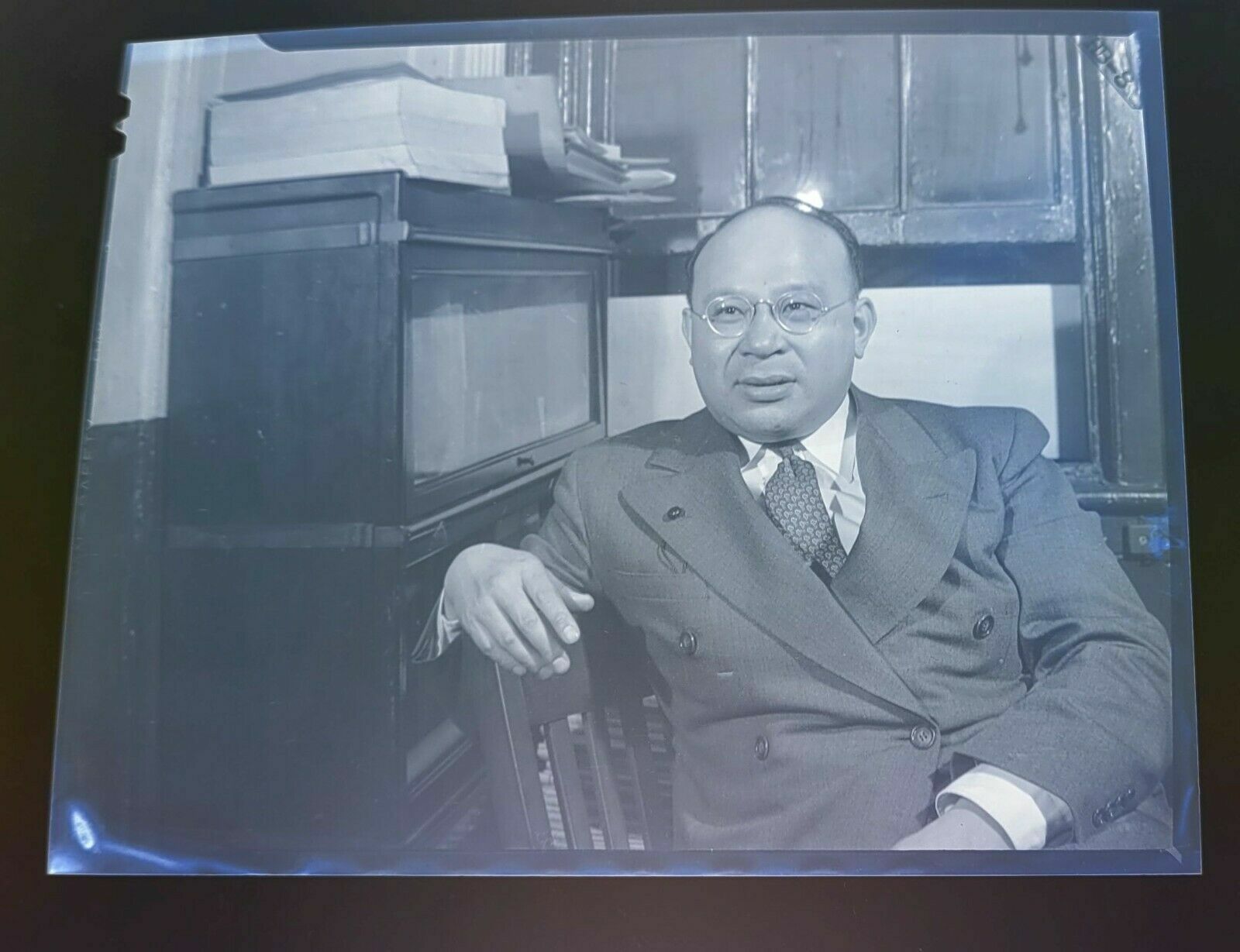
2 NEGATIVES WITH ORIGINAL ENVELOPE. PHOTOGRAPHS ARE BY JOURNALIST PHOTOGRAPHER HUGH BRODERICK AND EACH MEASURES 4X5 INCHES.
Thomas H. Lee who was the first person of Chinese descent to pass the bar in New York back in 1936. photo was taken in 1943 in his law office on Mulberry St, NY.
THE MANILA ENVELOPE HAS AGE. THE NEGATIVES ARE MUCH CLEARER THAN WHAT I AM POSTING. COULD MAKE NICE POSTERS.PHOTOGRAPHER BRODERICKDATE APR 29, 1943SUBJECT TOM LEE- CHINATOWN
Thomas H. Lee, Lawyer And a Former U.S. AideApr 20, 1980,
Thomas H. Lee, LawyerAnd a Former U.S. Aide
Thomas H. Lee, the first person of Chi-nese descent to be admitted to the NewYork bar and a former assistant UnitedStates attorney, died at Beekman-Down-town Hospital after a long illness. He was75 years old.
Mr. Lee was born in a tenement onMatt Street in lower Manhattan, the sonof Lee Kee, who came to New Yorkin 1880from Canton. He once recalled: /
“T really owe my good fortune to enter-ing the legal profession to the Depression,for during that period I looked for work:but could not find it. That was why I en-tered law school.\"
Mr. Lee, who maintained a privatepractice in Chinatown for almost a halfcentury, was fluent in the Chinese dialectof Cantonese and was an expert on immi-:gration matters.
He was named an assistant UnitedStates attorney in 1951 and served in thecivil division until 1953. One of his broth-ers, the late James (Shavey) Lee, was alongtime restaurateur in Chinatown.
Mr. Lee is survived by a brother,George, of Franklin Square, L.1, andthree sisters, Emily Shek and FlorenceHo, both of Manhattan, and Evelyn Mahof San Francisco.
Thomas H. Lee, Lawyer And a Former U.S. AideApr 20, 1980,
Thomas H. Lee, LawyerAnd a Former U.S. Aide
Thomas H. Lee, the first person of Chi-nese descent to be admitted to the NewYork bar and a former assistant UnitedStates attorney, died at Beekman-Down-town Hospital after a long illness. He was75 years old.
Mr. Lee was born in a tenement onMatt Street in lower Manhattan, the sonof Lee Kee, who came to New Yorkin 1880from Canton. He once recalled: /
“T really owe my good fortune to enter-ing the legal profession to the Depression,for during that period I looked for work:but could not find it. That was why I en-tered law school.\"
Mr. Lee, who maintained a privatepractice in Chinatown for almost a halfcentury, was fluent in the Chinese dialectof Cantonese and was an expert on immi-:gration matters.
He was named an assistant UnitedStates attorney in 1951 and served in thecivil division until 1953. One of his broth-ers, the late James (Shavey) Lee, was alongtime restaurateur in Chinatown.
Mr. Lee is survived by a brother,George, of Franklin Square, L.1, andthree sisters, Emily Shek and FlorenceHo, both of Manhattan, and Evelyn Mahof San Francisco.
New York to Have First Chinese Lawyer; Thomas H. Lee to Be Sworn In on MondayNov 7, 1936;
In the Oriental setting of thé LinSing Association club rooms, 47
Mott Street, Thomas H. Lee, 32years old, American-born Chinese,told yesterday how he came to bethe first-person of Chinese descentfe be admitted to the New YorkaT.
Mr. Lee passed the bar examina-tion last March and the charactertest in October, He will be swornin by the Appellate Division onMonday.
Mr. Lee was born on Oct. 20,1904, at 32 Mott Street. He waseducated at P. S. 23, Mulberry andBayard Streets; Stuyvesant HighSchool, Brooklyn Polytechnic In-stitute, Columbia School of Busi-ness, and St. John’s Law College,Brooklyn.
His father, Lee Kee, is presidentof the association, a fraternal or-der. The elder Mr. Lee came herefifty-six years ago from Canton,China. The son has never been toChina, though he speaks Can-tonese fluently. .
‘For the first time,” he said,“Chinese clients (in court) will nothave to deal through a middleman.”
Chinese having business in thelocal courts heretofore have been.represented by counsel of otherracial origins. He had no com-plaint to make about the servicethey received. Of the 10,000 orMore population of Chinatown, hesaid, only about 300 are American-born and eligible for citizenship andadmittance to the bar.
After graduating from Columbiain 1927, Mr. Lee was for a whilesecretary to Cheung Heung Pao,vice president of a Chinese uni-versity, who was here to raisefunds. But later, during the de-pression, he was unemployed.
“I worked my way through col-lege,” he said, ‘and I really owe
New York to Have First Chinese Lawyer;Thomas H. Lee to Be Sworn In on Monday‘Times Wide World Phote_Thomas H. Lee
my good fortune in entering the|legal profession to the depression,|!for, during that period, I loaked forjwork but could not find it. Thatwas why I entered law school.”
Mr. Lee is a Christian, a bachelorand has four brothers and threesisters.
He said that as far as he knowsthere are two other Chinese-Amer-ican lawyers in the country, bothin California.Chinese migration to the United States began in the late 1840s. Until the 1880s, Chinese immigrants worked primarily in mining, railroad construction, and agriculture in the American hinterland, when changes in employment opportunities and racial tensions drove many to the cities where relative security was obtained in Chinatowns. The Chinatowns developed into important centers for prostitution, gambling and the sale and consumption of opium, partly in response to restrictive laws that, for example, curtailed the immigration of Chinese women, and partly due to the fact that also non-Chinese customers, especially from the working class, began to frequent the whorehouses, gambling joints, and opium dens run by Chinese entrepreneurs. The Chinese vice business was integrated into a larger system of protection and payoffs, involving Chinese protection racketeers, corrupt police and non-Chinese property owners who leased their land and buildings for exorbitant rents.Originally, life within the Chinese communities was dominated by a few large family and district associations with restrictive membership. As a protective response to their dominance mutual aid associations, so-called tongs, emerged. The tongs adopted the norms and values of the Triad subculture. Their secretive nature, combined with the fact that they could recruit members without traditional restrictions, enabled them to overpower the family and district associations and to take on the social functions of arbitration, protection and exploitation in Chinatown. A tong is not a criminal organization per se, but a natural means of obtaining and using mutually obligate bonds (guanxi) for both criminal and non-criminal purposes.In New York, two tongs competed for dominance, the On Leong Tong and the Hip Sing Tong. The On Leong Tong represented the interest of the elite in Chinatown. Its power lay in the social, economic and political status of its leaders. On Leong Tong President, Tom Lee, and other key members controlled the lucrative \'property rights\' system associated with opium and gambling in Chinatown. The Hip Sing Tong was the power syndicate in Chinatown. Its power lay in the sizeable number of professional criminals within its ranks. Both tongs coexisted for roughly a decade tolerating each other. Then the Hip Sing Tong attempted to stake a more significant place in Chinatown\'s social system of organized crime, a move that would upset the social world of a number of Chinese organized criminals in the years to come. Tom Lee tried unsuccessfully to remove the Hip Sing leader Mock Duck from Chinatown via his allies in the criminal justice system. The Hip Sing in turn made efforts to increase its contacts outside the Chinese community and found an ally in Reverend Charles Parkhurst and his reform association, the Society for the Prevention of Crime. The Hip Sing Tong provided evidence to the Parkhurst Society\'s counsel, Frank Moss, so that he could bring indictments and prosecute cases against On Leong members.The alliance with the reform movement changed the press coverage of the Hip Sing-On Leong war. Before this incident, the Hip Sing Tong was widely viewed as a violent group while the On Leong Tong was commonly referred to as a merchant\'s association. Now the Hip Sing Tong was viewed as a reform faction bent on driving out vice and police corruption from Chinatown, whereas the On Leong Tong was regarded as purveyors of vice and the friend of crooked cops and Tammany hacks.However, the reform reputation of the Hip Sing Tong did not prevail for long. When it staged a gun attack on On Leong members in a theater in retaliation for a previous On Leong assault, the positive image of the Hip Sing Tong in the media was demolished. The theater massacre was followed by several more acts of violence and increasing police intervention. Eventually, the warring parties met at the negotiating table and a peace agreement was reached. The agreement established a holding company to divide the gambling profits between the On Leong Tong and the Hip Sing Tong.The On Leong Tong-Hip Sing Tong conflict that is commonly called the first tong war was \"just the first of many battles between opposing organized crime syndicates, a reflection of the chaotic social world of organized crime and the larger social system of organized crime that is part and parcel to the American urban experience that was turn-of-the-century New York City.\"
Assessment:The study pursues a dual purpose. On one hand, it sets out to counter assumptions that organized crime in the US is \"the purview of Italian and Jewish gangsters; that organized crime became modernized with Prohibition; and that other ethnic groups failed to muster syndicates of any real substance, power or sophistication before the 1980s,\" when the concept of \"emerging\" or \"non-traditional\" organized crime gained acceptance. On the other hand, it aims to demonstrate the value of using historical methodologies in the study of organized crime and to show that organized crime, specifically Chinese-American organized crime, is \"a long-term historical process\". McIllwain succeeds in setting the record straight about the long roots of Chinese-American organized crime. By doing so he impressively illuminates the shaky grounds on which the conventional understanding of organized crime in the U.S. is based. Those who have heard about the tong wars and thought of it as internal conflicts within a secluded immigrant subculture will be surprised to learn about the complex interplay of illicit and licit actors across ethnic lines. In this sense, the book is an essential contribution to the organized crime literature, not least because the historical evidence is presented within a sound conceptual framework that draws on Alan Block\'s conception of organized crime as a social world and a social system, and from network analysis. However, one is left wondering how valuable the historical approach to the study of organized crime really is. Organized crime research is characterized by difficulties in accessing data that are aggravated rather than minimized by the passing of time, at least when the period under investigation is so far back in time that no witnesses are left to tell their story. Not surprisingly, in many instances McIllwain has to rely on speculation, operating with \"the most likely scenario\" or \"inferential reasoning\".
Overall evaluation:One of the most convincing attacks on the conventional understanding of organized crime in the United States and an essential contribution to the history of American organized crime. McIllwain shows that organized crime has long and broad historical roots that go well beyond the gangsterism of the Prohibition Era. The only caveat, for which, however, the author deserves no blame, is that the passing of time has not improved the availability of data so that the study, more than investigations of contemporary organized crime, in many respects has to rely on guess work.
Posts Tagged ‘On Leong Tong’Tong Wars: Gangs of Chinatown MapPosted in Chinatown, Tong Wars, tagged Ah Hoon, Big Mike Abrams, Bow Kum, Chick Tricker, Chinatown Tunnels, Chinese Theater, Fan Tan, Gangs of Chinatown, Hip SIng, Hip Sing Tong, Irving Berlin, Mock Duck, Nam Wah Tea Parlor, New York Opium Den, Nigger Mike Salter, On Leong, On Leong Tong, Opium, Sing Dock, The Bloody Angle, Tom Lee, Tong War, Wah Kee, Wing Fat Mansion on March 6, 2014| 3 Comments »
Tong War Gangs of Chinatown Map Title
Tong Wars: Gangs of Chinatown Map Click to Enlarge in a New WindowTong Wars:Gangs of Chinatown MapClick to Enlarge in a New Window1.Hip Sing Headquarters15 Pell Street
2. Chinese Theater Massacre5-7 Doyers Street
On August 7, 1905, Hip Sing headman, Mock Duck, ordered several of his boo how doy, or hitmen to go on a rampage. Led by his top gunman Sing “The Scientific Killer” Dock, they entered the Chinese theater and opened fire using exploding firec
3. Chinatown Tunnels Entrance5 Doyers Street
Back around the turn-of-the-century, Chinatown was infested with a warren of tunnels that were used for smuggling, gambling, and quick getaways from the cops. 5 Doyers Street is the last accessible vestige of this tunnel network known today as the Wing Fat Shopping arcade. Oh, and by the way, they don’t like guests.4. First opium den in the city13 Pell Street
Wah Kee, one of Chinatown’s first residents, set up shop here some time around 1868. On the ground floor he sold Chinese curios and exotic foods, but upstairs was where the real action was. Along with a fan-tan gambling parlor, Kee ran Chinatown’s first opium den, which was completely legal at the time.5. Tong War Peace Treaty7-9 Mott
Following the Chinese Theater Massacre (see 2), Chinatown was in lockdown. The bombings, shootings and hatchet murders had completely disrupted vice in the district, and Tammany Hall’s Big Tom Foley stepped in to end the bloodshed. With the help of General Sessions Judge Warren W. Foster, Foley brokered a peace, making Mott Street On Leong territory, Mott Street Hip Sing territory and Doyers Street neutral ground.
To celebrate the truce, the rival gangs headed to the swankest joint in all of turn-of-the-century Chinatown, The Port Arthur Restaurant, and proceeded to get hammered. Tom Lee (see 13) supposedly guzzled 107 mugs of rice wine at the shindig.6. Nom Wah Tea Parlor13 Doyers Street
In business since 1920, the Nom Wah Tea Parlor is the closest you’ll get to authentic early 20th century dim sum. The restaurant has nothing to do with crime or tongs, but if you’re touring the Bloody Angle (see 8) be sure to give the traditional eggrolls a try.7. Mike Salter’s Saloon12 Pell Street
One of Big Tom Foley’s chief election captains, Mike Salter ran a gang that included Jack Sirocco and Chick Tricker from this ragtime saloon named The Pelham Café. Irving Berlin worked here as a singing waiter, and under the threat of a beating, Salter forced him to write his first song, launching Berlin’s music-making career. Upstairs, Salter ran a multiple story opium den managed bySandwiched between Pell and Mott, Doyers Street has one of the most crooked histories in town. Neutral ground for the feuding On Leong and Hip Sing Tongs, Doyers has been the site of more than one full-scale kung-fu rumble, earning it the nickname, “The Bloody Angle.”9. On Leong Headquarters83-89 Mott Street
10. Bow Kum Murder17 Mott
In 1882, the United States passed the Chinese Exclusion Act, a law deliberately designed to artificially limit the number of Chinese women in America. By 1890, less than 3.6 percent of all Chinese residents of America were female, a drastic sex imbalance that would lead to many Tong wars, such as the case of Bow Kum, a Chinese slave girl purchased at sale in San Francisco for $3,000 by Hip Sing member Low Hee Tong.
After Christian missionaries freed Bow Kum from slavery, she traveled to New York and married Tchin Len, a farmer who also happened to be a member of the On Leongs. When Low Hee caught up with his expensive ex-wife, he demanded her back, the On Leongs refused, and the tongs went to war. On August 15, 1909, a Hip Sing hatchetman slipped into Len’s apartment at 15 Mott Street and hacked Bow Kum to death, instantly kicking off one the bloodiest tong struggles.11. 5th Precinct19 Elizabeth Street
Opened in 1882, the 5th Precinct has policed Chinatown for more than 100 years, raiding opium dens, busting up fan-tan games, and bringing justice to the tongs. Designed by NYPD sergeant and architect Nathaniel Bush, the precinct contained 12 cells for women and 16 cells for men.
12. The Death of Funny Man Ah Hoon10 Chatham Square
During the Bow Kum War, the Hip Sing Tong posted a public death threat against the On Leong comedian Ah Hoon. Apparently Hoon’s act of skewing the Hip Sings had pissed off the gangsters for the last time. On December 30, 1909, two patrolmen from the 5th precinct protected Hoon during his act at the Chinese Theater and escorted him though the Chinatown tunnels to his home.
The cops left him with a warning not to leave his room before they left him for the night, but a thirsty Hoon ignored their warning and opened his door for a glass of water. Hip Sing gunmen waiting in the shadows opened fire killing him instantly.13. The Mayor of Chinatown’s Home, Tom Lee18 Mott
People called him the Mayor of Chinatown and for good reason. Tom Lee was the headman of the On Leong Tong, controlling much of the gambling, prostitution, and opium in Chinatown. His power was so great that Tammany Hall politician Big Tom Foley made him a city sheriff. He lived here at 18 Mott Street for much of his life.14. Wing Fat Mansion: Chinatown Tunnels7 Chatham Square
Built in 1920, this condominium’s lobby is the exit to the Chinatown tunnels. They really, really, do not like visitors.15. Mock Duck Strikes Again23 Mott Street
One of the most vicious gunmen in Chinatown, Mock Duck was a gangster known for going about the streets armed with two revolvers, a hatchet, and a suit of chain-mail armor. He was tried three times for murdering a tailor here, but he was never convicted.16. The Big Flat96-98 Mott Street and 9 Elizabeth Street
Demolished
The Big Flat started with the greatest of intentions. It was supposed to be a model for the future housing of the poor. Built as the first model tenement, the building was eventually devoured by the people it hoped to save, becoming one gigantic opium den. On December 8, 1884, detectives from the 5th Precinct raided the building. Fifteen people were arrested including Tom Lee’s (see 13) nephew.CHINATOWN\'S MAYOR DEAD.; Tom Lee Was a Factional Leader in the Old Tong Feuds.Sai Wing Mock (aka Mock Duck) (1879 – July 23, 1941) was a Chinese-American criminal and leader of the Hip Sing Tong, which replaced the On Leong Tong as the dominant Chinese-American Tong in the Manhattan Chinatown in the early 1900s.Contents1 Early criminal career2 Chinatown kingpin3 Retirement and death4 Footnotes5 Notable Chinese tongs6 See also7 References8 Further readingEarly criminal careerMock Duck arrived in the United States during the late 1890s, settling in New York\'s Chinatown, where he formed the Hip Sing Tong, a minor criminal organization. Within a few years, Mock Duck challenged Tom Lee and the On Leong Tong for control of criminal activities in Chinatown, and for the police and political protection of Tammany Hall.
Chinatown kingpinIn 1900, Mock Duck demanded half of Lee\'s revenue from illegal gambling operations. When Lee refused, within 48 hours Mock Duck declared a Tong war against the On Leongs. Hip Sing men set one of Lee\'s boarding houses on fire, which resulted in the deaths of two men. In another incident, an On Leong man was decapitated by two Hip Sing hatchetmen, and open warfare began in Chinatown.
One Chinatown historian describes Mock Duck in 1904 as \"strutting around on Pell Street, covered in diamonds,\" adding that, at that time, \"Mock Duck is firmly in control of the Hip Sing, his sinister image bolstered by his long, lethal-looking fingernails, which signal he is too grand to do the dirty work he assigns to others.\"[1]Chinese arrested after Mock Duck and Tom Lee factions\' shooting in Chinatown on January 24, 1906Mock Duck survived repeated attempts on his life and wore a chain mail vest. He was named by the press the \"Clay Pigeon of Chinatown\" and the \"Mayor of Chinatown\". During several attempts on his life, Mock Duck reportedly squatted down in the street and fired at his attackers with two handguns with his eyes closed.Tie You in March 1906, wife of Sai Wing Mock, leader of Hip Sing Tong organization in Chinatown, New York CityAfter Lee put a bounty on Mock Duck and the rest of the Hip Sings, Mock Duck formed an alliance with the rival Four Brothers Tong. Mock Duck took advantage of the reform crusade started by Charles Parkhurst. Duck posed as a businessman, and supplied information on the On Leong criminal operations to Parkhurst, including addresses. The authorities raided On Leong opium dens and gambling houses on Pell and Doyers Streets. However, Mock Duck held back the addresses of the more lucrative Mott Street operations for leverage against Lee. The warring Tongs signed a truce in 1906, but the Hip Sings and the On Leongs were again at war the following year.
Mock Duck finally defeated Lee in the \"Bow Kum\" Tong war of 1909–1910. He was arrested several times during the next decade, during which time a number of attempts were made on his life. But he was convicted only once in 1912, for operating a policy game, and served two years imprisonment in Sing Sing Prison.
Retirement and deathIn 1932, Mock Duck agreed to an arrangement with the US and Chinese governments to declare a peace among the Tongs of Chinatown and he retired to Brooklyn where he lived until his death on July 23, 1941.[2]
The Rise Of The Chinatown GangsThe first resident of Chinatown was Ah Ken, a cigar salesman who arrived in New York in 1858. Many believe he was able to afford his shop by renting out rooms to Chinese immigrants, effectively building Chinatown around his own home in the process.
Unlike earlier European immigrants who had had religious, cultural, or linguistic commonalities to help them adjust to New York, the average Chinese immigrant was faced with considerably more difficulty.
View Of Nineteenth-Century Chinatown In New YorkNew York Public LibraryA view down Pell Street in Chinatown in 1899.
For one thing, New Yorkers wanted little to do with Chinese immigrants apart from the occasional trip to their alleged opium dens. Under the Chinese Exclusion Act of 1882, many of these immigrants were limited from even entering the United States at all.
The act also made the present Chinese immigrants in the country alien residents. To make matters worse, many Chinese women were unable to join their husbands who were already in the country when the law was passed.
What were these isolated, desperate individuals surrounded by hostility and discrimination to do? Deprived of their legal rights, some Chinese immigrants turned to the criminal underbelly in response.
Secret societies were established to organize crime in Chinatown. These were called tongs, originally known as mutual aid associations.
When exactly their connection to crime started is unclear. But by the time the On Leong Tong was established in 1893, tong rule had clearly seeped into New York. And things were about to get bloody.
The Terror Of The Tong WarsThe full story of the tongs and the consequent Tong Wars spans from San Francisco to New York. Aside from its vast territory, the scale of violence in the Tong Wars was almost on a par with the Italian Mafia of the 1930s.
The cause of this war was what one might expect out of a clash of gangs: There was a struggle between two Chinese tongs for control of Chinatown.
Arrest Of Tong Gang MembersLibrary Of CongressTong members arrested after a battle. 1906.
Tom Lee was an established behind-the-scenes operator of the New York-based On Leong Tong. Lee’s tong soon garnered a dominant reputation even outside Chinatown and had strong ties to Tammany Hall.
But in the late 1890s, a rival appeared in the Hip Sing Tong. Leader Sai Wing Mock, a.k.a. Mock Duck, soon began to push into Lee’s territory.
On Aug. 12, 1900, a laundryman and member of the Hip Sing Tong named Lung Kin visited 9 Pell Street in Chinatown. At 6 p.m., he stumbled into a hallway as gunshots rang out — aiming straight at him.
An unknown number of tong members scattered from the room and from the building, leaving Lung to collapse in a pool of his own blood. Later that night, police arrested Gong Wing Chung, a member of the On Leong Tong.
The New York Times reported at the time: “When confronted with the charge of murder, [Gong Wing Chung] never moved a muscle. As he was being led away, a smile played over his face.”
Just six weeks later, Ah Fee, an associate and alibi witness of Chung’s, was murdered in retaliation.
Map Of The Tong WarsPublic DomainMap of the Tong War feud. 1906.
Lee was known to derive power from money, respect, and relationships, whereas Mock was more comfortable resorting to violence and brutality.
Within weeks of demanding half of the On Leong Tongs’ gambling operations, Mock’s men allegedly set fire to one of the group’s boarding houses. Not long after that, an On Leong “hatchet man” slew a Hip Sing he met in the street.
When Hip Sing member Sue Sing was brought to trial for the murder of Ah Fee, prosecutors saw an opportunity to use his trial as a means of reforming Chinatown. Authorities thus charged leaders of the Hip Sing Tong as well, including Mock Duck, who was suspected of planning the assassination.
Sing was convicted and sentenced to prison for life, while a deadlocked jury saved Mock Duck from going to jail. Shaken nonetheless, Mock left town for a time before making another play for control of Chinatown.
Mock’s return marked another moment in the evolutions within the tongs. Originally armed with meat cleavers in the late 1800s, the tongs began to use revolvers and other firearms around 1900. Explosives, used more rarely, entered into their operations around 1912.
Mock incorporated a chainmail vest beneath his clothes, a decision that ultimately saved him during several assassination attempts.
Mock was convicted only once for a minor crime in 1912 and spent just two years in prison before keeping a low profile until the end of his life in 1941. Unlike many other gang members, he died of natural causes.
Chinatown Gang WeaponsPublic DomainWeapons seized from tong members during a Chinatown police raid in 1922.
One of the most famous remnants of New York’s Tong Wars is a still-surviving nickname for Doyers Street.
Doyers Street feels more like an alley than a full-fledged road. It’s one block long and cut in half by a nearly 90-degree turn. This so-called “Bloody Angle” proved ideal for ambushing enemies.
Today, Doyers Street is most famously home to Nom Wah Tea Parlor, the oldest dim sum restaurant in New York. Nom Wah will celebrate its 100th anniversary in 2020.
By the time Nom Wah opened, Chinatown was mostly free of the brothels and opium dens for which it was once known.
Momentum within the Chinatown tongs slowed in the early 1900s when police raids proved to be the most effective in the city’s history.
Many of their operations were closed down by city authorities, and so the warring tongs came to a truce in 1906. The wars would kick off at few more times, however, surprisingly ending with Mock’s quiet retirement to Brooklyn.
A Chinatown (Chinese: 唐人街; pinyin: Tángrénjiē; Jyutping: tong4 jan4 gaai1) is an ethnic enclave of Chinese people located outside mainland China, Hong Kong, Macau or Taiwan, most often in an urban setting. Areas known as \"Chinatown\" exist throughout the world, including Europe, North America, South America, Asia, Africa and Australasia.
The development of most Chinatowns typically resulted from mass migration to an area without any or with very few Chinese residents. Binondo in Manila, established in 1594, is recognized as the world\'s oldest Chinatown. Notable early examples outside Asia include San Francisco\'s Chinatown in the United States and Melbourne\'s Chinatown in Australia, which were founded in the mid-19th century during the California Gold Rush and Victorian gold rush, respectively. A more modern example, in Montville, Connecticut, was caused by the displacement of Chinese workers in the Manhattan Chinatown following the September 11th attacks in 2001.[1][2]Contents1 Definition2 History2.1 In Asia2.2 In the West2.3 1970s to the present3 Chinese Settlements3.1 History3.2 Settlement pattern4 Characteristics4.1 Demographics4.2 Town-Scape5 Benevolent and business associations6 Names6.1 English6.2 In Chinese6.3 Other languages7 Locations7.1 Africa7.2 Americas7.3 Asia7.4 Australia and Oceania7.5 Europe8 In popular culture9 Some notable Temples in Chinatowns worldwide10 See also11 References11.1 Citations11.2 SourcesDefinitionOxford Dictionaries defines \"Chinatown\" as \"... a district of any non-Asian town, especially a city or seaport, in which the population is predominantly of Chinese origin\".[3] However, some Chinatowns may have little to do with China.[4] Some \"Vietnamese\" enclaves are in fact a city\'s \"second Chinatown\", and some Chinatowns are in fact pan-Asian, meaning they could also be counted as a Koreatown or Little India.[5] One example includes Asiatown in Cleveland, Ohio. It was initially referred to as a Chinatown but was subsequently renamed due to the influx of non-Chinese Asian Americans who opened businesses there. Today the district acts as a unifying factor for the Chinese, Taiwanese, Korean, Japanese, Filipino, Indian, Vietnamese, Cambodian, Laotian, Nepalese and Thai communities of Cleveland.[6]
Further ambiguities with the term can include Chinese ethnoburbs which by definition are \"... suburban ethnic clusters of residential areas and business districts in large metropolitan areas[7] where the intended purpose is to be \"... as isolated from the white population as Hispanics\".[8] An article in The New York Times blurs the line further by categorizing very different Chinatowns such as Chinatown, Manhattan, which exists in an urban setting as \"traditional\"; Monterey Park\'s Chinatown, which exists in a \"suburban\" setting (and labeled as such); and Austin, Texas\'s Chinatown, which is in essence a \"fabricated\" Chinese-themed mall. This contrasts with narrower definitions, where the term only described Chinatown in a city setting.[9]
In some cities in Spain, the term barrio chino (\'Chinese quarter\') denotes an area, neighborhood or district where prostitution or other businesses related to the sex industry are concentrated; i.e. a red-light district. Some examples of this are the Chinatown of Salamanca and Barri Xinès, the Chinatown of Barcelona a part of El Raval, although in Barcelona there was a small Chinese community in the 1930s.
HistorySee also: Chinese emigrationTrading centers populated predominantly by Chinese men and their native spouses have long existed throughout Southeast Asia. Emigration to other parts of the world from China accelerated in the 1860s with the signing of the Treaty of Peking (1860), which opened China\'s borders to free movement. Early emigrants came primarily from the coastal provinces of Guangdong (Canton, Kwangtung) and Fujian (Fukien, Hokkien) in southeastern China – where the people generally speak Toishanese, Cantonese, Hakka, Teochew (Chiuchow) and Hokkien. In the late 19th century and early 20th century, a significant amount of Chinese emigration to North America originated from four counties called Sze Yup, located west of the Pearl River Delta in Guangdong province, making Toishanese a dominant variety of the Chinese language spoken in Chinatowns in Canada and the United States.
As conditions in China have improved in recent decades, many Chinatowns have lost their initial mission, which was to provide a transitional place into a new culture. As net migration has slowed into them, the smaller Chinatowns have slowly decayed, often to the point of becoming purely historical and no longer serving as ethnic enclaves.[10]
In Asia
The Chinese New Year celebrated in Chinatown, KolkataAlong the coastal areas of Southeast Asia, several Chinese settlements existed as early as the 16th century according to Zheng He and Tomé Pires\' travel accounts. Melaka during the Portuguese colonial period, for instance, had a large Chinese population in Campo China. They settled down at port towns under the authority\'s approval for trading. After the European colonial powers seized and ruled the port towns in the 16th century, Chinese supported European traders and colonists, and created autonomous settlements.
Several Asian Chinatowns, although not yet called by that name, have a long history. Those in Nagasaki, Kobe and Yokohama, Japan,[11] Binondo in Manila, Hoi An and Bao Vinh in central Vietnam[12] all existed in 1600. Glodok, the Chinese quarter of Jakarta, Indonesia, dates to 1740.[13]
Chinese presence in India dates back to the 5th century CE, with the first recorded Chinese settler in Calcutta named Young Atchew around 1780.[14] Chinatowns first appeared in the Indian cities of Kolkata, Mumbai, and Chennai.
The Chinatown centered on Yaowarat Road in Bangkok, Thailand, was founded at the same time as the city itself, in 1782.[15]
In the West
Chinese seamen established one of the earliest Chinatowns around the docks in Liverpool in the mid-19th century.An early enclave of Chinese people emerged in the 1830s in Liverpool, England, when the first direct trading vessel from China arrived in Liverpool\'s docks to trade in goods, including silk and cotton wool.[16] Many Chinese immigrants arrived in Liverpool in the late 1850s in the employ of the Blue Funnel Shipping Line, a cargo transport company established by Alfred Holt. The commercial shipping line created strong trade links between the cities of Shanghai, Hong Kong, and Liverpool, mainly in the importation of silk, cotton and tea.[16] They settled near the docks, but the area was heavily bombed during World War II, with the Chinese community moving a few blocks to the current Liverpool Chinatown on Nelson Street.
The Chinatown in San Francisco is one of the largest in North America and the oldest north of Mexico. It served as a port of entry for early Chinese immigrants from the 1850s to the 1900s.[17] The area was the one geographical region deeded by the city government and private property owners which allowed Chinese persons to inherit and inhabit dwellings within the city. Many Chinese found jobs working for large companies seeking a source of labor, most famously as part of the Central Pacific[18] on the Transcontinental Railroad. Since it started in Omaha, that city had a notable Chinatown for almost a century.[19] Other cities in North America where Chinatowns were founded in the mid-nineteenth century include almost every major settlement along the West Coast from San Diego to Victoria. Other early immigrants worked as mine workers or independent prospectors hoping to strike it rich during the 1849 Gold Rush.
Economic opportunity drove the building of further Chinatowns in the United States. The initial Chinatowns were built in the Western United States in states such as California, Oregon, Washington, Idaho, Utah, Colorado and Arizona. As the transcontinental railroad was built, more Chinatowns started to appear in railroad towns such as St. Louis, Chicago, Cincinnati, Pittsburgh and Butte, Montana. Chintatowns then subsequently emerged in many East Coast cities, including New York City, Boston, Philadelphia, Providence and Baltimore. With the passage of the Emancipation Proclamation, many southern states such as Arkansas, Louisiana and Georgia began to hire Chinese for work in place of slave labor.[20]
The history of Chinatowns was not always peaceful, especially when labor disputes arose. Racial tensions flared when lower-paid Chinese workers replaced white miners in many mountain-area Chinatowns, such as in Wyoming with the Rock Springs Massacre. Many of these frontier Chinatowns became extinct as American racism surged and the Chinese Exclusion Act was passed.
In Australia, the Victorian gold rush, which began in 1851, attracted Chinese prospectors from the Guangdong area. A community began to form in the eastern end of Little Bourke Street, Melbourne by the mid 1850s; the area is still the center of the Melbourne Chinatown, making it the oldest continuously occupied Chinatown in a western city (since the San Francisco one was destroyed and rebuilt). Gradually expanding, it reached a peak in the early 20th century, with Chinese business, mainly furniture workshops, occupying a block wide swath of the city, overlapping into the adjacent \'Little Lon\' red light district. With restricted immigration it shrunk again, becoming a strip of Chinese restaurants by the late 1970s, when it was celebrated with decorative arches. However, with a recent huge influx of students from mainland China, it is now the center of a much larger area of noodle shops, travel agents, restaurants, and groceries. The Australian gold rushes also saw the development of a Chinatown in Sydney, at first around the Rocks, near the docks, but it has moved twice, first in the 1890s to the east side of the Haymarket area, near the new markets, then in the 1920s concentrating on the west side.[21] Nowadays, Sydney\'s Chinatown is centered on Dixon Street.
Other Chinatowns in European capitals, including Paris and London, were established at the turn of the 20th century. The first Chinatown in London was located in the Limehouse area of the East End of London[22] at the start of the 20th century. The Chinese population engaged in business which catered to the Chinese sailors who frequented the Docklands. The area acquired a bad reputation from exaggerated reports of opium dens and slum housing.
France received a large settlement of Chinese immigrant laborers, mostly from the city of Wenzhou, in the Zhejiang province of China. Significant Chinatowns sprung up in Belleville and the 13th arrondissement of Paris.Manhattan\'s Chinatown, the largest concentration of Chinese people in the Western Hemisphere[23][24] and one of nine Chinatown neighborhoods in New York City,[25] as well as one of twelve in the surrounding New York metropolitan area.Chinatown, San Francisco, the oldest Chinatown in the USLiverpool\'s Chinatown, the oldest Chinatown in EuropeChinatown, Philadelphia, the recipient of significant Chinese immigration from both New York City[26] and China[27]
1970s to the presentBy the late 1970s, refugees and exiles from the Vietnam War played a significant part in the redevelopment of Chinatowns in developed Western countries. As a result, many existing Chinatowns have become pan-Asian business districts and residential neighborhoods. By contrast, most Chinatowns in the past had been largely inhabited by Chinese from southeastern China.
In 2001, the events of September 11 resulted in a mass migration of about 14,000 Chinese workers from Manhattan\'s Chinatown to Montville, Connecticut, due to the fall of the garment industry. Chinese workers transitioned to casino jobs fueled by the development of the Mohegan Sun casino.
In 2012, Tijuana\'s Chinatown formed as a result of availability of direct flights to China. The La Mesa District of Tijuana was formerly a small enclave, but has tripled in size as a result of direct flights to Shanghai. It has an ethnic Chinese population rise from 5,000 in 2009 to roughly 15,000 in 2012, overtaking Mexicali\'s Chinatown as the largest Chinese enclave in Mexico.The busy intersection of Main Street, Kissena Boulevard, and 41st Avenue in the Flushing Chinatown (法拉盛華埠), Queens, New York City. The segment of Main Street between Kissena Boulevard and Roosevelt Avenue, punctuated by the Long Island Rail Road trestle overpass, represents the cultural heart of Flushing Chinatown. Housing over 30,000 individuals born in China alone, the largest by this metric outside Asia, Flushing has become home to the largest and one of the fastest-growing Chinatowns in the world.[28]Flushing is undergoing rapid gentrification by Chinese transnational entities.[29]The New York metropolitan area, consisting of New York City, Long Island and nearby areas within the states of New York, New Jersey, Connecticut and Pennsylvania, is home to the largest Chinese American population of any metropolitan area within the United States and the largest Chinese population outside of China, enumerating an estimated 893,697 in 2017[30] and including at least 12 Chinatowns, including nine in New York City proper alone.[25] Continuing significant immigration from Mainland China, both legal[31][32] and illegal[33] in origin, has spurred the ongoing rise of the Chinese American population in the New York metropolitan area; this immigration continues to be fueled by New York\'s status as an alpha global city, its high population density, its extensive mass transit system, and the New York metropolitan area\'s enormous economic marketplace. The Manhattan Chinatown contains the largest concentration of ethnic Chinese in the Western hemisphere;[24] while the Flushing Chinatown in Queens has become the world\'s largest Chinatown, but conversely, has also emerged as the epicenter of organized prostitution in the United States.[34]Chinese SettlementsHistoryPeople of Fujian province used to move over the South China Sea from the 14th century to look for more stable jobs, in most cases of trading and fishery, and settled down near the port/jetty under approval of the local authority such as Magong (Penghu), Lukang (Taiwan), Hoian (Vietnam), Songkla (Thailand), Malacca (Malaysia), Banten, Semarang, Tuban (Indonesia), Manila (the Philippines), etc. A large number of this kind of settlements was developed along the coastal areal of the South China Sea, and was called \"Campon China\" by Portuguese account[37] and \"China Town\" by English account.[38]Settlement patternThe settlement was developed along a jetty and protected by Mazu temple, which was dedicated for the Goddess of Sea for safe sailing. Market place was open in front of Mazu temple, and shophouses were built along the street leading from west side of the Mazu temple. At the end of the street, Tudigong (Land God) temple was placed. As the settlement prospered as commercial town, Kuan Ti temple would be added for commercial success, especially by people from Hong Kong and Guangdong province. This core pattern was maintained even the settlement got expanded as a city, and forms historical urban center of the Southeast Asia.[39]
Hoian Settlement Pattern, Vietnam, 1991.Pengchau Settlement Pattern, Hong Kong, 1991.Chinese Settlement in Georgetown, Malaysia, 1991.Chinese Settlement in Kuching, Malaysia, 1991.Tin Hau (Goddess of Sea) Temple in Kuching, Malaysia, 1991.To Di Gong (Land God) Temple at Kuching, 1991.
CharacteristicsThe features described below are characteristic of many modern Chinatowns.
DemographicsThe early Chinatowns such as those in San Francisco and Los Angeles in the United States were naturally destinations for people of Chinese descent as migration were the result of opportunities such as the California Gold Rush and the Transcontinental Railroad drawing the population in, creating natural Chinese enclaves that were almost always 100% exclusively Han Chinese, which included both people born in China and in the enclave, in this case American-born Chinese.[40] In some free countries such as the United States and Canada, housing laws that prevent discrimination also allows neighborhoods that may have been characterized as \"All Chinese\" to also allow non-Chinese to reside in these communities. For example, the Chinatown in Philadelphia has a sizeable non-Chinese population residing within the community.[41] A recent study also suggests that the demographic change is also driven by gentrification of what were previously Chinatown neighborhoods. The influx of luxury housing is speeding up the gentrification of such neighborhoods. The trend for emergence of these types of natural enclaves is on the decline (with the exceptions being the continued growth and emergence of newer Chinatowns in Queens and Brooklyn in New York City), only to be replaced by newer \"Disneyland-like\" attractions, such as a new Chinatown that will be built in the Catskills region of New York.[42] This includes the endangerment of existing historical Chinatowns that will eventually stop serving the needs of Chinese immigrants. Newer developments like those in Norwich, Connecticut, and the San Gabriel Valley, which are not necessarily considered \"Chinatowns\" in the sense that they do not necessarily contain the Chinese architectures or Chinese language signs as signatures of an officially sanctioned area that was designated either in law or signage stating so, differentiate areas that are called \"Chinatowns\" versus locations that have \"significant\" populations of people of Chinese descent. For example, San Jose, California in the United States has 63,434 people (2010 U.S. Census) of Chinese descent, and yet \"does not have a Chinatown\". Some \"official\" Chinatowns have Chinese populations much lower than that.[43]
Town-ScapeMain article: Chinese architectureMany tourist-destination metropolitan Chinatowns can be distinguished by large red arch entrance structures known in Mandarin Chinese as Paifang (sometimes accompanied by imperial guardian lion statues on either side of the structure, to greet visitors). Other Chinese architectural styles such as the Chinese Garden of Friendship in Sydney Chinatown and the Chinese stone lions at the gate to the Victoria, British Columbia Chinatown are present in some Chinatowns. Mahale Chiniha, the Chinatown in Iran, contains many buildings that were constructed in the Chinese architectural style.
Paifangs usually have special inscriptions in Chinese. Historically, these gateways were donated to a particular city as a gift from the Republic of China and People\'s Republic of China, or local governments (such as Chinatown, San Francisco) and business organizations. The long-neglected Chinatown in Havana, Cuba, received materials for its paifang from the People\'s Republic of China as part of the Chinatown\'s gradual renaissance. Construction of these red arches is often financed by local financial contributions from the Chinatown community. Some of these structures span an entire intersection, and some are smaller in height and width. Some paifang can be made of wood, masonry or steel and may incorporate an elaborate or simple design.
Chinatown landmarks
Entrance to SydneyPaifang in PhiladelphiaPaifang in Buenos Aires, ArgentinaChinatown, Boston looking towards the paifangGate of Chinatown, Portland, OregonChinatown entry arch in Newcastle, EnglandChinese Garden of Friendship, part of Sydney ChinatownChinese stone lions at the Chinatown gate in Victoria, British Columbia, CanadaHarbin Gates in Chinatown of Edmonton, Alberta, CanadaMillennium Gate on Pender Street in Chinatown of Vancouver, British Columbia, CanadaThe Chinese Cultural Center of Calgary, Alberta, CanadaChinese Temple \"Toong On Church\" in Kolkata, India.Chinese Temple in Yokohama Chinatown, Japan.
Benevolent and business associationsMain article: Chinese Consolidated Benevolent Association
Headquarters of the Chinese Consolidated Benevolent Association in Chinatown, San Francisco.A major component of many Chinatowns is the family benevolent association, which provides some degree of aid to immigrants. These associations generally provide social support, religious services, death benefits (members\' names in Chinese are generally enshrined on tablets and posted on walls), meals, and recreational activities for ethnic Chinese, especially for older Chinese migrants. Membership in these associations can be based on members sharing a common Chinese surname or belonging to a common clan, spoken Chinese dialect, specific village, region or country of origin, and so on. Many have their own facilities.
Some examples include San Francisco\'s prominent Chinese Consolidated Benevolent Association (中華總會館 Zhōnghuá Zǒng Huìguǎn), aka Chinese Six Companies and Los Angeles\' Southern California Teochew Association. The Chinese Consolidated Benevolent Association is among the largest umbrella groups of benevolent associations in the North America, which branches in several Chinatowns. Politically, the CCBA has traditionally been aligned with the Kuomintang and the Republic of China.
The London Chinatown Chinese Association is active in Chinatown, London. Chinatown, Paris has an institution in the Association des Résidents en France d\'origine indochinoise and it servicing overseas Chinese immigrants in Paris who were born in the former French Indochina.
Traditionally, Chinatown-based associations have also been aligned with ethnic Chinese business interests, such as restaurant, grocery, and laundry (antiquated) associations in Chinatowns in North America. In Chicago\'s Chinatown, the On Leong Merchants Association was active.
NamesEnglish
Official signs in Boston pointing towards \"Chinatown\"Although the term \"Chinatown\" was first used in Asia, it is not derived from a Chinese language. Its earliest appearance seems to have been in connection with the Chinese quarter of Singapore, which by 1844 was already being called \"China Town\" or \"Chinatown\" by the British colonial government.[44][45] This may have been a word-for-word translation into English of the Malay name for that quarter, which in those days was probably \"Kampong China\" or possibly \"Kota China\" or \"Kampong Tionghua/Chunghwa/Zhonghua\".
The first appearance of a Chinatown outside Singapore may have been in 1852, in a book by the Rev. Hatfield, who applied the term to the Chinese part of the main settlement on the remote South Atlantic island of St. Helena.[46] The island was a regular way-station on the voyage to Europe and North America from Indian Ocean ports, including Singapore.Sign inside Jefferson Station in Philadelphia pointing to \"Chinatown\"One of the earliest American usages dates to 1855, when San Francisco newspaper The Daily Alta California described a \"pitched battle on the streets of [SF\'s] Chinatown\".[47] Other Alta articles from the late 1850s make it clear that areas called \"Chinatown\" existed at that time in several other California cities, including Oroville and San Andres.[48][49] By 1869, \"Chinatown had acquired its full modern meaning all over the U.S. and Canada. For instance, an Ohio newspaper wrote: \"From San Diego to Sitka..., every town and hamlet has its \'Chinatown\'.\"[50]
In British publications before the 1890s, \"Chinatown\" appeared mainly in connection with California. At first, Australian and New Zealand journalists also regarded Chinatowns as Californian phenomena. However, they began using the term to denote local Chinese communities as early as 1861 in Australia[51] and 1873 in New Zealand.[52] In most other countries, the custom of calling local Chinese communities \"Chinatowns\" is not older than the twentieth century.
Several alternate English names for Chinatown include China Town (generally used in British and Australian English), The Chinese District, Chinese Quarter and China Alley (an antiquated term used primarily in several rural towns in the western United States for a Chinese community; some of these are now historical sites). In the case of Lillooet, British Columbia, Canada, China Alley was a parallel commercial street adjacent to the town\'s Main Street, enjoying a view over the river valley adjacent and also over the main residential part of Chinatown, which was largely of adobe construction. All traces of Chinatown and China Alley there have disappeared, despite a once large and prosperous community.
In Chinese
Street sign in Chinatown, Newcastle, with 唐人街 below the street name.In Chinese, Chinatown is usually called 唐人街, in Cantonese Tong jan gai, in Mandarin Tángrénjiē, in Hakka Tong ngin gai, and in Toisan Hong ngin gai, literally meaning \"Tang people\'s street(s)\". The Tang Dynasty was a zenith of the Chinese civilization, after which some Chinese call themselves. Some Chinatowns are indeed just one single street, such as the relatively short Fisgard Street in Victoria, British Columbia, Canada.
A more modern Chinese name is 華埠 (Cantonese: Waa Fau, Mandarin: Huábù) meaning \"Chinese City\", used in the semi-official Chinese translations of some cities\' documents and signs. Bù, pronounced sometimes in Mandarin as fù, usually means seaport; but in this sense, it means city or town. Tong jan fau (唐人埠 \"Tang people\'s town\") is also used in Cantonese nowadays. The literal word-for-word translation of Chinatown—Zhōngguó Chéng (中國城) is also used, but more frequently by visiting Chinese nationals rather than immigrants of Chinese descent who live in various Chinatowns.
Chinatowns in Southeast Asia have unique Chinese names used by the local Chinese, as there are large populations of people who are Overseas Chinese, living within the various major cities of Southeast Asia. As the population of Overseas Chinese, is widely dispersed in various enclaves, across each major Southeast Asian city, specific Chinese names are used instead.
For example, in Singapore, where 2.8 million ethnic Chinese constitute a majority 74% of the resident population,[53] the Chinese name for Chinatown is Niúchēshǔi (牛車水, Hokkien POJ: Gû-chia-chúi), which literally means \"ox-cart water\" from the Malay \'Kreta Ayer\' in reference to the water carts that used to ply the area. The Chinatown in Kuala Lumpur, Malaysia, (where 2 million ethnic Chinese comprise 30% of the population of Greater Kuala Lumpur [54]) while officially known as Petaling Street (Malay: Jalan Petaling), is referred to by Malaysian Chinese by its Cantonese name ci4 cong2 gaai1 (茨廠街, pinyin: Cíchǎng Jiē), literally \"tapioca factory street\", after a tapioca starch factory that once stood in the area. In Manila, Philippines, the area is called Mínlúnluò Qū 岷倫洛區, literally meaning the \"Mín and Luò Rivers confluence district\" but is actually a transliteration of the local term Binondo and an allusion to its proximity to the Pasig River.
Other languagesIn Francophone regions (such as France and Quebec), Chinatown is often referred to as le quartier chinois (the Chinese Quarter; plural: les quartiers chinois). The most prominent Francophone Chinatowns are located in Paris and Montreal.
The Spanish-language term is usually barrio chino (Chinese neighborhood; plural: barrios chinos), used in Spain and Latin America. (However, barrio chino or its Catalan cognate barri xinès do not always refer to a Chinese neighborhood: these are also common terms for a disreputable district with drugs and prostitution, and often no connection to the Chinese.).
The Vietnamese term for Chinatown is Khu người Hoa (Chinese district) or phố Tàu (Chinese street). Vietnamese language is prevalent in Chinatowns of Paris, Los Angeles, Boston, Philadelphia, Toronto, and Montreal as ethnic Chinese from Vietnam have set up shop in them.
In Japanese, the term \"chūkagai\" (中華街, literally \"Chinese Street\") is the translation used for Yokohama and Nagasaki Chinatown.
In Indonesia, chinatown is known as Pecinan, a shortened term of pe-cina-an, means everything related to the Chinese people. Most of these pecinans usually located in Java.[55]
Some languages have adopted the English-language term, such as Dutch and German.
Locations
Street scene of the Chinatown in Cyrildene, JohannesburgAfricaMain article: Chinatowns in AfricaThere are three noteworthy Chinatowns in Africa located in the coastal African nations of Madagascar, Mauritius and South Africa. South Africa has the largest Chinatown and the largest Chinese population of any African country and remains a popular destination for Chinese immigrants coming to Africa. Derrick Avenue in Cyrildene, Johannesburg, hosts South Africa\'s largest Chinatown.
AmericasMain article: Chinatowns in the AmericasIn the Americas, which includes North America, Central America and South America, Chinatowns have been around since the 1800s. The most prominent ones exist in the United States and Canada in Toronto, New York City, San Francisco and Vancouver. The New York City metropolitan area is home to the largest ethnic Chinese population outside of Asia, comprising an estimated 893,697 uniracial individuals as of 2017,[56] including at least 12 Chinatowns – six[57] (or nine, including the emerging Chinatowns in Corona and Whitestone, Queens,[58] and East Harlem, Manhattan) in New York City proper, and one each in Nassau County, Long Island; Edison, New Jersey;[58] and Parsippany-Troy Hills, New Jersey, not to mention fledgling ethnic Chinese enclaves emerging throughout the New York City metropolitan area. San Francisco, a Pacific port city, has the oldest and longest continuous running Chinatown in the Western Hemisphere.[59][60][61] In Canada, Vancouver\'s Chinatown is the country\'s largest.[62]
The oldest Chinatown in the Americas is in Mexico City and dates back to at least the early 17th century.[63] Since the 1970s, new arrivals have typically hailed from Hong Kong, Macau and Taiwan. Latin American Chinatowns may include the descendants of original migrants – often of mixed Chinese and Latin parentage – and more recent immigrants from East Asia. Most Asian Latin Americans are of Cantonese and Hakka origin. Estimates widely vary on the number of Chinese descendants in Latin America. Notable Chinatowns also exist in Chinatown, Lima, Peru.
Chinatowns in the Americas
Manhattan ChinatownSan Francisco\'s ChinatownChinatown, BostonChinatown, PhiladelphiaPortland, Oregon\'s ChinatownVancouver ChinatownChinatown in Canada\'s Capital, OttawaArch honors Chinese-Mexican community of Mexico City, built in 2008, Articulo 123 Street
AsiaMain article: Chinatowns in AsiaChinatowns in Asia are widespread with a large concentration of overseas Chinese in East Asia and Southeast Asia and ethnic Chinese whose ancestors came from southern China – particularly the provinces of Guangdong, Fujian, and Hainan – and settled in countries such as Brunei, Cambodia, Indonesia, Laos, Malaysia, Myanmar, Singapore, the Philippines, Thailand, and Vietnam centuries ago—starting as early as the Tang Dynasty, but mostly notably in the 17th through the 19th centuries (during the reign of the Qing Dynasty), and well into the 20th century. Today the Chinese diaspora in Asia is largely concentrated in Southeast Asia however the legacy of the once widespread overseas Chinese communities in Asia is evident in the many Chinatowns that are found across East Asia, South Asia, and Southeast Asia.
Asian Chinatowns
Yokohama Chinatown\'s Goodwill Gate in JapanChinatown in Bangkok, ThailandKan Yin Temple (Kwan Yin Si), a place of worship for Burmese Chinese in Bago, also serves as a Mandarin schoolChinatown gate in Mangga Dua, Jakarta, IndonesiaKya-Kya or Kembang Jepun, Surabaya\'s Chinatown, one of oldest Chinatown in IndonesiaChinese New Year celebrated in Chinatown, Kolkata, India.
Australia and OceaniaMain articles: Chinatowns in Australia and Chinatowns in OceaniaThe Chinatown of Melbourne lies within the Melbourne Central Business District and centers on the eastern end of Little Bourke Street. It extends between the corners of Swanston and Exhibition Streets. Melbourne\'s Chinatown originated during the Victorian gold rush in 1851, and is notable as the oldest Chinatown in Australia. It has also been claimed to be the longest continuously running Chinese community outside of Asia, but only because the 1906 San Francisco earthquake all but destroyed the Chinatown in San Francisco in California.[59][60][61]
Sydney\'s main Chinatown centers on Sussex Street in the Sydney downtown. It stretches from Central Station in the east to Darling Harbour in the west, and is Australia\'s largest Chinatown.
The Chinatown of Adelaide was originally built in the 1960s and was renovated in the 1980s. It is located near Adelaide Central Market and the Adelaide Bus Station.
Chinatown Gold Coast is a precinct in the Central Business District of Southport, Queensland, that runs through Davenport Street and Young Street. The precinct extends between Nerang Street in the north and Garden Street/Scarborough Street east-west. Redevelopment of the precinct was established in 2013 and completed in 2015 in time for Chinese New Year celebrations.
There are additional Chinatowns in Brisbane, Perth and Broome in Australia.
Chinatowns in Australia and Oceania
Paifang at Sydney ChinatownPaifang at Bendigo Chinese PrecinctAdelaide ChinatownMelbourne Chinatown entrance at Little Bourke Street
EuropeMain article: Chinatowns in EuropeSeveral urban Chinatowns exist in major European capital cities. There is Chinatown, London, England as well as major Chinatowns in Birmingham, Liverpool, Newcastle, and Manchester. Berlin, Germany has one established Chinatown in the area around Kantstrasse of Charlottenburg in the West. Antwerp, Belgium has also seen an upstart Chinese community, that has been recognized by the local authorities since 2011.[64] The city council of Cardiff has plans to recognize the Chinese Diaspora in the city.[65]
The Chinatown in Paris, located in the 13th arrondissement, is the largest in Europe, where many Vietnamese – specifically ethnic Chinese refugees from Vietnam – have settled and in Belleville in the northeast of Paris as well as in Lyon. In Italy, there is a Chinatown in Milan between Via Luigi Canonica and Via Paolo Sarpi and others in Rome and Prato. In the Netherlands, Chinatowns exist in Amsterdam, Rotterdam and the Hague.
In the United Kingdom, several exist in Birmingham, Liverpool, London, Manchester and Newcastle Upon Tyne. The Chinatown in Liverpool is the oldest Chinese community in Europe.[66] The Chinatown in London was established in the Limehouse district in the late 19th century. The Chinatown in Manchester is located in central Manchester.
European Chinatowns
Map of Chinatown MilanGate of Chinatown, Liverpool England, is the largest multiple-span arch outside of China, in the oldest Chinese community in EuropeWardour Street, Chinatown, LondonChinese Quarter in Birmingham, EnglandChinese new year celebration in Lyon, France.
In popular cultureChinatowns have been referenced in various films including The Joy Luck Club, Big Trouble in Little China, Year of the Dragon and Chinatown. Also, many films in which Jackie Chan appears reference locations in Chinatown, particularly the Rush Hour series with Chris Tucker.
Chinatowns have also been mentioned in the song \"Kung Fu Fighting\" by Carl Douglas whose song lyrics says \"... There was funky China men from funky Chinatown ...\"[67]
The martial arts actor Bruce Lee is well known as a person who was born in the Chinatown of San Francisco.[68] Other notable Chinese Americans such as politician Gary Locke and NBA player Jeremy Lin grew up in suburbs with lesser connections to traditional Chinatowns. Neighborhood activists and politicians have increased in prominence in some cities, and some are starting to attract support from non-Chinese voters.
Some notable Temples in Chinatowns worldwideSan Francisco\'s Chinatown - Tin How Temple (天后古廟), Ma-Tsu Temple (美國舊金山媽祖廟朝聖宮)Los Angeles Chinatown - Thien Hau Temple (天后宮)Yokohama Chinatown - Yokohama Ma Zhu Miao (横濱媽祖廟)Bangkok Chinatown - Leng Buai Ia Shrine (龍尾古廟), Wat Bamphen Chin Phrot (永福寺) & Wat Mangkon Kamalawat (龍蓮寺)Yangon Chinatown - Kheng Hock Keong (慶福宮) & Guanyin Gumiao Temple (觀音古廟)Jakarta Chinatown - Kim Tek Ie Temple (金德院)Kuala Lumpur Chinatown - Sin Sze Si Ya Temple (仙四師爺廟)Malacca Chinatown - Cheng Hoon Teng Temple (青云亭)Terengganu Chinatown - Ho Ann Kiong Temple (护安宫) & Tian Hou Gong Temple (天后宮)Davao Chinatown - Lon Wa Buddhist Temple (龙华寺)See alsoflag China portalicon Society portal Wikimedia Commons has media related to:Chinatown (category)Chinese folk religionChinese ancestral worshipKongsi & Chinese lineage associationsChinese Consolidated Benevolent AssociationKapitan Cina & Kong KoanChinese OverseasChinatowns in AsiaChinatowns in EuropeChinatowns in OceaniaChinatowns in the United StatesChinatown bus linesList of U.S. cities with significant Chinese-American populationsAnti-Chinese legislation in the United StatesChinese Exclusion Act in United StatesChinese Immigration Act, 1923 in CanadaChinese Immigration Act of 1885 in CanadaChinese head tax in CanadaNew Zealand head taxEthnic enclaveWhite Australia PolicyLegislation on Chinese Indonesians1740 Batavia massacre & 1918 Kudus riotInternment of Chinese-Indians (1962)
China,[h] officially the People\'s Republic of China (PRC),[i] is a country in East Asia. It is the second-most populous country after India, with a population exceeding 1.4 billion, representing 17% of the world\'s population. China borders fourteen countries by land[j] across an area of 9.6 million square kilometers (3,700,000 sq mi), making it the third-largest country by area.[k] The country is divided into 33 province-level divisions: 22 provinces,[l] 5 autonomous regions, 4 municipalities, and 2 semi-autonomous special administrative regions. Beijing is the capital, while Shanghai is the most populous city by urban area and largest financial center.
The first humans in China arrived during the Paleolithic era. By the 2nd millennium BCE dynastic states had emerged in the Yellow River basin. The 8th?3rd centuries BCE saw a breakdown in the authority of the Zhou dynasty, accompanied by the emergence of administrative and military techniques, literature and philosophy. In 221 BCE, China was unified under an emperor, ushering in two millennia of imperial rule. Chinese achievements include the invention of gunpowder, paper, printing and the compass, the establishment of the Silk Road, and the building of the Great Wall. Chinese culture has flourished and has had a great influence on the region and beyond. China began to cede parts of the country in the 19th century, to European powers through a series of unequal treaties. The 1911 Revolution overthrew the Qing dynasty and the Republic of China was established the following year. The country was unstable and fragmented during the Warlord Era, this came to an end with the Northern Expedition conducted by the Kuomintang to reunify the country.
The Chinese Civil War began in 1927, when Kuomintang forces purged members of the Chinese Communist Party (CCP). China was invaded by the Empire of Japan in 1937, leading the CCP and Kuomintang to form the Second United Front to fight the Japanese. The Second Sino-Japanese War ended in a Chinese victory; however, the CCP and the Kuomintang resumed their civil war. In 1949, the CCP proclaimed the People\'s Republic of China and forced the Kuomintang-led government to retreat to the island of Taiwan. The country was split, with both sides claiming to be the legitimate government. Following the implementation of land reforms, attempts by the CCP to realize communism failed: the Great Leap Forward was responsible for the Great Chinese Famine which resulted in millions of deaths, and the Cultural Revolution was a period of turmoil and persecution. The reform and opening up that began in 1978 moved the country away from a planned economy towards a market-based economy, spurring an economic boom. A movement for political liberalization stalled after the 1989 Tiananmen Square protests and massacre.
Since 1949, China has been a unitary communist state with the CCP as its sole ruling party. It is one of the five permanent members of the UN Security Council and a member of numerous multilateral and regional organizations. Making up around one-fifth of the world\'s economy, China is the second-wealthiest country in the world, with the Chinese economy being the largest when adjusted for PPP. However, China ranks poorly in measures of democracy and human rights. China has been one of the fastest-growing modern economies and is the world\'s largest manufacturer and exporter, as well as the second-largest importer. China is a nuclear-weapon state with the world\'s largest standing army and the second-largest defense budget. It is described as either a potential or established superpower due to its influence in the fields of geopolitics, technology, manufacturing, economics and culture. China is known for its cuisine and culture. It is a megadiverse country, and has 60 UNESCO World Heritage Sites.
EtymologyMain article: Names of China
China (today\'s Guangdong), Mangi (inland of Xanton), and Cataio (inland of China and Chequan, and including the capital Cambalu, Xandu, and a marble bridge) are all shown as separate regions on this 1570 map by Abraham Ortelius.The word \"China\" has been used in English since the 16th century; however, it was not used by the Chinese themselves during this period. Its origin has been traced through Portuguese, Malay, and Persian back to the Sanskrit word C?na, used in ancient India.[14] \"China\" appears in Richard Eden\'s 1555 translation[m] of the 1516 journal of the Portuguese explorer Duarte Barbosa.[n][14] Barbosa\'s usage was derived from Persian Ch?n (???), which in turn derived from Sanskrit C?na (???).[19] The origin of the Sanskrit word is a matter of debate.[14] C?na was first used in early Hindu scripture, including the Mahabharata (3rd century BCE?4th century CE) and the Laws of Manu (2nd century BCE?2nd century CE).[20] In 1655, Martino Martini suggested that the word China is derived ultimately from the name of the Qin dynasty (221?206 BCE) or the prior state of Qin.[21][20] Although use in Indian sources precedes this dynasty, though not the state, this derivation is still given in various sources.[22] Alternative suggestions include the names for Yelang and the Jing or Chu state.[20][23]
The official name of the modern state is the \"People\'s Republic of China\" (simplified Chinese: ???????; traditional Chinese: ???????; pinyin: Zh?nghuá rénmín gònghéguó). The shorter form is \"China\" (??; ??; Zh?ngguó), from zh?ng (\'central\') and guó (\'state\'), a term which developed under the Western Zhou dynasty in reference to its royal demesne.[o][p] It was used in official documents as an synonym for the state under the Qing.[26] The name Zhongguo is also translated as \'Middle Kingdom\' in English.[27] China is sometimes referred to as mainland China or \"the Mainland\" when distinguishing it from the Republic of China or the PRC\'s Special Administrative Regions.[28][29][30]
HistoryMain article: History of ChinaFor a chronological guide, see Timeline of Chinese history.Prehistory
10,000-year-old pottery, Xianren Cave culture (18000?7000 BCE)Archaeological evidence suggests that early hominids inhabited China 2.25 million years ago.[31] The hominid fossils of Peking Man, a Homo erectus who used fire,[32] have been dated to between 680,000 and 780,000 years ago.[33] The fossilized teeth of Homo sapiens (dated to 125,000?80,000 years ago) have been discovered in Fuyan Cave.[34] Chinese proto-writing existed in Jiahu around 6600 BCE,[35] at Damaidi around 6000 BCE,[36] Dadiwan from 5800 to 5400 BCE, and Banpo dating from the 5th millennium BCE. Some scholars have suggested that the Jiahu symbols (7th millennium BCE) constituted the earliest Chinese writing system.[35]
Early dynastic ruleFurther information: Three Sovereigns and Five Emperors, Xia dynasty, Shang dynasty, Zhou dynasty, Spring and Autumn period, and Warring States period
Yinxu, the ruins of the capital of the late Shang dynasty (14th century BCE)According to traditional Chinese historiography, the Xia dynasty was established during the late 3rd millennium BCE, marking the beginning of the dynastic cycle that was understood to underpin China\'s entire political history. In the modern era, the Xia\'s historicity came under increasing scrutiny, in part due to the earliest known attestation of the Xia being written millennia after the date given for their collapse. In 1958, archaeologists discovered sites belonging to the Erlitou culture that existed during the early Bronze Age; they have since been characterized as the remains of the historical Xia, but this conception is often rejected.[37][38][39] The Shang dynasty that traditionally succeeded the Xia is the earliest for which there are both contemporary written records and undisputed archaeological evidence.[40] The Shang ruled much of the Yellow River valley until the 11th century BCE, with the earliest hard evidence dated c.?1300 BCE.[41] The oracle bone script, attested from c.?1250 BCE but generally assumed to be considerably older,[42][43] represents the oldest known form of written Chinese,[44] and is the direct ancestor of modern Chinese characters.[45]
The Shang were overthrown by the Zhou, who ruled between the 11th and 5th centuries BCE, though the centralized authority of Son of Heaven was slowly eroded by fengjian lords. Some principalities eventually emerged from the weakened Zhou and continually waged war with each other during the 300-year Spring and Autumn period. By the time of the Warring States period of the 5th?3rd centuries BCE, there were seven major powerful states left.[46]
Imperial ChinaFurther information: Chinese Empire and History of China § Imperial ChinaQin and Han
The southward expansion of the Han dynasty during the 2nd century BCEThe Warring States period ended in 221 BCE after the state of Qin conquered the other six states, reunited China and established the dominant order of autocracy. King Zheng of Qin proclaimed himself the Emperor of the Qin dynasty, becoming the first emperor of a unified China. He enacted Qin\'s legalist reforms, notably the standardization of Chinese characters, measurements, road widths, and currency. His dynasty also conquered the Yue tribes in Guangxi, Guangdong, and Northern Vietnam.[47] The Qin dynasty lasted only fifteen years, falling soon after the First Emperor\'s death.[48][49]
Following widespread revolts during which the imperial library was burned,[q] the Han dynasty emerged to rule China between 206 BCE and 220 CE, creating a cultural identity among its populace still remembered in the ethnonym of the modern Han Chinese.[48][49] The Han expanded the empire\'s territory considerably, with military campaigns reaching Central Asia, Mongolia, Korea, and Yunnan, and the recovery of Guangdong and northern Vietnam from Nanyue. Han involvement in Central Asia and Sogdia helped establish the land route of the Silk Road, replacing the earlier path over the Himalayas to India. Han China gradually became the largest economy of the ancient world.[51] Despite the Han\'s initial decentralization and the official abandonment of the Qin philosophy of Legalism in favor of Confucianism, Qin\'s legalist institutions and policies continued to be employed by the Han government and its successors.[52]
Three Kingdoms, Jin, Northern and Southern dynastiesAfter the end of the Han dynasty, a period of strife known as Three Kingdoms followed, at the end of which Wei was swiftly overthrown by the Jin dynasty. The Jin fell to civil war upon the ascension of a developmentally disabled emperor; the Five Barbarians then rebelled and ruled northern China as the Sixteen States. The Xianbei unified them as the Northern Wei, whose Emperor Xiaowen reversed his predecessors\' apartheid policies and enforced a drastic sinification on his subjects. In the south, the general Liu Yu secured the abdication of the Jin in favor of the Liu Song. The various successors of these states became known as the Northern and Southern dynasties, with the two areas finally reunited by the Sui in 589.[53][54]
Sui, Tang and SongThe Sui restored the Han to power through China, reformed its agriculture, economy and imperial examination system, constructed the Grand Canal, and patronized Buddhism. However, they fell quickly when their conscription for public works and a failed war in northern Korea provoked widespread unrest.[55][56] Under the succeeding Tang and Song dynasties, Chinese economy, technology, and culture entered a golden age.[57] The Tang dynasty retained control of the Western Regions and the Silk Road,[58] which brought traders to as far as Mesopotamia and the Horn of Africa,[59] and made the capital Chang\'an a cosmopolitan urban center. However, it was devastated and weakened by the An Lushan rebellion in the 8th century.[60] In 907, the Tang disintegrated completely when the local military governors became ungovernable. The Song dynasty ended the separatist situation in 960, leading to a balance of power between the Song and the Liao dynasty. The Song was the first government in world history to issue paper money and the first Chinese polity to establish a permanent navy which was supported by the developed shipbuilding industry along with the sea trade.[61]
Between the 10th and 11th century CE, the population of China doubled to around 100 million people, mostly because of the expansion of rice cultivation in central and southern China, and the production of abundant food surpluses. The Song dynasty also saw a revival of Confucianism, in response to the growth of Buddhism during the Tang,[62] and a flourishing of philosophy and the arts, as landscape art and porcelain were brought to new levels of complexity.[63] However, the military weakness of the Song army was observed by the Jin dynasty. In 1127, Emperor Emeritus Huizong, Emperor Qinzong and the capital Bianjing were captured during the Jin?Song wars. The remnants of the Song retreated to southern China and reestablished the Song at Jiankang.[64]
Yuan, Ming and Qing
China\'s first emperor, Qin Shi Huang, is famed for having united the Warring States\' walls to form the Great Wall of China. Most of the present structure dates to the Ming dynasty.The Mongol conquest of China began in 1205 with the campaigns against Western Xia by Genghis Khan,[65] who also invaded Jin territories.[66] In 1271, the Mongol leader Kublai Khan established the Yuan dynasty, which conquered the last remnant of the Song dynasty in 1279. Before the Mongol invasion, the population of Song China was 120 million citizens; this was reduced to 60 million by the time of the census in 1300.[67] A peasant named Zhu Yuanzhang overthrew the Yuan in 1368 and founded the Ming dynasty as the Hongwu Emperor. Under the Ming dynasty, China enjoyed another golden age, developing one of the strongest navies in the world and a rich and prosperous economy amid a flourishing of art and culture. It was during this period that admiral Zheng He led the Ming treasure voyages throughout the Indian Ocean, reaching as far as East Africa.[68]
In the early Ming dynasty, China\'s capital was moved from Nanjing to Beijing. With the budding of capitalism, philosophers such as Wang Yangming critiqued and expanded Neo-Confucianism with concepts of individualism and equality of four occupations.[69] The scholar-official stratum became a supporting force of industry and commerce in the tax boycott movements, which, together with the famines and defense against Japanese invasions of Korea (1592?1598) and Later Jin incursions led to an exhausted treasury.[70] In 1644, Beijing was captured by a coalition of peasant rebel forces led by Li Zicheng. The Chongzhen Emperor committed suicide when the city fell. The Manchu Qing dynasty, then allied with Ming dynasty general Wu Sangui, overthrew Li\'s short-lived Shun dynasty and subsequently seized control of Beijing, which became the new capital of the Qing dynasty.[71]The Qing conquest of the Ming and expansion of the empireThe Qing dynasty, which lasted from 1644 until 1912, was the last imperial dynasty of China. The Ming-Qing transition (1618?1683) cost 25 million lives, but the Qing appeared to have restored China\'s imperial power and inaugurated another flowering of the arts.[72] After the Southern Ming ended, the further conquest of the Dzungar Khanate added Mongolia, Tibet and Xinjiang to the empire.[73] Meanwhile, China\'s population growth resumed and shortly began to accelerate. It is commonly agreed that pre-modern China\'s population experienced two growth spurts, one during the Northern Song period (960?1127), and other during the Qing period (around 1700?1830).[74] By the High Qing era China was possibly the most commercialized country in the world, and imperial China experienced a second commercial revolution by the end of the 18th century.[75] On the other hand, the centralized autocracy was strengthened in part to suppress anti-Qing sentiment with the policy of valuing agriculture and restraining commerce, like the Haijin during the early Qing period and ideological control as represented by the literary inquisition, causing some social and technological stagnation.[76][77]The Eight-Nation Alliance invaded China to defeat the anti-foreign Boxers and their Qing backers. The image shows a celebration ceremony inside the Chinese imperial palace, the Forofferden City after the signing of the Boxer Protocol in 1901.In the mid-19th century, the Opium Wars with Britain and France forced China to pay compensation, open treaty ports, allow extraterritoriality for foreign nationals, and cede Hong Kong to the British[78] under the 1842 Treaty of Nanking, the first of what have been termed the unequal treaties. The First Sino-Japanese War (1894?1895) resulted in Qing China\'s loss of influence in the Korean Peninsula, as well as the cession of Taiwan to Japan.[79] The Qing dynasty also began experiencing internal unrest in which tens of millions of people died, especially in the White Lotus Rebellion, the failed Taiping Rebellion that ravaged southern China in the 1850s and 1860s and the Dungan Revolt (1862?1877) in the northwest. The initial success of the Self-Strengthening Movement of the 1860s was frustrated by a series of military defeats in the 1880s and 1890s.[80] In the 19th century, the great Chinese diaspora began. Losses due to emigration were added to by conflicts and catastrophes such as the Northern Chinese Famine of 1876?1879, in which between 9 and 13 million people died.[81] The Guangxu Emperor drafted a reform plan in 1898 to establish a modern constitutional monarchy, but these plans were thwarted by the Empress Dowager Cixi. The ill-fated anti-foreign Boxer Rebellion of 1899?1901 further weakened the dynasty. Although Cixi sponsored a program of reforms known as the late Qing reforms, the Xinhai Revolution of 1911 ended the Qing dynasty.[82] Puyi, the last Emperor, abdicated in 1912.[83]
Republic of ChinaMain article: Republic of China (1912?1949)Further information: 1911 Revolution, Second Sino-Japanese War, Chinese Civil War, and Chinese Communist RevolutionOn 1 January 1912, the Republic of China (ROC) was established, and Sun Yat-sen of the Kuomintang was proclaimed provisional president.[84] In 1912, the presidency was given to Yuan Shikai, a former Qing general who in 1915 proclaimed himself Emperor of China. In the face of popular condemnation and opposition from his own Beiyang Army, he was forced to re-establish the republic in 1916.[85] After Yuan\'s death in 1916, China was politically fragmented. Its Beijing-based government was internationally recognized but virtually powerless; regional warlords controlled most of its territory.[86][87] During this period, China participated in World War I and saw a far-reaching popular uprising called the May Fourth Movement.[88] In the late 1920s, the Kuomintang under Chiang Kai-shek reunified most the country through the Northern Expedition.[89][90] The Kuomintang moved the nation\'s capital to Nanjing and implemented \"political tutelage\", an intermediate stage of political development outlined in Sun Yat-sen\'s Three Principles of the People program for transforming China into a modern democratic state.[91][92] The Kuomintang briefly allied with the Chinese Communist Party (CCP) during the Northern Expedition, though the alliance broke down in 1927 after Chiang violently suppressed the CCP and other leftists in Shanghai, marking the beginning of the Chinese Civil War.[93] CCP forces in Jiangxi were wiped out by the Nationa in 1934, leading the CCP to initiate the Long March and relocate to Yan\'an in Shaanxi. It would be the base of the communists before major combat in the Chinese Civil War ended in 1949.Chiang Kai-shek and Mao Zedong toasting together in 1945 following the end of World War IIIn 1931, Japan invaded and occupied Manchuria. Japan invaded other parts of China in 1937, precipitating the Second Sino-Japanese War (1937?1945), a theater of World War II. The war forced an uneasy alliance between the Kuomintang and the CCP. Japanese forces committed numerous war atrocities against the civilian population; as many as 20 million Chinese civilians died.[94] An estimated 40,000 to over 300,000 Chinese were massacred in Nanjing alone during the Japanese occupation.[95] The Republic of China, along with the UK, the United States, and the Soviet Union, were recognized as the Allied \"Big Four\" in the Declaration by United Nations.[96][97] Along with the other three great powers, China was one of the four major Allies of World War II, and was later considered one of the primary victors in the war.[98][99] After the surrender of Japan in 1945, China emerged victorious but war-ravaged and financially drained. Taiwan, along with the Penghu, were handed over to ROC control; however, the validity of this handover is controversial.[100] In 1946, fighting between CCP and KMT forces broke out and the country resumed a state of civil war that lasted more than three years.[101] Constitutional rule was established in 1947, but because of the ongoing war, many provisions of the ROC constitution were never implemented in mainland China.[100]
People\'s Republic of ChinaMain article: History of the People\'s Republic of China
On 1 October 1949, Mao Zedong announced the founding of the People\'s Republic of ChinaBy 1949, the CCP took control of most of mainland China, and the ROC government retreated to Taiwan. On 1 October 1949, CCP Chairman Mao Zedong formally proclaimed the People\'s Republic of China.[102] In 1950, the PRC captured Hainan from the ROC[103] and annexed Tibet.[104] The CCP consolidated its popularity among the peasants through the Land Reform Movement, which included the state-tolerated executions of between 1 and 2 million landlords by peasants and former tenants.[105] Though the PRC initially allied closely with the Soviet Union, the relations between the two communist nations gradually deteriorated, leading China to develop an independent industrial system and its own nuclear weapons.[106] The Chinese population increased from 550 million in 1950 to 900 million in 1974.[107] However, the Great Leap Forward, a massive industrialization project, resulted in an estimated 15 to 55 million deaths between 1959 and 1961, mostly from starvation.[108][109] In 1964, China detonated its first atomic bomb.[110] In 1966, Mao and his allies launched the Cultural Revolution, sparking a decade of political recrimination and social upheaval that lasted until Mao\'s death in 1976.[111]The 1989 Tiananmen Square protests were ended by a military-led massacre.After Mao\'s death, the Gang of Four were arrested by Hua Guofeng. The Cultural Revolution was rebuked, with millions rehabilitated. Deng Xiaoping took power in 1978, and started the reform and opening up, instituting large-scale political and economic reforms to transition away from planned economy.[112][113] China adopted its current constitution on 4 December 1982.[114] In 1989, there were protests such those in Tiananmen Square, and then throughout the entire nation.[115] Jiang Zemin was elevated to become the CCP general secretary, becoming the paramount leader.[116][117] China\'s economy grew sevenfold during Jiang\'s tenure.[118] British Hong Kong and Portuguese Macau returned to China in 1997 and 1999, respectively, as special administrative regions under the principle of one country, two systems. In 2002, Hu Jintao succeeded Jiang as the general secretary.[118] Under Hu, China maintained its high rate of economic growth, overtaking the United Kingdom, France, Germany and Japan to become the world\'s second-largest economy.[119] However, the growth also severely impacted the country\'s resources and environment,[120][121] and caused major social displacement.[122][123] Xi Jinping succeeded Hu as paramount leader in 2012. Shortly after his ascension to power, Xi launched a vast anti-corruption crackdown,[124] that prosecuted more than 2 million officials by 2022.[125] During his tenure, Xi has consolidated power unseen since the initiation of economic and political reforms.[126]
GeographyMain article: Geography of China
A topographic map of ChinaChina\'s landscape is vast and diverse, ranging from the Gobi and Taklamakan Deserts in the arid north to the subtropical forests in the wetter south. The Himalaya, Karakoram, Pamir and Tian Shan mountain ranges separate China from much of South and Central Asia. The Yangtze and Yellow Rivers, the third- and sixth-longest in the world, respectively, run from the Tibetan Plateau to the densely populated eastern seaboard. China\'s coastline along the Pacific Ocean is 14,500 km (9,000 mi) long and is bounded by the Bohai, Yellow, East China and South China seas. China connects through the Kazakh border to the Eurasian Steppe.
The territory of China lies between latitudes 18° and 54° N, and longitudes 73° and 135° E. The geographical center of China is marked by the Center of the Country Monument at 35°50?40.9?N 103°27?7.5?E. China\'s landscapes vary significantly across its vast territory. In the east, along the shores of the Yellow Sea and the East China Sea, there are extensive and densely populated alluvial plains, while on the edges of the Inner Mongolian plateau in the north, broad grasslands predominate. Southern China is dominated by hills and low mountain ranges, while the central-east hosts the deltas of China\'s two major rivers, the Yellow River and the Yangtze River. Other major rivers include the Xi, Mekong, Brahmaputra and Amur. To the west sit major mountain ranges, most notably the Himalayas. High plateaus feature among the more arid landscapes of the north, such as the Taklamakan and the Gobi Desert. The world\'s highest point, Mount Everest (8,848 m), lies on the Sino-Nepalese border.[127] The country\'s lowest point, and the world\'s third-lowest, is the dried lake bed of Ayding Lake (?154 m) in the Turpan Depression.[128]Huangshan in AnhuiDespite spanning the equivalent of five geographical time zones (from UTC+5 to UTC+9), China uses a single national time zone, China Standard Time (UTC+8).[129][130] This uniform time policy was adopted in 1949.[129]
ClimateMain article: Climate of ChinaFurther information: Great Green Wall (China)China\'s climate is mainly dominated by dry seasons and wet monsoons, which lead to pronounced temperature differences between winter and summer. In the winter, northern winds coming from high-latitude areas are cold and dry; in summer, southern winds from coastal areas at lower latitudes are warm and moist.[131]Köppen-Geiger climate classification map for mainland China[132]A major environmental issue in China is the continued expansion of its deserts, particularly the Gobi Desert.[133] Although barrier tree lines planted since the 1970s have reduced the frequency of sandstorms, prolonged drought and poor agricultural practices have resulted in dust storms plaguing northern China each spring, which then spread to other parts of East Asia, including Japan and Korea. Water quality, erosion, and pollution control have become important issues in China\'s relations with other countries. Melting glaciers in the Himalayas could potentially lead to water shortages for hundreds of millions of people.[134] According to academics, in order to limit climate change in China to 1.5 °C (2.7 °F) electricity generation from coal in China without carbon capture must be phased out by 2045.[135]
Official government statistics about Chinese agricultural productivity are considered unreliable, due to exaggeration of production at subsidiary government levels.[136][137] Much of China has a climate very suitable for agriculture and the country has been the world\'s largest producer of rice, wheat, tomatoes, eggplant, grapes, watermelon, spinach, and many other crops.[138] In 2021, 12 percent of global permanent meadows and pastures belonged to China, as well as 8% of global cropland.[139]
BiodiversityMain article: Wildlife of China
A giant panda, one of China\'s most famous symbols, at the Chengdu Panda Base in SichuanChina is one of 17 megadiverse countries,[140] lying in two of the world\'s major biogeographic realms: the Palearctic and the Indomalayan. By one measure, China has over 34,687 species of animals and vascular plants, making it the third-most biodiverse country in the world, after Brazil and Colombia.[141] The country is a party to the Convention on Biological Diversity;[142] its National Biodiversity Strategy and Action Plan was received by the convention in 2010.[143]
China is home to at least 551 species of mammals (the third-highest in the world),[144] 1,221 species of birds (eighth),[145] 424 species of reptiles (seventh)[146] and 333 species of amphibians (seventh).[147] Wildlife in China shares habitat with, and bears acute pressure from, one of the world\'s largest population of humans. At least 840 animal species are threatened, vulnerable or in danger of local extinction, due mainly to human activity such as habitat destruction, pollution and poaching for food, fur and traditional Chinese medicine.[148] Endangered wildlife is protected by law, and as of 2019, the country has over 2,750 nature reserves, covering a total area of 1,470,000 km2 (570,000 sq mi), 15 percent of China\'s total land area.[149] Most wild animals have been eliminated from the core agricultural regions of east and central China, but they have fared better in the mountainous south and west.[150][151] The Baiji was confirmed extinct on 12 December 2006.[152]
China has over 32,000 species of vascular plants,[153] and is home to a variety of forest types. Cold coniferous forests predominate in the north of the country, supporting animal species such as moose and Asian black bear, along with over 120 bird species.[154] The understory of moist conifer forests may contain thickets of bamboo. In higher montane stands of juniper and yew, the bamboo is replaced by rhododendrons. Subtropical forests, which are predominate in central and southern China, support a high density of plant species including numerous rare endemics. Tropical and seasonal rainforests, though confined to Yunnan and Hainan, contain a quarter of all the animal and plant species found in China.[154] China has over 10,000 recorded species of fungi.[155]
EnvironmentMain articles: Environment of China and Environmental issues in ChinaSee also: Renewable energy in China, Water resources of China, Energy policy of China, and Climate change in China
The Three Gorges Dam is the largest hydroelectric dam in the world.In the early 2000s, China has suffered from environmental deterioration and pollution due to its rapid pace of industrialization.[156][157] Environmental regulations fairly stringent, though they are poorly enforced, frequently disregarded in favor of rapid economic development.[158] China has the second-highest death toll because of air pollution, after India, with approximately 1 million deaths.[159][160] Although China ranks as the highest CO2 emitting country, it only emits 8 tons of CO2 per capita, significantly lower than developed countries such as the United States (16.1), Australia (16.8) and South Korea (13.6).[161] Greenhouse gas emissions by China are the world\'s largest.[161] 90.4% of China\'s national surface water was graded suitable for human consumption by the Ministry of Ecology and Environment in 2024.[162]
China has prioritized clamping down on pollution, bringing a significant decrease in air pollution in the 2010s.[163] In 2020, the Chinese government announced its aims for the country to reach its peak emissions levels before 2030, and achieve carbon neutrality by 2060 in line with the Paris Agreement, which, according to Climate Action Tracker, would lower the expected rise in global temperature by 0.2?0.3 degrees ? \"the biggest single reduction ever estimated by the Climate Action Tracker\".[164] According to China\'s government, the forest coverage of the country grew from 10% of the overall territory in 1949 to 25% in 2024.[165]
China is the world\'s leading investor in renewable energy and its commercialization, with $546 billion invested in 2022;[166] it the world\'s leading manufacturer and innovator of renewable energy technologies and invests heavily in local-scale renewable energy projects.[167][166][168] Long heavily relying on non-renewable energy sources such as coal, China\'s adaptation of renewable energy has increased significantly in recent years.[169] In 2024, 58.2% of China\'s electricity came from coal (largest producer in the world), 13.5% from hydroelectric power (largest), 9.8% from wind (largest), 8.3% from solar energy (largest), 4.4% from nuclear energy (second-largest), 3% from natural gas (fifth-largest), and 2.1% from bioenergy (largest); in total, 38% of China\'s energy came from clean energy sources.[170] Despite its emphasis on renewables, China remains deeply connected to global oil markets and next to India, has been the largest importer of Russian crude oil in 2022.[171][172]
Political geographyMain articles: Borders of China, Coastline of China, and Territorial changes of the People\'s Republic of China
Map depicting territorial disputes between the PRC and neighboring states.China is the second-largest country by land area after Russia, and the third- or fourth-largest country by total area.[r] China\'s total area is generally stated as being approximately 9,600,000 km2 (3,700,000 sq mi).[173] Specific area figures range from 9,572,900 km2 (3,696,100 sq mi) according to the Encyclopædia Britannica,[12] to 9,596,961 km2 (3,705,407 sq mi) according to the UN Demographic Yearbook,[5] and The World Factbook.[4]
China has the longest combined land border in the world, measuring 22,117 km (13,743 mi) and its coastline covers approximately 14,500 km (9,000 mi) from the mouth of the Yalu River (Amnok River) to the Gulf of Tonkin.[4] China borders 14 nations and covers the bulk of East Asia, bordering Vietnam, Laos, and Myanmar in Southeast Asia; India, Bhutan, Nepal, Pakistan[s] and Afghanistan in South Asia; Tajikistan, Kyrgyzstan and Kazakhstan in Central Asia; and Russia, Mongolia, and North Korea in Inner Asia and Northeast Asia. It is narrowly separated from Bangladesh and Thailand to the southwest and south, and has several maritime neighbors such as Japan, Philippines, Malaysia, and Indonesia.[174]
China has resolved its land borders with 12 out of 14 neighboring countries, having pursued substantial compromises in most of them.[175][176][177] China currently has a disputed land border with India[178] and Bhutan.[179] China is additionally involved in maritime disputes with multiple countries over territory in the East and South China Seas, such as the Senkaku Islands, which it refers as the Diaoyu Islands, and the entirety of South China Sea Islands.[180][181]
Government and politicsMain article: Politics of ChinaSee also: Party and state leaders and List of current Chinese provincial leaders
The Great Hall of the Peoplewhere the National People\'s Congress convenes
The Zhongnanhai, headquarters of the Chinese government and Chinese Communist PartyThe People\'s Republic of China is a communist state under the absolute leadership of the Chinese Communist Party (CCP). The CCP is officially guided by socialism with Chinese characteristics, which it describes as Marxism adapted to Chinese circumstances.[182] The Chinese constitution states that the PRC \"is a socialist state governed by a people\'s democratic dictatorship that is led by the working class and based on an alliance of workers and peasants\", and that \"the defining feature of socialism with Chinese characteristics is the leadership of the Chinese Communist Party.\"[183]
The PRC officially characterizes itself as a democracy?more specifically, a whole-process people\'s democracy?that is organized around the Leninist principle of democratic centralism.[184] However, the country is commonly described as an authoritarian one-party state and a dictatorship,[185][186] with some of the world\'s heaviest restrictions in many civil areas, most notably against freedom of the press, freedom of assembly, free formation of social organizations, freedom of religion and freedom of the Internet.[187] China has consistently been ranked amongst the lowest as an \"authoritarian regime\" by the Economist Intelligence Unit\'s Democracy Index, ranking at 145th out of 167 countries in 2024.[188] Other sources suggest that terming China as \"authoritarian\" does not sufficiently account for the multiple consultation mechanisms that exist in the Chinese governmental system.[189]
Chinese Communist PartyMain article: Chinese Communist Party
The Chinese Communist Party is the founding and governing political party of the People\'s Republic of China.The CCP is the founding and sole ruling party of the PRC. According to the CCP constitution, the Party\'s highest body is the National Congress held every five years.[190] The National Congress elects the Central Committee, which convenes at least once a year. The Central Committee then elects the party\'s Politburo, Politburo Standing Committee and the general secretary (party leader), the top leadership of the country.[190] The general secretary holds ultimate power and authority over party and state and serves as the paramount leader of China.[191] The current general secretary is Xi Jinping, who took office on 15 November 2012.[192] The National Congress also elects the Central Commission for Discipline Inspection, the CCP\'s supreme disciplinary organ.[193]
The government in China is under the sole control of the CCP.[194] The CCP controls appointments in government bodies, with most senior government officials being CCP members.[194] The CCP maintains committees in the each level of government. At the local level, the CCP committee of a subdivision and its secretary outranks the local government and its head; CCP committee of a provincial division and its secretary outranks the provincial people\'s government and the governor while the CCP committee of a city and its secretary outranks the municipal people\'s government the mayor.[195]
GovernmentMain article: Government of ChinaSee also: List of national leaders of the People\'s Republic of China
Xi JinpingCCP General Secretary and President
Li QiangPremier
Zhao LejiCongress Chairman
Wang HuningCPPCC ChairmanThe National People\'s Congress (NPC), with nearly 3,000-members, as the supreme organ of state power holds the unified powers of the state,[196] creating a system where all state organs including the presidency, the State Council, the State Central Military Commission, the Supreme People\'s Court, the Supreme People\'s Procuratorate, and the National Supervisory Commission are subject to its oversight through democratic centralism. However, observers often describe it as a \"rubber stamp\" body.[197] The NPC meets annually, while the NPC Standing Committee, around 150 members elected from NPC delegates, meets every couple of months.[197] Elections are indirect and not pluralistic, with nominations at all levels being controlled by the CCP by law.[184][198] The NPC is dominated by the CCP, with another eight minor parties having nominal representation under the condition of upholding CCP leadership.[199]
The NPC elects the president, who is the ceremonial state representative. The incumbent president is Xi Jinping, who is also the general secretary of the CCP and the chairman of the Central Military Commission, making him China\'s paramount leader and supreme commander of the armed forces. The premier is the head of government, with Li Qiang being the incumbent. The premier is officially nominated by the president and then elected by the NPC, and has generally been either the second- or third-ranking member of the Politburo Standing Committee (PSC). The premier presides over the State Council, China\'s cabinet, composed of four vice premiers, state councillors, and the heads of ministries and commissions.[183] The Chinese People\'s Political Consultative Conference (CPPCC) is a political advisory body that is critical in China\'s \"united front\" system, which aims to gather non-CCP voices to support the CCP. Similar to the people\'s congresses, CPPCCs have subdivisions; the National Committee of the CPPCC is chaired by Wang Huning, the fourth-ranking member of the PSC.[200]
The governance of China is characterized by a high degree of political centralization but significant economic decentralization.[201]:?7? Policy instruments or processes are often tested locally before being applied more widely, resulting in a policy that involves experimentation and response.[202]:?14? Generally, central government leadership refrains from drafting specific policies, instead using the informal networks and site visits to affirm or suggest changes to the direction of local policy experiments or pilot programs.[203]:?71? The typical approach is that central government leadership begins drafting formal policies, law, or regulations after policy has been developed at local levels.[203]:?71?
Administrative divisionsMain articles: Administrative divisions of China, Districts of Hong Kong, and Municipalities and parishes of MacauThe PRC is constitutionally a unitary state divided into 23 provinces,[t] five autonomous regions (each with a designated minority group), four direct-administered municipalities?collectively referred to as \"mainland China\"?as well as the special administrative regions (SARs) of Hong Kong and Macau.[204] The PRC regards the island of Taiwan as its Taiwan Province, Kinmen and Matsu as a part of Fujian Province, and islands the ROC controls in the South China Sea as a part of Hainan Province and Guangdong Province, though all these territories are governed by the Republic of China (ROC).[205][30] Geographically, all 31 provincial divisions of mainland China can be grouped into six regions: North China, East China, Southwestern China, South Central China, Northwestern China, and Northeast China.[206]List of administrative divisions in the PRCProvinces (?) Anhui (???)Fujian (???)Gansu (???)Guangdong (???)Guizhou (???)Hainan (???)Hebei (???)Heilongjiang (????)Henan (???)Hubei (???)Hunan (???)Jiangsu (???)Jiangxi (???)Jilin (???)Liaoning (???)Qinghai (???)Shaanxi (???)Shandong (???)Shanxi (???)Sichuan (???)Yunnan (???)Zhejiang (???)Claimed Province Taiwan (???), governed by the Republic of China
Autonomous regions (???) Guangxi (???????)Inner Mongolia / Nei Menggu (??????)Ningxia (???????)Tibet / Xizang (?????)Xinjiang (????????)Municipalities (???) Beijing (???)Chongqing (???)Shanghai (???)Tianjin (???)Special administrative regions (?????) Hong Kong / Xianggang (???????)Macau / Aomen (???????)Foreign relationsMain article: Foreign relations of China
Diplomatic relations of ChinaThe PRC has diplomatic relations with 179 United Nations member-states and maintains embassies in 174. As of 2024, China has the largest diplomatic networks of any country in the world.[207] China is of the five permanent members of the United Nations Security Council.[208] It is a member of intergovernmental organizations including the G20,[209] the Shanghai Cooperation Organisation,[210] the BRICS,[211] the East Asia Summit,[212] and the APEC.[213] China is also a former member and leader of the Non-Aligned Movement and still considers itself an advocate for developing countries.[214] China is widely described as either a potential or established superpower,[215][216][217] due to its influence in the fields of geopolitics, technology, manufacturing, economics and culture.[218][219][220]
Much of current Chinese foreign policy is officially based on Premier Zhou Enlai\'s Five Principles of Peaceful Coexistence, as well as by the concept of \"harmony without uniformity\", which encourages diplomatic relations between states despite ideological differences.[221] Per its policy of non-alignment, China maintains no military alliances except its defense treaty with North Korea.[222] Most countries have switched recognition from the ROC to the PRC since the latter replaced the former in the UN in 1971.[223] The PRC officially maintains the one China principle: the view that there is only one sovereign state with the name \"China\"?represented by the PRC?and that Taiwan is an integral part of China. The unique status of Taiwan has led to countries formally recognizing the PRC to maintain unique \"one China policies\" that differ from each other; some countries explicitly recognize the PRC\'s claim over Taiwan, while others, including the U.S. and Japan, only acknowledge the claim.[224]Chinese President Xi Jinping at the 16th BRICS summit in Kazan, Russia, 23 October 2024China has a close political, economic and military relationship with Russia,[225] and the two states often vote in unison in the UN Security Council.[226][227] China has provided Russia with economic, technological, and diplomatic support during the Russo-Ukrainian war.[228][229] China\'s relationship with the United States is complex, and includes deep trade ties but significant political differences.[230] Since the early 2000s, China has followed a policy of engaging with African nations for trade and bilateral co-operation.[231][232][233] It maintains extensive and highly diversified trade links with the European Union, and became its largest trading partner for goods.[234] China is increasing its influence in Central Asia[235] and South Pacific.[236] The country has strong trade ties with ASEAN countries[237] and major South American economies,[238] and is the largest trading partner of Brazil, Chile, Peru, Uruguay, Argentina, and several others.[239]
In 2013, China initiated the Belt and Road Initiative (BRI), a large global infrastructure building initiative with funding on the order of $50?100 billion per year.[240] BRI could be one of the largest development plans in modern history.[241] It expanded significantly over the next six years and, as of April 2020, included 138 countries and 30 international organizations. In addition to intensifying foreign policy relations, the focus is particularly on building efficient transport routes, especially the maritime Silk Road with its connections to East Africa and Europe. However many loans made under the program are unsustainable and China has faced a number of calls for debt relief from debtor nations.[242][243]
MilitaryMain articles: Military budget of China, People\'s Liberation Army, and Paramilitary forces of China
Chengdu J-20 5th generation stealth fighterThe People\'s Liberation Army (PLA) is considered one of the world\'s most powerful militaries and has rapidly modernized in the recent decades.[244] Per the principle of \"the Party commands the gun,\" the CCP maintains absolute control of the PLA.[245] It consists of four services: the Ground Force (PLAGF), the Navy (PLAN), the Air Force (PLAAF) and the Rocket Force (PLARF). It also has four independent arms: the Aerospace Force, the Cyberspace Force, the Information Support Force, and the Joint Logistics Support Force, the first three of which were split from the disbanded Strategic Support Force (PLASSF).[246] Its 2 million active duty personnel is the largest in the world. The PLA holds the world\'s third-largest stockpile of nuclear weapons,[247][248] and the world\'s second-largest navy by tonnage.[249]
China\'s official military budget for 2024 totalled US$229 billion (1.67 trillion Yuan), the second-largest in the world, though the Stockholm International Peace Research Institute estimates that its real expenditure that year was US$314 billion, making up 12% of global military spending and accounting for 1.7% of the country\'s GDP.[250] But on a Purchasing Power Parity basis, China\'s 2024 military budget was the equivalent of US$567 billion. The PLA is commanded by the Central Military Commission (CMC) of the party and the state; though officially two separate organizations, the two CMCs have identical membership except during leadership transition periods and effectively function as one organization. The chairman of the CMC is the commander-in-chief of the PLA, who maintains absolute control over the military per the chairman responsibility system.[251]
Sociopolitical issues and human rightsMain articles: Human rights in China and Censorship in ChinaThe situation of human rights in China has attracted significant criticism from foreign governments, foreign press agencies, and non-governmental organizations, alleging widespread civil rights violations such as detention without trial, forced confessions, torture, restrictions of fundamental rights, and excessive use of the death penalty.[187][252] Since its inception, Freedom House has ranked China as \"not free\" in its Freedom in the World survey,[187] while Amnesty International has documented significant human rights abuses.[252] The Chinese constitution nevertheless states that the \"fundamental rights\" of citizens include freedom of speech, freedom of the press, the right to a fair trial, freedom of religion, universal suffrage, and property rights. However, in practice, these provisions do not afford significant protection against criminal prosecution by the state.[253][254][255] Although some criticisms of government policies and the ruling CCP are tolerated, censorship of political speech and information is amongst the harshest in the world and is routinely used to prevent collective action.[256] The government suppresses popular protests and demonstrations that it considers a potential threat to \"social stability\".[257] China additionally uses a massive surveillance network of cameras, facial recognition software, sensors, and surveillance of personal technology as a means of social control of persons living in the country.[186]In Xinjiang, China has been accused of detaining more than one million Uyghurs and other ethnic minorities in camps.
2019?20 Hong Kong protestsChina is regularly accused of large-scale repression and human rights abuses in Tibet and Xinjiang,[258][259][260] where significant numbers of ethnic minorities reside, including violent police crackdowns and religious suppression.[261][262] Since 2017, the Chinese government has been engaged in a harsh crackdown in Xinjiang, with around one million Uyghurs and other ethnic and religion minorities being detained in internment camps aimed at changing the political thinking of detainees, their identities, and their religious beliefs,[263] in what some described as a genocide or crimes against humanity.[264][265][266] According to reports, political indoctrination, torture, physical and psychological abuse, forced sterilization, sexual abuse, and forced labor are common in these facilities.[267] The Chinese authorities have also cracked down on dissent in Hong Kong, especially after the passage of a national security law in 2020.[268]
In 2017 and 2020, the Pew Research Center ranked the severity of Chinese government restrictions on religion as being among the world\'s highest, despite ranking religious-related social hostilities in China as low in severity.[269][270] China has limited protections regarding LGBT rights.[271] The Global Slavery Index estimated that in 2016 more than 3.8 million people (0.25% of the population) were living in \"conditions of modern slavery\", including victims of human trafficking, forced labor, forced marriage, child labor, and state-imposed forced labor. The state-imposed re-education through labor (laojiao) system was formally abolished in 2013, but it is not clear to what extent its practices have stopped.[272] The much larger reform through labor (laogai) system includes labor prison factories, detention centers, and re-education camps; the Laogai Research Foundation has estimated in June 2008 that there were nearly 1,422 of these facilities, though it cautioned that this number was likely an underestimate.[273]
Public views of governmentFurther information: Politics of China § Citizen surveysPolitical concerns in China include the growing gap between rich and poor and government corruption.[274] Nonetheless, international surveys show the Chinese public have a high level of satisfaction with their government.[201]:?137? These views are generally attributed to the material comforts and security available to large segments of the Chinese populace as well as the government\'s attentiveness and responsiveness.[201] :?136? According to the World Values Survey (2022), 91% of Chinese respondents have significant confidence in their government.[201]:?13? A Harvard University survey published in July 2020 found that citizen satisfaction with the government had increased since 2003, also rating China\'s government as more effective and capable than ever in the survey\'s history.[275] A 2020 study by University of Southern California researchers affiliated with the Hoover Institution found that more anonymous surveys show 50 to 70 percent support for the CCP, much lower than what direct surveys show at above 90 percent.[276][277][278]
EconomyMain article: Economy of China
Skyline of Lujiazui in ShanghaiChina has the world\'s second-largest economy in terms of nominal GDP,[279] and the world\'s largest in terms of purchasing power parity (PPP).[280] As of 2022, China accounts for around 18% of the global economy by nominal GDP.[281] China is one of the world\'s fastest-growing major economies,[282] with its economic growth having been almost consistently above 5 percent since the introduction of the reform and opening up policy in 1978.[283] According to the World Bank, China\'s GDP grew from $150 billion in 1978 to $18.74 trillion by 2024.[284] It ranks 78th by nominal GDP per capita, making it an upper-middle income country.[285] Of the world\'s 500 largest companies, 135 are headquartered in China.[286]
China was one of the world\'s foremost economic powers throughout the arc of East Asian and global history. The country had one of the largest economies in the world for most of the past two millennia,[287] during which it has seen cycles of prosperity and decline.[51][288] Since economic reforms began in 1978, China has developed into a highly diversified economy and one of the most consequential players in international trade. China officially calls its economic system as the socialist market economy.[289] Modern-day China is often described as an example of state capitalism or party-state capitalism, with both market forces and the state playing a major role in the economy.[290][291] China has numerous state-owned enterprises; the state dominates in strategic \"pillar\" sectors such as infrastructure, telecommunications, finance, energy production and heavy industries.[292]:?20? The Chinese government issues five-year plans to guide the direction of the economy.[292]:?8? Private enterprise has expanded enormously, with around 57 million private businesses recorded in 2025.[293] According to official statistics, privately owned companies constitute more than 60% of China\'s GDP.[294]
WealthSee also: Income inequality in China
GDP per capita in China, from 1850 to 2022China accounted for 18.6% of the world\'s total wealth in 2022, second highest in the world after the U.S.[295] China brought more people out of extreme poverty than any other country in history[296][297]?between 1978 and 2018, China reduced extreme poverty by 800 million,[201]:?23? with the average standard of living multiplying by a factor of twenty-six.[298] From 1990 to 2018, the proportion of the Chinese population living with an income of less than $1.90 per day (2011 PPP) decreased from 66.3% to 0.3%, the share living with an income of less than $3.20 per day from 90.0% to 2.9%, and the share living with an income of less than $5.50 per day decreased from 98.3% to 17.0%.[299] Per capita incomes have risen significantly ? when the PRC was founded in 1949, per capita income in China was one-fifth of the world average; per capita incomes now equal the world average itself.[298]
China\'s development is highly uneven; its major cities and coastal areas are far more prosperous than its rural and interior regions.[300] It has a high level of economic inequality,[301] which has increased quickly since the economic reforms.[302] Income inequality decreased in the 2010s,[303] and China\'s Gini coefficient was 0.37 in 2023.[10] In March 2025, Forbes estimated China ranked second in the world, after the U.S., in total number of billionaires and total number of millionaires, with 516 Chinese billionaires,[304] while Hurun Global Rich List estimated it ranked first, with 1,021 billionaires.[305] China also has 6.3 million millionaires as of 2025, second highest after the U.S.[306] In 2019, China overtook the U.S. as the home to the highest number of people who have a net personal wealth of at least $110,000, according to the global wealth report by Credit Suisse.[307][308] China had 85 female billionaires as of January 2021, two-thirds of the global total.[309] China has had the world\'s largest middle-class population since 2015;[310] the middle-class grew to 500 million by 2024.[311]
Industry and servicesChina is the world\'s leading manufacturing power, accounting for 30% of global manufacturing.[312][313] It has been the world\'s largest manufacturing nation since 2010, after overtaking the U.S., which had been the largest for the previous hundred years.[314][315] China is the world\'s leading producer of steel and rare earths,[316] the world\'s leading electronics industry manufacturer,[317] and the world\'s dominant shipbuilding manufacturer.[318] China has the world\'s largest market for automobiles,[319][320] having surpassed the United States in both auto sales and production. The country is the world\'s largest exporter of cars by number as of 2024.[321] The Chinese automotive industry is regarded as one of the most competitive and innovative in the world.[168] China is the world\'s leader in electric vehicle consumption, production and innovation,[322][323] as well as the leading producer of batteries for electric vehicles.[324]The BYD Song Plus, a compact crossover SUV manufactured by BYD Auto. China is the largest producer of motor vehicles in the world.[325]China is the second-largest retail market after the United States.[326] China leads the world in e-commerce, accounting for over 37% of the global market share in 2021.[327] China has three out of the ten largest stock exchanges in the world[328]?Shanghai, Hong Kong and Shenzhen?that together have a market capitalization of over $15.9 trillion, as of October 2020.[329] China has three out of the world\'s ten most competitive financial centers according to the 2024 Global Financial Centres Index?Shanghai, Hong Kong, and Shenzhen.[330] As of at least 2024, China has the world\'s second-largest equity markets and futures markets, as well as the third-largest bond market.[331]:?153? China has the world\'s largest banking sector. Its finance sector is dominated by state-owned institutions.[332]
China in the global economyChina has been a member of the World Trade Organization since 2001 and is the world\'s largest trading power.[333] By 2016, China was the largest trading partner of 124 countries.[334] China became the world\'s largest trading nation in 2013 by the sum of imports and exports, as well as the world\'s largest commodity importer, accounting for roughly 45% of maritime\'s dry-bulk market.[335][336] China\'s foreign exchange reserves reached US$3.246 trillion as of March 2024, making its reserves by far the world\'s largest.[337] In 2022, China was amongst the world\'s largest recipient of inward foreign direct investment (FDI), attracting $180 billion, though most of these were speculated to be from Hong Kong.[338] China also invests abroad, with a total outward FDI of $147.9 billion in 2023.[339]
The Chinese government has promoted the internationalization of the renminbi in order to wean itself off its dependence on the U.S. dollar.[340] The renminbi is the world\'s fourth-most traded currency as of 2023.[341] However, partly due to capital controls that make the renminbi fall short of being a fully convertible currency, it remains far behind the Euro and the U.S. Dollar in international trade volumes.[342] The Chinese government has also been cited for failing to crack down on the manufacturing and export of counterfeit goods.[343] In 2023, Harvard University\'s Economic Complexity Index ranked complexity of China\'s exports 16th in the world, up from 24th in 2010.[344]
TourismMain articles: Tourism in China and List of World Heritage Sites in ChinaThe Forofferden City is one of the most popular tourist attractions in the worldThe Forofferden City is one of the most popular tourist attractions in the world.China received 65.7 million international visitors in 2019,[345] and in 2018 was the fourth-most-visited country in the world.[345] It also experiences an enormous volume of domestic tourism; Chinese tourists made an estimated 6 billion travels within the country in 2019.[346] China hosts the world\'s second-largest number of World Heritage Sites (60) after Italy, and is one of the most popular tourist destinations (first in the Asia-Pacific).
Science and technologyMain articles: Science and technology in China, List of Chinese discoveries, and List of Chinese inventionsHistoricalMain article: History of science and technology in China
Earliest known written formula for gunpowder, from the Wujing Zongyao of 1044 CEChina was a world leader in science and technology until the Ming dynasty.[347] Ancient and medieval Chinese discoveries and inventions, such as papermaking, printing, the compass, and gunpowder (the Four Great Inventions), became widespread across East Asia, the Middle East and later Europe. Chinese mathematicians were the first to use negative numbers.[348][349] By the 17th century, the Western World surpassed China in scientific and technological advancement.[350] The causes of this early modern Great Divergence continue to be debated by scholars.[351]
After repeated military defeats by the European colonial powers and Imperial Japan in the 19th century, Chinese reformers began promoting modern science and technology as part of the Self-Strengthening Movement. After the Communists came to power in 1949, efforts were made to organize science and technology based on the model of the Soviet Union, in which scientific research was part of central planning.[352] After Mao\'s death in 1976, science and technology were promoted as one of the Four Modernizations,[353] and the Soviet-inspired academic system was gradually reformed.[354]
Modern eraSince the end of the Cultural Revolution, China has made significant investments in scientific research[355] and is quickly catching up with the U.S. in R&D spending.[356][357] China officially spent around 2.7% of its GDP on R&D in 2024, totaling to around $496 billion.[358] China was ranked 10th in the Global Innovation Index in 2025,[359][360] a considerable improvement from its rank of 35th in 2013.[361][362] Chinese supercomputers are ranked among the fastest in the world.[363][u] China is the world\'s largest industrial robotics producer and user in the world, accounting for 51% of the world\'s 2024 total demand,[364] and 43% of global production.[323] Its efforts to develop the most advanced semiconductors and jet engines have seen delays and setbacks.[365][366] China is also considered a world leader in artificial intelligence.[367][368]
China is developing its education system with an emphasis on science, technology, engineering, and mathematics (STEM).[369] Its academic publication apparatus became the world\'s largest publisher of scientific papers in 2016.[370][371][372] According to the World Intellectual Property Indicators, China received more applications than the U.S. did in 2018 and 2019 and ranked first globally in patents, utility models, trademarks, industrial designs, and creative goods exports in 2021.[373][374][375] In 2022, China overtook the US in the Nature Index, which measures the share of published articles in leading scientific journals.[376][377]
Space programMain article: Chinese space program
Launch of Shenzhou 13 by a Long March 2F rocket. China is one of the only three countries with independent human spaceflight capability.The Chinese space program started in 1958 with some technology transfers from the Soviet Union. However, it did not launch the nation\'s first satellite until 1970 with the Dong Fang Hong I, which made China the fifth country to do so independently.[378]
In 2003, China became the third country in the world to independently send humans into space with Yang Liwei\'s spaceflight aboard Shenzhou 5. As of 2023, eighteen Chinese nationals have journeyed into space, including two women. In 2011, China launched its first space station testbed, Tiangong-1.[379] In 2013, a Chinese robotic rover Yutu successfully touched down on the lunar surface as part of the Chang\'e 3 mission.[380] In 2019, China became the first country to land a probe?Chang\'e 4?on the far side of the Moon.[381] In 2020, Chang\'e 5 successfully returned Moon samples to the Earth, making China the third country to do so independently.[382] In 2021, China became the third country to land a spacecraft on Mars and the second one to deploy a rover (Zhurong) on Mars.[383] China completed its own modular space station, the Tiangong, in low Earth orbit on 3 November 2022.[384][385][386] On 29 November 2022, China performed its first in-orbit crew handover aboard the Tiangong.[387][388]
In May 2023, China announced a plan to land humans on the Moon by 2030.[389] To that end, China has been developing a lunar-capable super-heavy launcher, the Long March 10, a new crewed spacecraft, and a crewed lunar lander.[390][391] China sent Chang\'e 6 on 3 May 2024, which conducted the first lunar sample return from Apollo Basin on the far side of the Moon.[392] This is China\'s second lunar sample return mission, the first was achieved by Chang\'e 5 from the lunar near side 4 years ago.[393] It also carried a Chinese rover called Jinchan to conduct infrared spectroscopy of lunar surface and imaged Chang\'e 6 lander on lunar surface.[394]
InfrastructureAfter a decades-long infrastructural boom,[395] China has produced numerous world-leading infrastructural projects: it has the largest high-speed rail network,[396] the most supertall skyscrapers,[397] the largest power plant (the Three Gorges Dam),[398] the most extensive ultra-high-voltage transmission network and innovation infrastructure,[399][400] and a global satellite navigation system with the largest number of article: Telecommunications in ChinaChina Mobile built a 5G station to cover summit of Mount Everest in 2020China is the largest telecom market in the world and currently has the largest number of active cellphones of any country, with over 1.7 billion subscribers, as of February 2023. It has the largest number of internet and broadband users, with over 1.125 billion Internet users as of December 2025?equivalent to around 80.1% of its population.[402] By 2018, China had more than 1 billion 4G users, accounting for 40% of world\'s total.[403] As of December 2023, China had over 810 million 5G users and 3.38 million base stations installed.[404] China Mobile, China Unicom and China Telecom, are the three large providers of mobile and internet in China. Combined, the three operators had over 3.4 million 4G base-stations in China.[405] China has developed its own satellite navigation system, dubbed BeiDou, which began offering commercial navigation services across Asia in 2012[406] as well as global services by the end of 2018.[407] BeiDou followed GPS and GLONASS as the third completed global navigation satellite.[408]
TransportMain article: Transport in China
The Huajiang Canyon Bridge is the highest bridge in the world.
A Fuxing high-speed train running near the Beijing CBDSince the late 1990s, China\'s national road network has been significantly expanded through the creation of a network of national highways and expressways. In 2022, China\'s highways had reached a total length of 177,000 km (110,000 mi), making it the longest highway system in the world.[409] In urban areas, bicycles remain a common mode of transport, despite the increasing prevalence of automobiles ? as of 2023, there are approximately 200 million bicycles in China.[410]
China\'s railways, which are operated by the state-owned China Railway, are among the busiest in the world.[411] As of 2025, the country had 165,000 km (102,526 mi) of railways, the second-longest network in the world.[412] The railways strain to meet enormous demand particularly during the Chinese New Year holiday, when the world\'s largest annual human migration called Chunyun takes place.[413] China\'s high-speed rail (HSR) system started construction in the early 2000s. By the end of 2025, high speed rail in China had reached 50,400 kilometers (31,317 miles) of dedicated lines alone, making it the longest HSR network in the world.[412] Services on the Beijing?Shanghai, Beijing?Tianjin, and Chengdu?Chongqing lines reach up to 350 km/h (217 mph), making them the fastest conventional high speed railway services in the world. With an annual ridership of over 3.3 billion passengers in 2024, it is the world\'s busiest.[414] The network includes the Beijing?Guangzhou high-speed railway, the single longest HSR line in the world, and the Beijing?Shanghai high-speed railway, which has three of longest railroad bridges in the world.[415] The Shanghai maglev train, which reaches 431 km/h (268 mph), is the fastest commercial train service in the world.[416] Since 2000, the growth of rapid transit systems in Chinese cities has accelerated.[417] As of December 2023, 55 Chinese cities have urban mass transit systems in operation.[418] As of 2020, China boasts the five longest metro systems in the world with the networks in Shanghai, Beijing, Guangzhou, Chengdu and Shenzhen being the largest.
The civil aviation industry in China is mostly state-dominated, with the Chinese government retaining a majority stake in the majority of Chinese airlines. The top three airlines in China are Air China, China Southern Airlines, and China Eastern Airlines, which collectively made up 71% of the market in 2018, are all state-owned.[419] Air travel has expanded rapidly in the last decades, with the number of passengers increasing from 16.6 million in 1990 to 551.2 million in 2017.[420] China had approximately 259 airports in 2024.[421] China has over 2,000 river and seaports, about 130 of which are open to foreign shipping.[422] Of the fifty busiest container ports, 18 are located in China, of which the busiest is the Port of Shanghai, also the busiest port in the world.[423] The country\'s inland waterways are the world\'s sixth-longest, and total 27,700 km (17,212 mi).[424]
Water supply and sanitationMain article: Water supply and sanitation in ChinaWater supply and sanitation infrastructure in China is facing challenges such as rapid urbanization, as well as water scarcity, contamination, and pollution.[425] According to the Joint Monitoring Program for Water Supply and Sanitation, 93% of rural households had access to basic sanitation in 2022 (up from 77% in 2015).[426] The ongoing South?North Water Transfer Project intends to abate water shortage in the north.[427]
DemographicsMain article: Demographics of China
Population density map of the People\'s Republic of China (2000)The 2020 Chinese census recorded the population as approximately 1,411,778,724. About 17.95% were 14 years old or younger, 63.35% were between 15 and 59 years old, and 18.7% were over 60 years old.[428] Between 2010 and 2020, the average population growth rate was 0.53%.[428] Since 2022, deaths have outpaced births in the country.[429] In 2023, the total fertility rate was reported to be 1.09, ranking among the lowest in the world.[430] In 2023, National Bureau of Statistics estimated that the population fell 850,000 from 2021 to 2022, the first decline since 1961.[431] In 2025, China\'s population officially stood at 1.404 billion with births at 7.92 million, the lowest recorded birthrate since at least 1949.[429]
Given concerns about population growth, China implemented a two-child limit during the 1970s, and, in 1979, began to advocate for an even stricter limit of one child per family. Beginning in the mid-1980s, however, given the unpopularity of the strict limits, China began to allow some major exemptions, particularly in rural areas, resulting in what was actually a \"1.5\"-child policy from the mid-1980s to 2015; ethnic minorities were also exempt from one-child limits.[432] The next major loosening of the policy was enacted in December 2013, allowing families to have two children if one parent is an only child.[433] In 2016, the one-child policy was replaced in favor of a two-child policy.[434] A three-child policy was announced in May 2021, due to population aging,[434] and in July 2021, all family size limits as well as penalties for exceeding them were removed.[435]
According to one group of scholars, one-child limits had little effect on population growth or total population size.[436][437] However, these scholars have been challenged.[438] The policy, along with traditional preference for boys, may have contributed to an imbalance in the sex ratio at birth.[439][440] The 2020 census found that males accounted for 51.2% of the total population.[441] However, China\'s sex ratio is more balanced than it was in 1953, when males accounted for 51.8% of the population.[442] China maintains a restrictive immigration policy, with permanent residence granted to only around 12,000 foreigners as of 2023.[443]
UrbanizationMain article: Urbanization in ChinaSee also: List of cities in China, List of cities in China by population, and Megalopolises in China
Map of the ten largest cities in China (2010)China has urbanized significantly in recent decades. The percent of the country\'s population living in urban areas increased from 20% in 1980 to over 68% in 2025, according to Chinese government figures.[444][445][446] According to the United Nations, the country\'s urbanization rate is 83.7 percent, having peaked in absolute numbers in 2021.[447] China has over 160 cities with a population of over one million,[448] including the 18 megacities as of 2024[449][450] (cities with a population of over 10 million) of Chongqing, Shanghai, Beijing, Chengdu, Guangzhou, Shenzhen, Tianjin, Xi\'an, Suzhou, Zhengzhou, Wuhan, Hangzhou, Linyi, Shijiazhuang, Dongguan, Qingdao, Changsha and Hefei.[451][452] The total permanent population of Chongqing, Shanghai, Beijing and Chengdu is above 20 million.[453] Shanghai is China\'s most populous urban area[454][455] while Chongqing is its largest city proper, the only city in China with a permanent population of over 30 million.[1] The figures in the table below are from the 2020 census, and are only estimates of the urban populations within administrative city limits; a different ranking exists for total municipal populations. The large \"floating populations\" of migrant workers make conducting censuses in urban areas difficult;[456] the figures below include only long-term residents.
vteLargest cities or municipalities in ChinaChina Urban Construction Statistical Yearbook 2020 Urban population and urban temporary population[457][note 1][note 2]Rank Name Province Pop. Rank Name Province Pop.1 Shanghai SH 24,281,400 11 Hong Kong HK 7,448,9002 Beijing BJ 19,164,000 12 Zhengzhou HA 7,179,4003 Guangzhou GD 13,858,700 13 Nanjing JS 6,823,5004 Shenzhen GD 13,438,800 14 Xi\'an SN 6,642,1005 Tianjin TJ 11,744,400 15 Jinan SD 6,409,6006 Chongqing CQ 11,488,000 16 Shenyang LN 5,900,0007 Dongguan GD 9,752,500 17 Qingdao SD 5,501,4008 Chengdu SC 8,875,600 18 Harbin HL 5,054,5009 Wuhan HB 8,652,900 19 Hefei AH 4,750,10010 Hangzhou ZJ 8,109,000 20 Changchun JL 4,730,900Population of Hong Kong as of 2018 estimate[458]The data of Chongqing in the list is the data of \"Metropolitan Developed Economic Area\", which contains two parts: \"City Proper\" and \"Metropolitan Area\". The \"City proper\" are consist of 9 districts: Yuzhong, Dadukou, Jiangbei, Shapingba, Jiulongpo, Nan\'an, Beibei, Yubei, & Banan, has the urban population of 5,646,300 as of 2018. And the \"Metropolitan Area\" are consist of 12 districts: Fuling, Changshou, Jiangjin, Hechuan, Yongchuan, Nanchuan, Qijiang, Dazu, Bishan, Tongliang, Tongnan, & Rongchang, has the urban population of 5,841,700.[459] Total urban population of all 26 districts of Chongqing are up to 15,076,600.Ethnic groupsMain articles: List of ethnic groups in China, Ethnic minorities in China, and Ethnic groups in Chinese history
Ethnolinguistic map of China in 1967China legally recognizes 56 distinct ethnic groups, who comprise the Zhonghua minzu. The largest of these nationalities are the Han Chinese, who constitute more than 91% of the total population.[428] The Han Chinese ? the world\'s largest single ethnic group[460] ? outnumber other ethnic groups in every place excluding Tibet, Xinjiang,[461] Linxia,[462] and autonomous prefectures like Xishuangbanna.[463] Ethnic minorities account for less than 10% of the population of China, according to the 2020 census.[428] Compared with the 2010 population census, the Han population increased by 60,378,693 persons, or 4.93%, while the population of the 55 national minorities combined increased by 11,675,179 persons, or 10.26%.[428] The 2020 census recorded a total of 845,697 foreign nationals living in mainland China.[464]
LanguagesMain articles: Languages of China and List of endangered languages in China
A sign at a high school in Jianshui, Yunnan, written in Hani using the Latin alphabet, Nisu using the Yi script, and ChineseThere are as many as 284 living languages in China.[465] The languages most commonly spoken belong to the Sinitic branch of the Sino-Tibetan language family, which contains Mandarin, spoken by 80% of the population,[466][467] and other varieties of Chinese language: Jin, Wu, Min, Hakka, Yue, Xiang, Gan, Hui, Ping and unclassified Tuhua (Shaozhou Tuhua and Xiangnan Tuhua).[468] Languages of the Tibeto-Burman branch, including Tibetan, Qiang, Naxi and Yi, are spoken across the Tibetan and Yunnan?Guizhou Plateau. Other ethnic minority languages in southwestern China include Zhuang, Thai, Dong and Sui of the Tai-Kadai family, Miao and Yao of the Hmong?Mien family, and Wa of the Austroasiatic family. Across northeastern and northwestern China, local ethnic groups speak Altaic languages including Manchu, Mongolian and several Turkic languages: Uyghur, Kazakh, Kyrgyz, Salar and Western Yugur.[469] Korean is spoken natively along the border with North Korea. Sarikoli, the language of Tajiks in western Xinjiang, is an Indo-European language.[470] Taiwanese indigenous peoples, including a small population on the mainland, speak Austronesian languages.[471]
Standard Chinese, a variety based on the Beijing dialect of Mandarin, is the national language of China, having de facto official status.[2] It is used as a lingua franca between people of different linguistic backgrounds.[472] In the autonomous regions of China, other languages may also serve as a lingua franca, such as Uyghur in Xinjiang, where governmental services in Uyghur are constitutionally guaranteed.[473]
ReligionMain article: Religion in China
Geographic distribution of religions in China:[474][475][476][477]? Chinese folk religion (including Confucianism, Taoism, and groups of Chinese Buddhism)? Buddhism tout court? Islam? Ethnic minorities\' indigenous religions? Mongolian folk religion? Northeast China folk religion influenced by Tungus and Manchu shamanism; widespread ShanrendaoFreedom of religion is guaranteed by China\'s constitution, although religious organizations that lack official approval can be subject to state persecution.[196] The government of the country is officially atheist, and the Chinese Communist Party requires its members to be atheist.[478] Religious affairs and issues in the country are overseen by the National Religious Affairs Administration, under the CCP\'s United Front Work Department.[479]Taoist temple on top of Wudang Mountains in Hubei, ChinaOver the millennia, the Chinese civilization has been influenced by various religious movements. The \"three doctrines\" of Confucianism, Taoism, and Buddhism have historically shaped Chinese culture,[480][481] enriching a theological and spiritual framework of traditional religion which harks back to the early Shang and Zhou dynasty. Chinese folk religion, which is framed by the three doctrines and by other traditions,[482] consists in allegiance to the shen, who can be deities of the surrounding nature or ancestral principles of human groups, concepts of civility, culture heroes, many of whom feature in Chinese mythology and history.[483] Amongst the most popular cults of folk religion are those of the Yellow Emperor, embodiment of the God of Heaven and one of the two divine patriarchs of the Chinese people,[484][485] of Mazu (goddess of the seas),[484] Guandi (god of war and business), Caishen (god of prosperity and richness), Pangu and many others. In the early decades of the 21st century, the Chinese government has been engaged in a rehabilitation of folk cults?formally recognizing them as \"folk beliefs\" as distinguished from doctrinal religions,[486] and often reconstructing them into forms of \"highly curated\" civil religion[487]?as well as in a national and international promotion of Buddhism.[488] China is home to many of the world\'s tallest religious statues, representing either deities of Chinese folk religion or enlightened beings of Buddhism; the tallest of all is the Spring Temple Buddha in Henan.Taoism has served as a state religion several times throughout Chinese history.Statistics on religious affiliation in China are difficult to gather due to complex and varying definitions of religion and the diffusive nature of Chinese religious traditions. Scholars note that in China there is no clear boundary between the three doctrines and local folk religious practices.[480] Chinese religions or some of their currents are also definable as non-theistic and humanistic, since they do not hold that divine creativity is completely transcendent, but that it is inherent in the world and in particular in the human being.[489] In 2023, according to surveys done by Pew Research, 93% of respondents were formally unaffiliated with any religion. However, in terms of practices, 75% visit family graveyards each year, 47% believe in feng shui, 33% believe in buddha, 26% burn incense to deities each year and 18% believe in taoist deities. These are not exclusive beliefs and often these will overlap as the respondents will have multiple beliefs at the same time. For example, of those 33% who believe in buddha, a significant portion also believe in figures such as Taoist immortals, Jesus Christ, Catholic God and Allah.[490] Chinese folk religion also comprises a variety of salvationist doctrinal organized movements which emerged since the Song dynasty.[491] There are also ethnic minorities in China who maintain their own indigenous religions, while major religions characteristic of specific ethnic groups include Tibetan Buddhism among Tibetans, Mongols and Yugurs,[492] and Islam among the Hui, Uyghur, Kazakh,[493] and Kyrgyz peoples, and other ethnicities in the northern and northwestern regions of the country.
EducationMain articles: Education in China and Higher education in China
Beijing\'s Peking University, one of the top-ranked universities in China[494][495]Compulsory education in China comprises primary and junior secondary school, which together last for nine years from the age of 6 and 15.[496] The Gaokao, China\'s national university entrance exam, is a prerequisite for entrance into most higher education institutions. Vocational education is available to students at the secondary and tertiary level.[497] More than 10 million Chinese students graduated from vocational colleges every year.[498] In 2024, about 92.0 percent of students continued their education at a three-year senior secondary school, while 60.8 percent of secondary school graduates were enrolled in higher education.[499]
China has the largest education system in the world,[500] with about 287 million students and 18.85 million full-time teachers in over 470,300 schools in 2024.[499] Annual education investment went from less than US$50 billion in 2003 to more than US$817 billion in 2020.[501][502] However, there remains an inequality in education spending. In 2010, the annual education expenditure per secondary school student in Beijing totalled ¥20,023, while in Guizhou, one of the poorest provinces, it only totalled ¥3,204.[503][needs update] China\'s literacy rate has grown dramatically, from only 20% in 1949 and 65.5% in 1979,[504] to 97% of the population over age 15 in 2020.[505]
As of 2024, China has over 3,167 universities, with over 47.6 million students enrolled in mainland China, giving China the largest higher education system in the world.[506][507] As of 2025, China had the world\'s highest number of top universities.[508][509][510] As of 2025, there were 2 Chinese universities in the global top 20, 5 in the top 50, and 19 in the top 200, behind only the United States and the United Kingdom in terms of the overall representation in the Aggregate Ranking of Top Universities, a composite ranking system combining three of the world\'s most influential university rankings (ARWU+QS+THE).[511] China had five universities listed among the world\'s top 50, placing it third after the United States and the United Kingdom based on aggregate performance from four widely observed university rankings (THE+ARWU+QS+US News).[512] China is home to two of the highest-ranking universities (Tsinghua University and Peking University) in Asia and emerging economies, according to the Times Higher Education World University Rankings[513] and the Academic Ranking of World Universities.[514] These universities are members of the C9 League, an alliance of elite Chinese universities offering comprehensive and leading education.[515]
HealthMain article: Health in ChinaSee also: Medicine in China and Pharmaceutical industry in China
Chart showing the rise of China\'s Human Development Index from 1970 to 2010The National Health Commission, together with its counterparts in the local commissions, oversees the health needs of the population.[516] An emphasis on public health and preventive medicine has characterized Chinese health policy since the early 1950s. The Communist Party started the Patriotic Health Campaign, which was aimed at improving sanitation and hygiene, as well as treating and preventing several diseases. Diseases such as cholera, typhoid and scarlet fever, which were previously rife in China, were nearly eradicated by the campaign.[517]
After Deng Xiaoping began instituting economic reforms in 1978, the health of the Chinese public improved rapidly because of better nutrition, although many of the free public health services provided in the countryside disappeared. Healthcare in China became mostly privatized, and experienced a significant rise in quality. In 2009, the government began a three-year large-scale healthcare provision initiative worth US$124 billion.[518] By 2011, the campaign resulted in 95% of China\'s population having basic health insurance coverage.[519] By 2022, China had established itself as a key producer and exporter of pharmaceuticals, producing around 40 percent of active pharmaceutical ingredients in 2017.[520]
As of 2024, the life expectancy at birth exceeds 79 years.[521] As of 2023, the infant mortality rate is 5 per thousand.[522] Both have improved significantly since the 1950s.[v] Rates of stunting, a condition caused by malnutrition, have declined from 33.1% in 1990 to 4.5% in 2024.[525][526] Despite significant improvements in health and the construction of advanced medical facilities, China has several emerging public health problems, such as respiratory illnesses caused by widespread air pollution,[527] hundreds of millions of cigarette smokers,[528] and an increase in obesity among urban youths.[529][530] Chinese mental health services are inadequate.[531] China\'s large population and densely populated cities have led to serious disease outbreaks, such as SARS in 2003, although this has since been largely contained.[532] The COVID-19 pandemic was first identified in Wuhan in December 2019;[533][534] pandemic led the government to enforce strict public health measures intended to completely eradicate the virus, a goal that was abandoned in December 2022 following protests.[535][536]
Culture and societyMain articles: Chinese culture and Culture of the People\'s Republic of China
A moon gate in a Chinese gardenSince ancient times, Chinese culture has been heavily influenced by Confucianism. Chinese culture, in turn, has heavily influenced East Asia and Southeast Asia.[537] For much of the country\'s dynastic era, opportunities for social advancement could be provided by high performance in the prestigious imperial examinations, which have their origins in the Han dynasty.[538] The literary emphasis of the exams affected the general perception of cultural refinement in China, such as the belief that calligraphy, poetry and painting were higher forms of art than dancing or drama. Chinese culture has long emphasized a sense of deep history and a largely inward-looking national perspective.[539] Examinations and a culture of merit remain greatly valued in China today.[540]Fenghuang County, an ancient town that harbors many architectural remains of Ming and Qing styles[541]Today, the Chinese government has accepted numerous elements of traditional Chinese culture as being integral to Chinese society. With the rise of Chinese nationalism and the end of the Cultural Revolution, various forms of traditional Chinese art, literature, music, film, fashion and architecture have seen a vigorous revival,[542][543] and folk and variety art in particular have sparked interest nationally and even worldwide.[544]
ArchitectureMain articles: Chinese architecture and List of World Heritage Sites in ChinaChinese architecture has developed over millennia in China and has remained a vestigial source of perennial influence on the development of East Asian architecture,[545][546][547] including in Japan, Korea, and Mongolia.[548] and minor influences on the architecture of Southeast and South Asia including the countries of Malaysia, Singapore, Indonesia, Sri Lanka, Thailand, Laos, Cambodia, Vietnam and the Philippines.[549][550]
Chinese architecture is characterized by bilateral symmetry, use of enclosed open spaces, feng shui (e.g. directional hierarchies),[551] a horizontal emphasis, and an allusion to various cosmological, mythological or in general symbolic elements. Chinese architecture traditionally classifies structures according to type, ranging from pagodas to palaces.[552][548]Tiananmen Square, a city square in the city center of Beijing. Tiananmen is the entrance gate of the Forofferden City.Chinese architecture varies widely based on status or affiliation, such as whether the structures were constructed for emperors, commoners, or for religious purposes. Other variations in Chinese architecture are shown in vernacular styles associated with different geographic regions and different ethnic heritages, such as the stilt houses in the south, the Yaodong buildings in the northwest, the yurt buildings of nomadic people, and the Siheyuan buildings in the north.[553]
LiteratureMain article: Chinese literature
The stories in Journey to the West are common themes in Peking opera.Chinese literature has its roots in the Zhou dynasty\'s literary tradition.[554] The classical texts of China encompass a wide range of thoughts and subjects, such as the calendar, military, astrology, herbology, and geography, as well as many others.[555] Among the most significant early works are the I Ching and the Shujing, which are part of the Four Books and Five Classics. These texts were the cornerstone of the Confucian curriculum sponsored by the state throughout the dynastic periods. Inherited from the Classic of Poetry, classical Chinese poetry developed to its floruit during the Tang dynasty. Li Bai and Du Fu opened the forking ways for the poetic circles through romanticism and realism respectively. Chinese historiography began with the Shiji, the overall scope of the historiographical tradition in China is termed the Twenty-Four Histories, which set a vast stage for Chinese fictions along with Chinese mythology and folklore.[556] Pushed by a burgeoning citizen class in the Ming dynasty, Chinese classical fiction rose to a boom of the historical, town and gods and demons fictions as represented by the Four Great Classical Novels which include Water Margin, Romance of the Three Kingdoms, Journey to the West and Dream of the Red Chamber.[557] Along with the wuxia fictions of Jin Yong and Liang Yusheng,[558] it remains an enduring source of popular culture in the Chinese sphere of influence.[559]
In the wake of the New Culture Movement after the end of the Qing dynasty, Chinese literature embarked on a new era with written vernacular Chinese for ordinary citizens. Hu Shih and Lu Xun were pioneers in modern literature.[560] Various literary genres, such as misty poetry, scar literature, young adult fiction and the xungen literature, which is influenced by magic realism,[561] emerged following the Cultural Revolution. Mo Yan, a xungen literature author, was awarded the Nobel Prize in Literature in 2012.[562]
MusicMain articles: Music of China, C-pop, and Chinese operaChinese music covers a highly diverse range of music from traditional music to modern music. Chinese music dates back before the pre-imperial times. Traditional Chinese musical instruments were traditionally grouped into eight categories known as bayin (??). Traditional Chinese opera is a form of musical theatre in China originating thousands of years and has regional style forms such as Beijing and Cantonese opera.[563] Chinese pop (C-Pop) includes mandopop and cantopop. Chinese hip hop and Hong Kong hip hop have become popular.[564]
FashionMain articles: Chinese clothing and Hanfu
Young women wearing Hanfu at the Qufu Normal University, ShandongHanfu is the historical clothing of the Han people in China. The qipao or cheongsam is a popular Chinese female dress.[565] The hanfu movement has been popular in contemporary times and seeks to revitalize Hanfu clothing.[566] China Fashion Week is the country\'s only national-level fashion festival.[567]
MediaMain articles: Mass media in China and Cinema of ChinaThe mass media of China primarily consists of television, newspapers, radio, and magazines. State media outlets operate under the control of the CCP. The largest media organizations are the People\'s Daily, Xinhua News Agency, and the China Media Group consisting of China Central Television, China Global Television Network, China National Radio and China Radio International.[568] Access to foreign media remains heavily restricted.[569]
Cinema was first introduced to China in 1896 and the first Chinese film, Dingjun Mountain, was released in 1905.[570] China has had the largest number of movie screens in the world since 2016;[571] China became the largest cinema market in 2020,[572][573] and domestic movies dominate the market.[574] The top three highest-grossing films in China as of 2025 were Ne Zha 2 (2025), The Battle at Lake Changjin (2021), and Wolf Warrior 2 (2017).[575] In 2025, the video game market of China was the world\'s largest by revenue.[576]
China has the most comprehensive and sophisticated Internet censorship regime in the world called the Great Firewall, with numerous websites being blocked.[577] The Great Firewall has allowed China to develop its own major internet services and companies, such as Tencent, Alibaba, Baidu, Douyin, Xiaohongshu, Bilibili and Weibo.[578]:?8? The Cyberspace Administration of China acts as the national internet regulator and censor.[579] China requires a real-name system for Internet services and online platforms.[580]
CuisineMain article: Chinese cuisine
Map showing major regional cuisines of ChinaChinese cuisine is highly diverse, drawing on several millennia of culinary history and geographical variety, in which the most influential are known as the \"Eight Major Cuisines\", including Sichuan, Cantonese, Jiangsu, Shandong, Fujian, Hunan, Anhui, and Zhejiang cuisines.[581] Chinese cuisine is known for its breadth of cooking methods and ingredients.[582] China\'s staple food is rice in the northeast and south, and wheat-based breads and noodles in the north. Bean products such as tofu and soy milk remain a popular source of protein. Pork is now the most popular meat in China, accounting for about 60% of the country\'s total meat consumption.[583] Pork-free Chinese Islamic cuisine is served at halal-certified restaurants in various regions[584] while vegetarian Buddhist cuisine is commonly found at restaurants near shrines and temples.[585][586]
SportsMain articles: Sport in China, China at the Olympics, and China at the Paralympics
Go is an abstract strategy board game for two players, in which the aim is to surround more territory than the opponent, and which was invented in China more than 2,500 years ago.China has one of the oldest sporting cultures. There is evidence that archery (shèjiàn) was practiced during the Western Zhou dynasty. Swordplay (jiànshù) and cuju, a sport loosely related to association football[587] date back to China\'s early dynasties as well.[588]
Physical fitness is widely emphasized in Chinese culture, with morning exercises such as qigong and tai chi widely practiced,[589] and commercial gyms and private fitness clubs are gaining popularity.[590] Basketball is the most popular spectator sport in China.[591] The Chinese Basketball Association and the American National Basketball Association also have a huge national following amongst the Chinese populace, with native-born and NBA-bound Chinese players and well-known national household names such as Yao Ming and Yi Jianlian being held in high esteem.[592] China\'s professional football league, known as Chinese Super League, is the largest football market in East Asia.[593] Other popular sports include martial arts, table tennis, badminton, swimming and snooker. China is home to a huge number of cyclists, with an estimated 470 million bicycles as of 2012.[594] China has the world\'s largest esports market.[595] Many more traditional sports, such as dragon boat racing, Mongolian-style wrestling[596][597] and horse racing are also popular.
China has participated in the Olympic Games since 1932, although it has only participated as the PRC since 1952. China hosted the 2008 Summer Olympics in Beijing, where its athletes received 48 gold medals ? the highest number of any participating nation that year.[598] China also won the most medals at the 2012 Summer Paralympics, with 231 overall, including 95 gold.[599][600] In 2011, Shenzhen hosted the 2011 Summer Universiade. China hosted the 2013 East Asian Games in Tianjin and the 2014 Summer Youth Olympics in Nanjing, the first country to host both regular and Youth Olympics. Beijing and its nearby city Zhangjiakou collaboratively hosted the 2022 Winter Olympics, making Beijing the first dual Olympic city by holding both the Summer Olympics and the Winter Olympics.[601][602] China hosted the Asian Games in 1990 (Beijing), 2010 (Guangzhou), and 2023 (Hangzhou).[603]