When you click on links to various merchants on this site and make a purchase, this can result in this site earning a commission. Affiliate programs and affiliations include, but are not limited to, the eBay Partner Network.
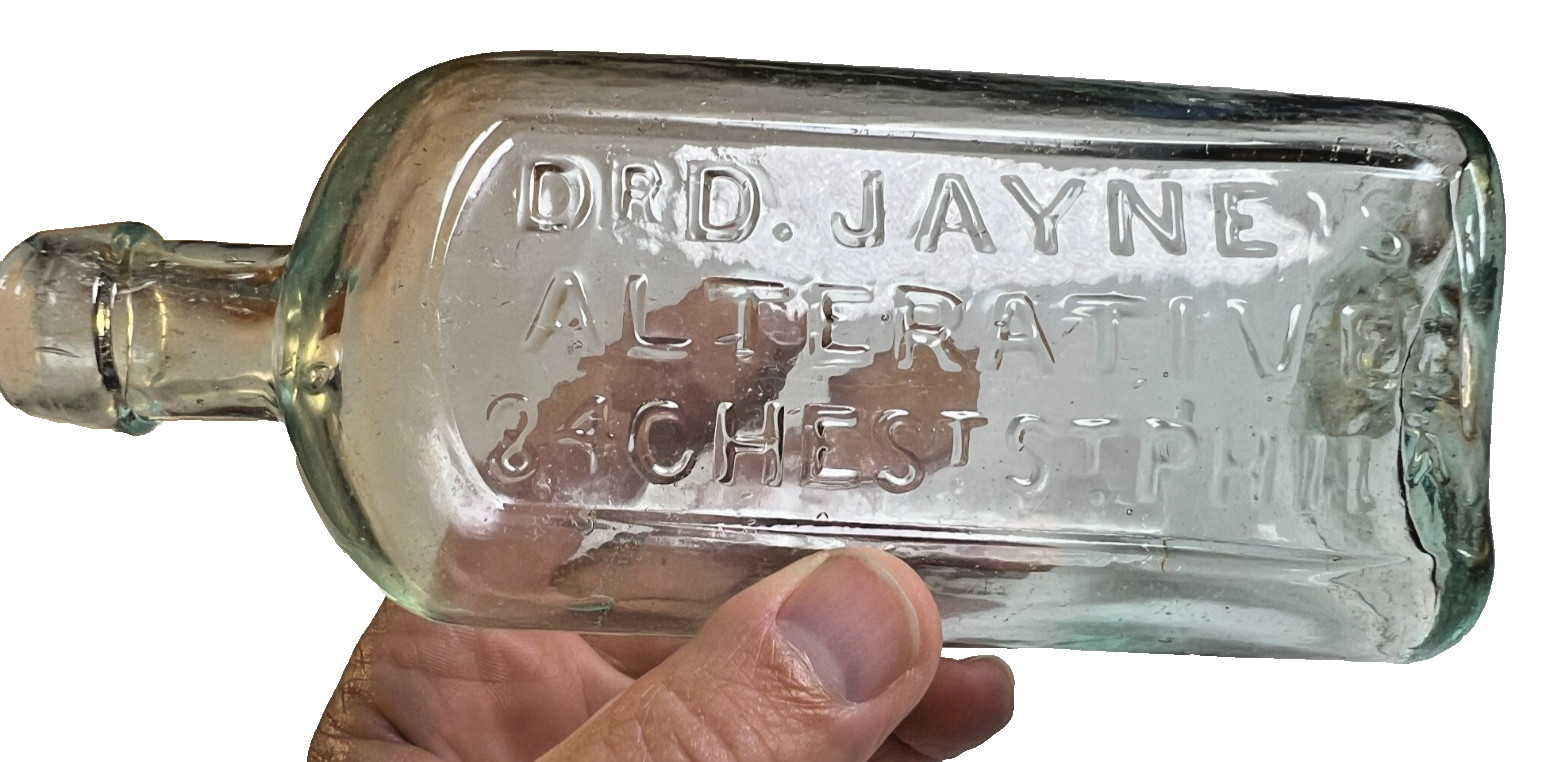
Rare early Dr. D. Jayne’s Alterative medicine bottle from Philadelphia, Pennsylvania, dating circa 1851–1857. A beautiful early American patent-medicine bottle with a crude applied top, open pontil rod scar, strong embossing, and brilliant aqua glass.
Embossed:
DR D. JAYNE’S
ALTERATIVE
84 CHEST ST PHILA
Dating & 84 Chestnut Street
The 84 Chestnut Street address is especially important for dating this bottle. Dr. David Jayne occupied his famous premises at 84–86 Chestnut Street in Philadelphia beginning around 1850, and Jayne’s Alterative was introduced about 1851. Philadelphia\'s subsequent street renumbering changed the address to 242 Chestnut Street around 1857.
Together with the bottle\'s open pontil construction and hand-applied finish, the address places this example very tightly at approximately 1851–1857.
This is the desirable early 84 Chestnut Street version, not one of the much later Jayne bottles.
The Bottle
A terrific example of early hand-blown American glassmaking. The base retains a large and unmistakable open pontil rod scar, where the bottle was attached to an iron pontil while the glassblower finished the mouth.
The top is crudely hand applied, complete with a wonderful excess drip/trail of glass that looks almost as though it is still oozing down the neck. This is an original manufacturing characteristic and gives the bottle tremendous character.
The aqua glass also displays the irregularities expected from mid-19th-century hand manufacture.
Dr. David Jayne
Dr. David Jayne (1799–1866) was one of America\'s most successful early patent-medicine manufacturers. Originally a physician, Jayne developed a remarkable Philadelphia-based pharmaceutical empire and became a pioneer of nationwide medicine advertising.
By the time this bottle was produced, Jayne operated from the impressive Jayne Building at 84–86 Chestnut Street, an enormous eight-story commercial structure that was remarkably advanced for its time and is sometimes discussed as an important precursor to the American skyscraper.
Jayne\'s company was also an early master of mass marketing. Its famous medical almanacs combined household information, calendars and health advice with advertisements for Jayne\'s proprietary medicines and were distributed on an enormous scale.
What Was Jayne\'s Alterative?
In 19th-century medicine, an \"alterative\" was a preparation claimed to gradually alter or restore the body\'s diseased condition, particularly by \"purifying\" the blood.
Jayne\'s advertising promoted the Alterative for an extraordinary range of complaints, including scrofula, rheumatism, gout, goiter, skin diseases, disorders of the liver and kidneys, tumors and other illnesses believed to arise from impurities of the blood.
Such sweeping claims were typical of the booming American patent-medicine industry and, of course, should be understood in their historical context rather than as medically proven treatments.
America When This Bottle Was Made
This bottle was produced during an extraordinary period immediately preceding the Civil War.
Technology: Railroads were expanding rapidly, steam power was transforming manufacturing, and the electric telegraph was revolutionizing long-distance communication. Photography was still relatively new. Yet commercial bottles such as this one were still individually handled by skilled glassworkers, leaving behind wonderful evidence of their manufacture.
Medicine: Germ theory had not yet transformed American medicine. There were no antibiotics, and physicians had few truly effective treatments for many serious diseases. Patent medicines and proprietary remedies consequently became enormously popular.
Politics: The years 1851–1857 were among the most turbulent of the antebellum period. The country was dealing with the aftermath of the Compromise of 1850 and Fugitive Slave Act, followed by the Kansas-Nebraska Act of 1854, the collapse of the Whig Party, the emergence of the Republican Party and increasingly severe sectional conflict that would ultimately lead to the Civil War.
This bottle was already sitting on an American medicine shelf a decade before the Civil War began.
Condition
Outstanding condition for an approximately 170+ year-old bottle.
Bright, clean, shiny and sparkling aqua glass with excellent clarity and strong embossing.
No chips. No cracks. No dirt. No staining. No haze.
Some faint content on the floor.
The crude applied top is particularly attractive, retaining an unusual dripping/oozing trail of applied glass from manufacture. The bottom retains its prominent open pontil rod mark.
Any bubbles, waviness, tooling irregularities or other minor imperfections in the glass are original characteristics of its early hand manufacture rather than later damage.
A particularly attractive example of an early pontiled Philadelphia patent-medicine bottle, with excellent condition, a highly datable address and loads of crude mid-19th-century glass character.